
As an Amazon Associate, we earn from qualifying purchases.
TLDR
Once you understand that “Dollartorium” is a satire and allegory about material obsession, it’s easy to enjoy the wacky ride and thoughtful rhetoric instead of looking for depth in character or story.
“Dollartorium” by Ron Pullins is a satirical and allegorical novel about a corn dog store owner named Ralph who gets sucked into the eponymous get-rich-quick scheme. The book has fantastical/absurd elements that might be a surprise for readers who don’t browse a detailed review like this one. Republicans and Trump supporters will probably find the book offensive.
Before purchasing the book and opening it up, you will likely see claims that the book is about late-stage capitalism. We believe the story is actually timeless and more broadly appealing. Pullins explores a psychology of material greed that is not specific to late-stage capitalism, and perhaps not even to any type of capitalism.
“Dollartorium” is best enjoyed for its satire, comedy and messaging. Readers looking for deep character development and intricate plot will be disappointed.
Pullin’s informal style and conversational narrator allows for plenty of clever prose. The narrator does a lot of telling rather than showing. This ratio seems deliberate, as opposed to a lack of showing caused by careless editing and underdeveloped skill. Unfortunately this first edition still has some typos and line editing weaknesses.
The novel works as a satire, so is it fair for us to want more? Does the satire genre change the rules of quality evaluation and storytelling itself?
‘Dollartorium’ Summary: A Moral Corn Dog Store Owner Goes on a Money-Making Bender
With the exception of being unclear on the fantastical/absurd elements of the story, the back cover provides an excellent plot summary. At the time of writing this review (late March, 2026), Pullins’ website is the main online destination where this summary is available:
“Ralph makes world-class corndogs in a small Kansas shop. It’s humble work, but honest. The problem? The bills pile up faster than the money rolls in, and Ralph can’t help but notice the widening gap between the haves and the have-nots.
Ralph’s wife has had enough. She’s determined to get rich, one way or another. So when an infomercial for the “Dollartorium” promises untold wealth through a few simple business courses, Ralph reluctantly agrees to give it a shot.
Soon he’s learning how to hire, fire, market, and hustle his way to success. When the entire Dollartorium empire inevitably collapses under the weight of its own greed, Ralph must find his way back to what really matters: honest work, family, and the best damn corndogs in Kansas.”
The website of Pullins’ publisher, Unsolicited Press, also has a good summary on their purchase page.
As for the fantastical/absurd elements, I will explore that aspect in other sections of this review. For now I’ll just say that this book isn’t a fit for readers who only like straight realistic/literary fiction or satire novels that remain in the realm of our day-to-day notion of physical reality.
Books Like ‘Dollartorium’
Because I’m a huge Steinbeck fan, “Dollartorium” reminds me of “The Winter of Our Discontent.” The latter is straight literary/realistic fiction, but the premise is similar: Upon facing social and economic pressure, a family patriarch loosens his moral standard to pursue material wealth.
Aesthetically and structurally speaking, “Dollartorium” made me think of “Charlie and the Chocolate Factory.” The Dollartorium itself is a sort of factory. The Money Master is like Willy Wonka, and the Sycophant creatures function similarly to Oompa-Loompas. We have Ralph in the role of Charlie. Both are trying to improve their family’s economic situation. Similar to the children who join Charlie on his tour of the factory, other people compete with Ralph to see who can be the Money Master’s favorite student.
The novel’s Goodreads page compares it to the following books:
- “Animal Farm” by George Orwell
- “Catch-22” by Joseph Heller
- “Gulliver’s Travels” by Jonathan Swift
I have yet to read these titles, so I can’t weigh in on how fair these comparisons are. Some consumer reviewers agree with the “Gulliver’s Travels” comparison.
At The Rauch Review, we care deeply about being transparent and earning your trust. These articles explain why and how we created our unique methodology for reviewing books and other storytelling mediums.
Audience and Genre: Liberals Who Enjoy Absurd/Fantastical Satirical Novels and Crude Humor
When I first saw “Dollartorium” and read the back cover, I assumed it was a realistic fiction/literary novel. The top blurb on the back cover doesn’t mention satire. The summary below the top blurb also doesn’t mention satire.
I imagined the Dollartorium was a shady self-help seminar business similar to The Landmark Forum. Because I’m from San Diego, where the company is based, one of my own family members got sucked briefly into this world. I also guessed that the Dollartorium might be a pyramid scheme or similar.
In the middle of the third chapter, this gnome-ish Uncle Sam-clad character called the Money Master literally jumps out of the TV in the middle of the corn dog shop. This scene was a jarring introduction to the book’s fantastical elements. I paused reading, looked at the rest of the info I had on the book, and saw the satire mentions.
Even if I had seen the satire label before I commenced reading, I think this scene would have been jarring. I’m no satire expert, but I think the genre exists on a spectrum of intensity. Satire, by default, doesn’t immediately make me think of physics-defying loonery. Instead my schema begins with physically realistic stories that make fun of some aspect of society.
“Office Space” is a good example. The film satirizes the soul-crushing nature of white-collar office work. All of the story events are physically possible, however silly or improbable. The absurdity intensity level stays pretty low.
“Sorry to Bother You” has absurd plot details outside current physical reality, but the absurdity level increases gradually. The first absurd detail I remember was the “white voice.” Let’s assign that detail a 2 out of 10. By the end, we are regularly dealing with horse-human hybrids.
With the introduction of the Money Master, I feel like “Dollartorium” jumps from zero to six. Afterward the increase in absurdity is more gradual.
Because of this risk of jarring readers with the Money Master introduction, I really think the back cover, front cover and/or online materials should mention the Money Master or at least the presence of fantastical elements. Imagine seeing a movie trailer for a film adaptation of “Dollartorium” that doesn’t have the Money Master, Sycophant creatures or money machines. Then you get into the theater and realize you didn’t fully understand what you paid for. The Money Master’s introduction is the inciting event, so I don’t think he’s a spoiler.
As for the liberal audience targeting aspect, Pullins goes out of his way to make it clear he thinks conservatives/Republicans — and especially Trump supporters — are particularly stupid, greedy, money-obsessed, naive and easy to fleece. Liberals tend to share these opinions.
The Money Master makes lots of crude remarks, so I would skip this book if you are on the prudish side and are already on the fence about whether you want to dive into the story.
Perspective: A Partially Omniscient Narrator Who Hates Phyllis
The narrator — who sounds like a man and whom I’m going to assume is a man, so we can use he/him pronouns — is an opinionated person who speaks informally in present tense. On page two, for example, he says “Oh no” as a way of emphasizing his opinion.
He seems to be able to see and hear everything in the story, but he doesn’t always know what everyone is thinking. There are times when he doesn’t speak with certainty.
On page five: “Touching money, feeling it, counting it all day, perhaps that is what has brought her to her current state of mind where she sees things differently than Ralph and their delightful daughter.”
The “perhaps” here is crucial to understanding the narrator’s limitations.
The narrator spends a lot of time explaining everything to the reader, sometimes repeating details within pages of their introduction. Some readers may interpret this style as a charming, folksy voiceover narration, fitting for satire. Other readers could feel patronized or robbed of opportunities to form their own opinion.
“Dollartorium” has a bit of second-person narrative: “you,” speaking directly to the reader. This style works smoothly most of the time.
There was one instance toward the end of the book, however, that left me confused. Stella speaks a line, and then this narration follows: “Stella says to you, the next customer in line.” Please correct me if I missed something, but I’m pretty sure this line is the only time in the book where Pullins declares that you, the reader, are also a character in the scene. If this language was deliberate, I would have liked other instances. Perhaps we could have seen a pattern with “you” character swap instances woven in to express interesting rhetoric.
The narrator is far more certain of his opinion of the characters. He loves Stella, Ralph’s dutiful daughter. In his eyes, she is nearly perfect. He describes Ralph with relative balance, but he clearly likes Ralph and forgives his flaws. He points out that the Money Master and his minions are charlatans.
With Phyllis, Ralph’s wife and Stella’s mother, the narrator spends many pages describing how she is lazy, dishonest, shallow, rude, greedy and obsessed with money. He notes that Ralph and Stella do not listen to Phyllis at all, even when she has reasonable ideas about how they can slightly tweak their business practices to make a bit more profit and live an elevated lifestyle. Nonetheless, the narrator seems to give Ralph and Stella a pass for completely ignoring a member of their family.
Three Cs: Compelling, Clear, Concise
Editorial Note: We believe these three factors are important for evaluating general writing quality across every aspect of the book. Before you get into further analysis, here’s a quick breakdown to clarify how we’re using these words:
- Compelling: Does the author consistently write in a way that would make most readers emotionally invested in the book’s content?
- Clear: Are most sentences and parts of the book easy enough to read and understand?
- Concise: Are there sections or many sentences that could be cut? Does the book have pacing problems?
Compelling: Relatable for Anyone in the Middle and Working Classes, and Very Funny If It’s Your Type of Humor
Unless you’ve always been wealthy, you will relate to the book’s theme of struggling to appreciate a modest life. We all have material desires beyond survival.
Perhaps more importantly, I thought the book was hilarious! If I’m remembering correctly, I laughed out loud five times. It’s not often I laugh so much and so hard.
I love crude humor, though. If you don’t, you might cringe instead of laughing.
There are funny lines that aren’t crude, but they didn’t make me laugh out loud, maybe a smile or chuckle. I hope you find those lines equally hilarious, because then you’ll derive even more enjoyment than I did.
Clear: Easy to Understand and Read
I always understood what was happening in the story, and I’m sure you will, too.
To my surprise, I encountered some fancy words and had to look them up. Here are the ones I took note of: burble, mewling, mote.
I enjoy learning new words. Even if you’re not like me, three words in an entire book shouldn’t be a bother.
A few lines are unclear. I’ve analyzed a few of these already, and we’ll dive deeper in the prose section.
Concise: Short Chapters and Tight Organization Make For a Fast Read
The chapters are short. Some are only a few pages. There are “parts” and chapters within parts. This structure fosters a sense of fast progress. At 231 paperback pages, the novel should take a majority of readers less than 10 hours.
The book doesn’t have much fluff. Some of the anti-greed rants go on a bit too long, but they are entertaining.
Character Development: The Paradox of Character Depth in Satire and Allegory
Before I get into the analysis, here’s a quick breakdown of our cast:
- Ralph, the owner of the Corny Doo Doggery corn dog shop and associated farmland
- Phyllis, Ralph’s wife who handles the business’ finances and cash register
- Stella, who performs all the same duties as Ralph
- The Money Master, who founded the Dollartorium and entices Phyllis into signing Ralph up for classes
- The Sycophant, a sniveling creature who runs the day-to-day operations of the Dollartorium
Ralph is the only character who exhibits a significant amount of depth. All he wants to do is read, but he can’t make a living from it. His own family fired him because he kept reading on the job. Corn dog selling was a profession he fell into by accident.
Stella is near perfect. There’s little room for her to experience any development.
Phyllis suddenly becomes a better person after Ralph and Stella’s absence forces her to run the store and do all the manual labor she had avoided for so long. The logic behind her growth makes sense, but the resolution feels unearned and overly convenient.
Ralph and Phyllis have a loveless marriage. They don’t listen to or understand each other anymore. They’re not attracted to each other. This situation barely changes, even by the very end of the book.
Based on his resume, I’m assuming Pullins has the skill to deeply develop more than one character and relationship in a novel. My theory is that he chose to focus primarily on the spectacle of satire, as well as the artistic conveyance of opinions on material greed.
It’s a difficult balancing act. I constantly struggle to evaluate how satirical stories should weight these elements.
If Pullins had fleshed out every character and written a detailed arc for Ralph and Phyllis’ relationship, the book would have been far longer. Pullins would have had to either sacrifice much of the satirical performance or slow the story’s pace to a crawl.
We also have to consider the fact that “Dollartorium” is an allegory or allegorical novel. The characters are symbols. It takes an extraordinary amount of skill to maintain an effective symbol while providing deep character development.
Phyllis, the Money Master and the Sycophant are all obvious symbols of material greed and exploitative business practices. Ralph and Stella are more open to interpretation. Because Ralph gives in to temptation while Stella remains steadfast, perhaps they function a bit differently.
Story: A Simple, Six-Part Structure
The novel has six unnamed parts, each with multiple named but unnumbered chapters:
- Establishing the premise
- Ralph goes to the Dollartorium
- The Money Master educates Ralph on stage in front of other students
- Ralph starts using the zany money machine
- Stella brings Ralph to his senses and retrieves him
- The family resumes their normal life
A simple plot, isn’t it? This simplicity leaves room for entertainment and pontification.
I wish the chapters were numbered as well. If there is ever another edition of the novel, I’m sure this change would be possible.
The ending might not be satisfying for everyone. The Dollartorium fiasco barely affects the family.
Prose Style: What’s the Line Between Informal and Incorrect/Inconsistent?
Because the narrator has the feel of a character who speaks conversationally, the prose style is informal and loose. There are lots of lines that intentionally ignore typical rules of grammar and sentence structure. This style works most of the time. The vast majority of sentences are easy to read.
There is a lot of repetition of details, especially in the beginning of the book. This repetition has a rhythm and tone readers may enjoy. But ultimately this type of close succession repetition is fluff.
I appreciated several instances of clever wordplay. Because Ralph loves Plato, the narrator says, “Platonic thoughts.” While referencing Plato and Ralph’s ideas of morality, we read “what is Good and what is Not.”
Unfortunately the book has some lines where it looks like the editors dropped the ball. Here’s one run-on sentence that was hard for me to read on my first go, in part because it has four em dashes:
“They are also good plain, so have them like you want them—the always tasty Corny Doo Dog—because—as Ralph says—when you see them dipped, you know they’re fresh, never frozen, and fresh is something you just don’t get in the stores these days.”
Editorial Note: Read my article about the benefits of spacing em dashes.
These sentences seem to have typos:
- “Standing there on Main Street in the morning, you can look in the window of Ralph’s corn dog store as the locals often do to see them dipped.” — There should be commas surrounding “as the locals often do.”
- “He grows his corn out back as well in the cornfield behind the sty. Stella grows the corn.” — I get what Pullins is trying to say here (Ralph owns the cornfield, and Stella does most of the actual corn growing work), but it reads like the second sentence is contradicting the first. I had to reread and pause to make sure I understood. A comma before “as well” might increase the percentage of readers who read the sentence as intended on their first try.
- “ —isn’t that odd?.” — Even in a novel that plays with prose, seeing a question mark and period next to each other makes me suspect a typo.
- On page 119: “it’s the numbers matter” was probably supposed to be “it’s the numbers that matter.”
- On page 212 a period is missing entirely.
On page 62 there is a line that was perhaps supposed to be a joke, but it felt like a mistake because there aren’t other jokes like this in the book. “pigs eat the cats.” Afterward I thought maybe the narrator just occasionally says silly things like this that aren’t true, but he didn’t seem to do so.
Dialogue: Often Hilarious, Sometimes Unnatural
The Money Master and Sycophant have many hilarious lines. Readers of all backgrounds should enjoy at least a few of their rants and one-liners.
Sometimes the dialogue between the family members feels unnatural. Several times, Stella refers to Ralph as “Father.” This family is supposed to be middle class, modern and living in Kansas. In modern-day America, I’ve never met a regular woman who addresses or refers to her dad as “Father.”
Fortunately the majority of the dialogue was natural and well-written.
Setting: Nondescript Small Town Kansas, the Corny Doo Doggery and the Dollartorium
The narrator tells us we are in a small town in Kansas, but he is deliberately vague. He describes the shop and family properties in a fair amount of detail, but not their apartment above the shop.
Naturally, the Dollartorium has the most vivid descriptions. It is gaudy, massive, ominous.
Again we have to analyze setting choices through the lens of allegory. This story could have happened anywhere in the U.S. or even the world. A specific town might have distracted from the universal theme.
Rhetoric: Being Content and Understanding the Absurdity of Material Greed
Within the obvious broad message of learning how to be content with basic amounts of material possessions, there are a few other rhetorical points I picked up on:
- Long-term stability is better than short-term wins
- Try something instead of assuming you would hate it
- Listen to loved ones, even when you often disagree with them
- Handle money in a simple, honest way, and you’ll likely be way less stressed
Pullins demonstrates an impressive amount of wisdom regarding the psychology of material greed. There are so many little but important lessons, the kind you won’t learn in a finance book. By the end, there’s a good chance you’ll be questioning the material obsessions in your own life.
Cultural and Political Significance: Dunking on Republicans and Trumpers During Trump 2.0
Based on this book, Pullins strikes me as a very stereotypical liberal Democrat boomer. He chose to set the story in Kansas so he could portray Republicans and Trump supporters as particularly immoral. Fox News is the only example given when discussing fearmongering propaganda. Like most of the liberal Democrat boomers I know, I can imagine Pullins reads The New York Times and watches “The Late Show With Stephen Colbert.”
As someone on the far left, outside the two-party system, it’s not that I care to defend the character of the average Trump supporter or never-Trump Republican. The novel is about the pitfalls of American material greed and money obsession. Our current society is a product of a two-party system that includes Republicans and Democrats, conservatives and liberals, Fox News and CNN viewers. Both voter bases are responsible for us being stuck in this system, for the pendulum swinging back and forth endlessly, always within a range that is hell for many average people and unfair for all but the rich.
It’s not helpful, nor is it a good faith criticism, to lampoon one side over another when discussing something as universal as greed. The “Who’s worse?” conversation doesn’t matter, and the answer is subjective anyway. To use my life as an example, most of the money-obsessed people I’ve met are liberals.
I wish Pullins had set the novel in Maine and featured Dollartorium members of both major political parties. I say Maine because I traveled there around the 2020 election. It was amazing to see how much of a purple state it was. On the same street, I’d see a criss-cross of houses with Trump signs and Biden signs. These people were far more similar than they’d ever admit.
Critiquing the Critics: If You Think This Book Is About Late-Stage Capitalism, You’re Wrong
Many reviewers and blurb writers claim the novel is about late-stage capitalism. The term has become one of those trendy buzzwords that gets thrown around until it loses meaning.
Late-stage capitalism has many meanings, but we should be able to agree that it is about recent developments in the centuries-old history of American capitalism: cryptocurrency, the recent spike in AI-triggered mass layoffs, younger generations of hardworking Americans with sizable salaries who are still on track to rent and work until they die, Citizens United, etc.
“Dollartorium” is not about any of these topics. The novel could have been published during the time of black and white TV, and it would still be relevant today. Pullins mentions cryptocurrency in passing, but these details are not essential to the story.
I don’t even think the novel is strictly about capitalism. People in any society can succumb to the same traps Ralph was pushed into. “Dollartorium” is timeless because it’s about material greed and obsession. The setting happens to be 2020s America.
Book Aesthetic: Say It’s a Novel
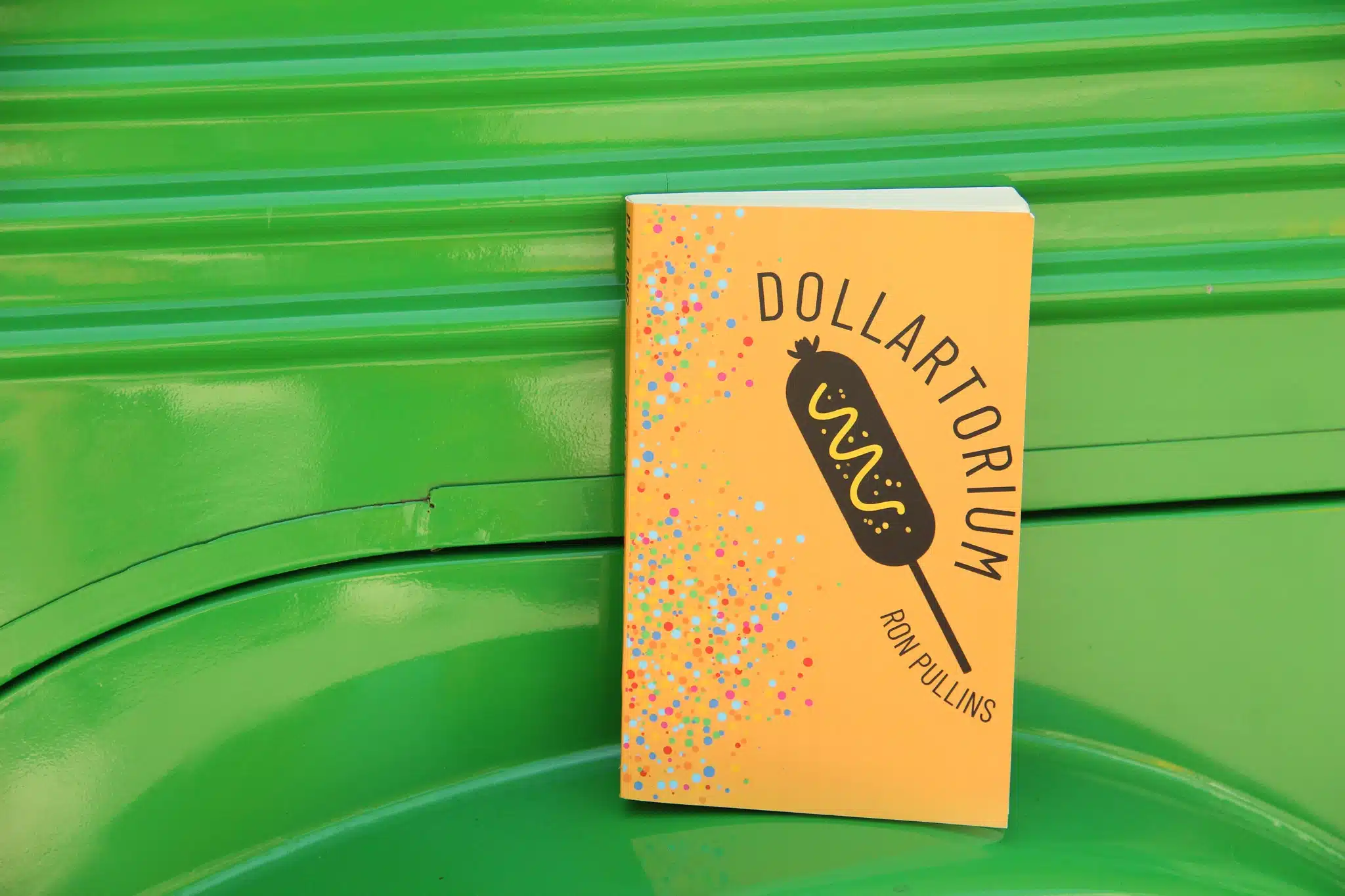
I showed the book to my wife and asked her what she thought it was, based only on the front cover. She said, “It looks like a Malcolm Gladwell book or something.” I understand her logic. Had I not chatted with a rep from the publisher, I might have had the same initial impression. Writing “a novel” in a little subheading would make a huge difference. “A satirical novel” would be good, too.
Otherwise the cover is great, very straightforward. At first I thought the rainbow dots were sprinkles for the corn dog, but I’m pretty sure they are actually the rainbow glitter described in the Dollartorium. Either interpretation works.
The front cover does signal satire. Nonetheless, the publisher could increase alignment of expectations with a higher percentage of readers simply by mentioning satire and at least one absurd/fantastical element on the back cover.
Reviewer’s Personal Opinion: The Emotional Journey of Writing My First Book Review on Request
MindBuck Media Book Publicity, an author-focused PR agency, contacted me and requested this review. The premise was intriguing, and I thought I might be able to strike up a business partnership. So I said yes.
This review is the third we have done on request. The first two were poetry books where the authors reached out to me directly. Because poetry isn’t my speciality, I assigned those reviews to freelance contributors who were poets themselves.
For this one, it made sense for me to write it myself. Like Pullins, I primarily write prose, including novels.
My past reviews covered books by Yoko Ogawa and Thomas Frank. I didn’t give either of those books a particularly low score, but my reviews did contain many criticisms. I doubt these two authors will ever read the reviews. When I was writing, I didn’t once think about how they would react to my analysis.
Writing this review has been a new type of emotional journey because MindBuck Media Book Publicity and Unsolicited Press are the only degrees of separation between myself and Pullins. If their teams believe the review is a net positive for brand awareness and sales, they will send the link to Pullins. Then perhaps he will read some or all of it.
When I was writing, there were a few times when I imagined what Pullins would think of me if he read my review. Would he think I’m a big jerk? I wouldn’t be offended, but I’m curious.
As an author, I have been in the position Pullins is in at this very moment. When my book launched and began garnering reviews, I did look at some of the reviewers and think they were huge assholes.
I have many questions for Pullins. I asked about an interview, and I suppose you’ll see it linked here if we can make it happen.
Conclusion: Despite Its Shortcomings, the Book Succeeds in Its Objectives
I harped on a lot about framing expectations vs. reality in this book, but this issue is not about writing quality. When evaluating quality measures such as our star rating, I often ruminate on this criteria:
- Was I able to discern the author’s intentions?
- Are these intentions logical enough to provide a book that is enjoyable to a sizable audience?
- Did the author write well enough to execute these intentions?
With “Dollartorium,” the answer to all three of these questions is yes. I believe Pullins wanted to write an entertaining, thought-provoking satirical and allegorical novel. In this goal, he succeeded. My score of four out of five stars is an acknowledgment of this success.
A five-star version of “Dollartorium” would’ve had tighter prose and significant character development beyond Ralph.

Get recommendations on hidden gems from emerging authors, as well as lesser-known titles from literary legends.