
As an Amazon Associate, we earn from qualifying purchases.
TLDR
"More Happy Than Not" sets itself apart by exploring self-acceptance, grief, class and race with a blend of genres: literary fiction, YA, LGBTQIA+ and speculative.
Adam Silvera’s 2015 YA novel, “More Happy Than Not,” is a contemporary work with speculative fiction elements. It features 16-year-old Aaron Soto, navigating the grief of his dead father and his own sexuality in his working class neighborhood of the Bronx, New York. Many readers and critics recognize the title as LGBTQIA+ fiction.
As an adult I have explored other contemporary YA fiction exploring LGBTQIA+ themes. In particular, the work of Alice Oseman, such as “Loveless,” which relates to young adults dealing with issues around asexuality, and her successful “Heartstopper” graphic novels, exploring teenage homosexuality and mental health struggles. Other titles, such as Simon James Green’s “Gay Club!” — described as “a landmark comedic novel about queer teens at their worst,” — tend to explore LGBTQIA+ themes in a more lighthearted way, showing an acceptance for difference. I would say that Silvera’s novel significantly differs in several ways from the genre I have explored thus far.
Firstly, it has speculative fiction elements. This secondary genre adds an extra, textural layer to the story. In Aaron Soto’s exploration of considering expunging his memory of his feelings for Thomas, to commit to a heterosexual relationship with his girlfriend Genevieve, we see a conflicted young adult who just wishes to fit in. In my experience, more recent YA LGBTQIA+ novels have sought to reassure young people that their feelings are perfectly normal and acceptable. Silvera’s exploration, in comparison, asks readers to challenge their ideas around such acceptance for a young teenager living in a working-class neighborhood.
“More Happy Than Not” also contains themes around grief, not only in the death of Soto’s father, but in the ways in which his father did not accept his sexuality before his death. Silvera’s book is altogether more gritty.
‘More Happy Than Not’ Summary: A Gritty Exploration of Grief and Self-Acceptance
Aaron Soto is a 16-year-old young man living with his mother and brother in the Bronx. He has recently lost his father, who we discover was found dead in the bathtub in the family’s apartment. He died by suicide. Soto’s mother has retreated to her bedroom, unable to deal with the grief.
Aaron has a girlfriend, Genevieve, with whom he claims he has found something close to happiness. He then meets Thomas, a new friend from a different project, whom Aaron begins spending all his time with. He finds Thomas’s carefree personality and idealistic views refreshing. When Genevieve attends a three week artists’ retreat, Aaron realizes he is attracted to Thomas and that he wants to be more than friends. He breaks off his relationship with his girlfriend. Following a conversation with Thomas and overheard by his old friends, he realizes his feelings are not reciprocated. His friends then attack him on the train, and he sees they will not accept him being gay.
Aaron discovers a new procedure called ‘Leteo,’ neurosurgery that erases traumatic memories. This point is where the speculative element of the book comes in. He finds out that a neighbor used the service after his twin brother had been gunned down. Up until this point, Aaron had assumed the procedure was “bullshit.” Aaron figures that if he can forget that he is gay by erasing his memories of Thomas, he will be able to regain his old friendships and girlfriend, allowing him to feel close to happy again.
Struggling with depression and his intensifying feelings for Thomas, Aaron decides to attempt the Leteo procedure to have his memories erased. Before the procedure can take place, a blow to the head causes Aaron’s memories to ‘unwind,’ leading to a plot twist in the book.
In this later section called “Part Zero: Unhappiness,” we discover the significant turning points in Aaron’s life. These revelations explain the sources of his unhappiness and failure to own up to who he really is. We discover that Thomas is not the first boy Aaron has felt an attraction to. Aaron once tried to explain the feelings he felt for another friend, Collin, to his parents. Whilst his mother was accepting, his father refused to accept his homosexuality. We discover that Aaron also attempted suicide, leaving him with a scar on his wrist imitating a smile.
At The Rauch Review, we care deeply about being transparent and earning your trust. These articles explain why and how we created our unique methodology for reviewing books and other storytelling mediums.
Audience and Genre: YA Novel With Adult Themes
Although Silvera’s novel is aimed at the YA market, it does transcend into adult themes. It shouldn’t be written off as ‘just’ a YA novel. It speaks to predominantly LGBTQIA+ groups, particularly young people who may be struggling with their own sexuality or that of friends and family members. It would also be of interest to anyone interested in learning more about the effects of grief, the loss of a parent, and depression.
Although the book primarily deals with the difficulties of a young adult attempting to make sense of his sexuality amid an unaccepting group of friends, it strays away from the more stereotypical coming-out stories. Silvera’s inclusion of the speculative element of the story allows for a deeper nuance to the book. Similarly, it does not fall neatly into a typical speculative fiction genre. The emotional depth of Silvera’s protagonist and the grief he navigates at the loss of his father — alongside his own personal demons — help to raise it above a single genre.
Perspective: A Narrator Struggling with Self-Acceptance
The book is written from the perspective of Aaron Soto, a 16-year-old boy living in the Bronx. Through first-person closed perspective, Aaron delivers some gut-punching language to convey the emotional turmoil of a young man struggling to accept his sexuality.
Despite what could have become a limited viewpoint, Silvera manages to convey the reactions of the group of friends and family around his protagonist. We understand that being gay within this closed community is not something that is taken lightly. Though the reactions of many of the other characters around Aaron are believable, this attitude could be an element of stereotype within this closed community.
Silvera’s decision to focus the narrative through Aaron alone allowed for a depth of connection with the reader. He is a confused and lonely young man who just wants to be accepted as “normal.” He also wishes to find some semblance of “happiness” through the love of another person. The thoughts of Aaron and the language used allow for an outsider to understand the difficulties he is facing. His grief at the loss of his father and his witness of the ways in which his death has affected his mother are carefully and emotionally dealt with.
Three Cs: Compelling, Clear, Concise
Editorial Note: We believe these three factors are important for evaluating general writing quality across every aspect of the book. Before you get into further analysis, here’s a quick breakdown to clarify how we’re using these words:
- Compelling: Does the author consistently write in a way that would make most readers emotionally invested in the book’s content?
- Clear: Are most sentences and parts of the book easy enough to read and understand?
- Concise: Are there sections or many sentences that could be cut? Does the book have pacing problems?
Compelling: Readers Care About Aaron Soto
Readers cannot help but care about Aaron Soto. Silvera’s development of his main character allows for a sympathetic understanding of the pressures faced by members of the LGBTQIA+ community. The book also allows for a deeper understanding of depression and suicide, and the ways in which these tragedies can affect a whole family.
Aaron is the most developed character in the book, but Silvera does extend the narrative beyond our star. The other characters are well-rounded and believable. Genevieve in particular was an interesting character. The narrative shows her understanding of Aaron, once he manages to finally open up to her. The author could have chosen to make her a stereotyped jilted girlfriend. Her empathy for Aaron’s situation is endearing.
The book is not a cutesy YA queer romance. It is a hard-hitting example of the ways in which young people may struggle in a masculine, working-class environment. Issues of race and class, as well difficulties around sexuality are delicately dealt with. Aaron Soto is a Puerto Rican queer teen living in an urban setting. The rest of the characters are largely Latinx. It appears that Adam Silvera, a queer writer of Puerto Rican origin who himself grew up in the South Bronx, deliberately chose to represent a queer character of color.
Silvera’s narrative plays around with mental health and memory. Aaron and his friends feel real. We can empathize with them. Anyone who has ever been a teenager cannot fail to respond to Aaron’s struggles.
Clear: A Non-Linear Narrative
The narrative is clearly written. Although the world of Aaron and his friends was not familiar to the reader, it was easy to drop into. Similarly, though there are speculative elements to the story, these were not complicated or unbelievable. The Leteo procedure feels like it could exist in the near future.
The book is written in a non-linear way in some respects. The narrative is split into sections, beginning with “Part One: Happiness.” Following “Part Two: A Different Happiness,” the narrative breaks into “Part Zero: Unhappiness,” moving back in time. After this section, it continues with parts three and four to end the book. “Part Zero” provides valuable context to the story.
The book is well edited, and the length of the story is just right for exploring the life of Aaron. There is enough backstory here to allow for the narrative to make sense. The style of putting this context around halfway through the book, rather than writing a more linear storyline, allowed for the plot-twist elements and reveals along the way to feel more natural and surprising.
Concise: Tight Plotting, Too Many Headings
The pacing of the novel felt about right for this type of book. YA novels are often around this length, and it felt that the book allowed for a good level of unpacking of Aaron’s experience, thought process and backstory.
However, the sections or “Parts” of the book also had many other headings with maybe one or two paragraphs beneath. This structure felt clunky and unnecessary at times, and the story may have flowed better without these breaks. For example, many chapters begin with an image of the smile-shaped scar graphic that appears on Soto’s wrist after his attempt at suicide. Although relevant to the theme of the book, it felt unnecessary to have this constant reminder.
The book is also split into distinctly themed parts, such as “The Day We Start Over,” and “The Day I Forget.” The choice for these is understandable by Silvera, but to then also have more narrative headlines within the actual sections, such as “Manning Up,” felt, at times, unnecessary. I found it difficult to get into the flow of the narrative because there were too many of these within short bursts of prose. It felt that the sections and chapters themselves should show such information, without needing a pointer as to what the theme of the section was about. However, other readers have found this structure useful, and have pointed out that this reflects Soto’s fragmented memory.
The ending of the book delivered. A completely ‘happy’ ending would have likely been unrealistic. What Silvera appears to have aimed at is an ending which allows for us to see that life is full of ups and downs and that we cannot expect to be happy all the time. The ending allows for us to expect that Aaron will face more discoveries and difficulties, but that facing the truth of who he is is the first step.
Character Development: Aaron Grows Throughout the Novel
Aaron felt like a sympathetic character. Silvera’s development allows us to see a realistic young man who has deep issues. Although his friends turn against him at points, the author appeared keen to develop them as real-life characters, rather than cut-outs. Though we may see their behavior as homophobic, we get some insight into the harsh world in which they are living. Rather than judgement, Silvera delivers a picture of realistic characters dealing with confusing and conflicting emotions.
The book is written with a lot of dialogue and interaction between characters. This style is something that felt realistic and relatable from the author. He does not paint a picture of wholesome young teenagers. These characters watch porn, cuss and masturbate. It is not a gentle story of a young man realizing his sexuality, but a brutally honest portrayal of struggling with sexuality among peers.
Having researched the author, it does appear that the main character of Aaron Soto represents close elements of Adam Silvera himself. Reading interviews with the author, he appears to feel a deep connection with Aaron Soto. His own sexuality, his experience of growing up Puerto Rican in the South Bronx area, and his struggles with mental health are likely to have affected this decision.
This parallel, however, doesn’t take away from the story he has written. Likely, the similarities will help other young people who may be struggling with their own sexuality. The introduction of the speculative fiction element of the book also allows for a distancing from Silvera’s real-life experiences.
Story: A Young Man Seeks Seeks to Wipe His Unrequited Gay Crush From Memory
The book was an engaging account of one young man’s struggles with grief, depression and acceptance of his own sexuality. The book is a fairly quick read. Once started, it is easy to get swept up in it. Readers will likely be keen to discover what happens to Aaron and whether he decides to go through with the Leteo treatment. The book felt unique in its inclusion of LGBTQIA+ themes alongside a speculative element. It is not a YA gay romance novel, neither is it a book on mental health specifically. It is a hybrid, genre-bending novel that is difficult to classify.
The details of Aaron’s experience with his family and friends felt both familiar and unique. Familiar in the sense that the non-acceptance of homosexuality is likely to have been covered in other books, but the uniqueness of utilizing a memory-wiping procedure to wipe out Aaron’s feelings for his friend. Most readers would find the ending satisfactory in that it brings hope but remains believable.
Prose Style: Realistic Dialogue and Language
The prose style felt fairly typical of a YA novel, though it does contain a significant amount of swearing and derogatory language. This diction is entirely relevant to the story, however, and did not feel gratuitous. Silvera is pretty good at showing the emotions of Aaron and the other main characters.
There are also some nice turns of phrase and descriptive prose such as:
“But for tonight, this is enough. From the shapes cast by the green paper lantern, you would never know that there were two boys sitting closely to one another trying to find themselves. You would only see shadows hugging, indiscriminate.”
The prose style and story did cause me to wonder about the influence of the author on the text. As previously mentioned, Aaron’s experience represents some of the author’s own. However, the book is a work of fiction, and the speculative elements lend a distancing from any connections to Silvera.
Setting: Life in a Bronx Project
The book is set in the Bronx, New York. Whilst this area did not feel like a unique setting for the book, it did represent a good background for the story. The class and race elements of the book felt fitting within such a setting. It is difficult for this reviewer to say whether the portrait of Bronx life is accurate, but the setting appeared realistic. Realism is likely the case due to the author’s proximity. The book contains some description of the setting and of Aaron’s immediate environment, though the book is more focused on the inner torment of Aaron and his experiences.
Rhetoric: The Author’s Personal Experience is Relevant
Because Adam Silvera is a male, queer writer from the Bronx, he is utilizing his authority on the issues faced by Aaron in the book. This grounding feels important because his use of language and the feelings expressed by characters within the story are likely to be based on some of his own experiences. The narrative emphasizes the difficulties of acceptance and of coming out to friends and family in such a difficult environment.
The author does appear keen, however, not to stereotype his characters. His ideas and themes do not interrupt the flow of the book. It doesn’t feel that Silvera is inserting his political views within the narrative, more that he is showing the difficulties for people who may be struggling with such issues.
Cultural and Political Significance: Published at a Watershed Moment
“More Happy Than Not” was published in 2015, the year of significant shifts in LGBTQIA+ rights in the U.S. The Supreme Court’s landmark ruling on gay marriage occurred during that year, as well as transgender visibility policies. Many of these discussions are continuing within the politics of today. This book would clearly resonate with young people who are dealing with issues around their own sexuality.
“More Happy Than Not” may help to make young men more aware of the difficulties that friends or family could be struggling with, not just around sexuality but around mental health. There has been a lot of discussion lately around young men and loneliness. Perhaps books such as this, which show a variety of issues that young men may be dealing with, could be useful to open up discussions around these.
Critiquing the Critics: Is the Book Actually Too Intense for Some Teens?
Despite its fans, some critics have claimed that the book is too intense for younger audiences, leading to banning of the book in some areas. Whilst “More Happy Than Not” contains intense themes such as suicide, trauma and grief, it is difficult not to see much of the concerns with the book being related to the LGBTQIA+ themes of the book. The bans have taken place mostly within the school districts of Texas and Florida, both predominantly Republican states. The STCC periodic table of banned books states that “More Happy Than Not” was banned on eight separate occasions due to its sexual content and LGBTQIA+ language. Supporters argue that the unflinching honesty in the book provides much-needed representation and sparks crucial conversations about identity, trauma and love.
Kirkus Reviews found the book to be a brilliantly conceived page-turner, with a review on Culturefly finding the themes within it universal. Most critics remark on the realistic portrayal of the themes and characters and the empathy which the author creates. However, some reviewers find Silvera’s decision not to create a wholly happy ending depressing and difficult. Arguably, however, this is what makes the story so believable and sets it apart from many YA novels.
Book Aesthetic
The review edition of the book has the title “More Happy Than Not” in white and strung around many small face emojis representing different emotions. It is a relevant cover. Throughout the narrative, the sections are exploring Aaron’s changing emotions. The cover feels simple but original.
Other covers show the character of Aaron Soto or an illustration with only two large emojis.
Collector’s Edition vs. Deluxe Edition vs. 10th Anniversary Edition
Because there are three editions of the book that you are likely to find online, we wanted to help you choose the best fit.
‘More Happy Than Not’ Deluxe Edition
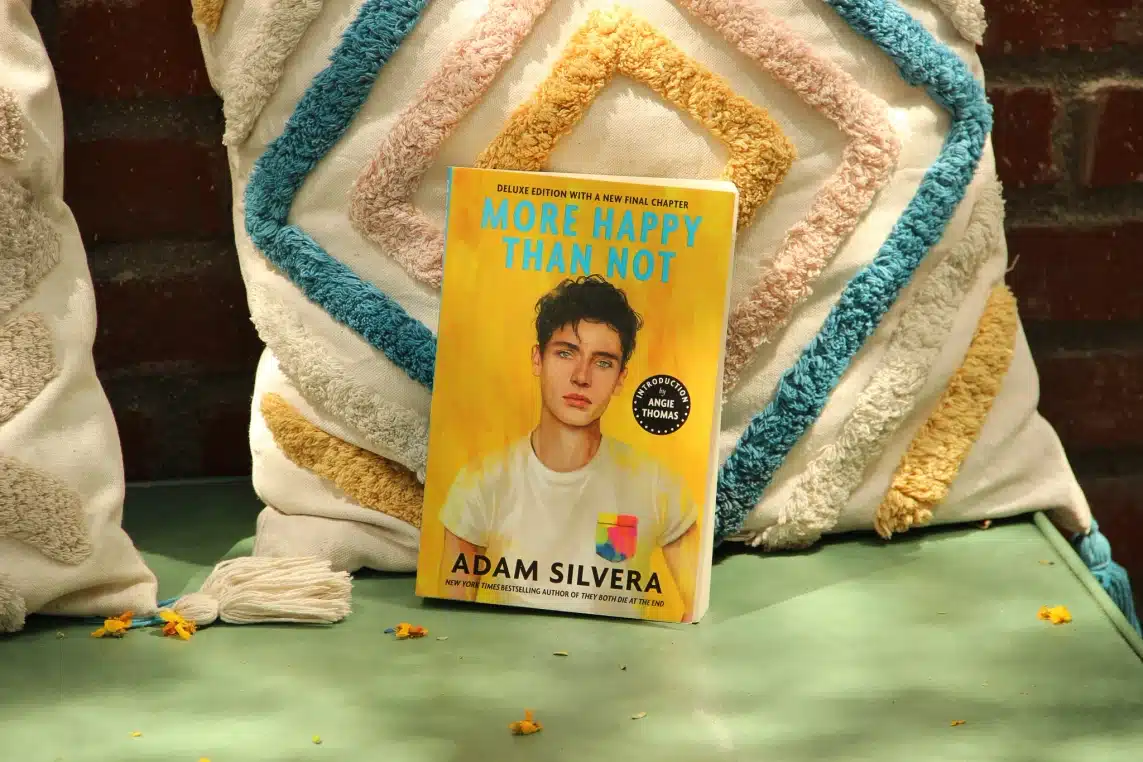
The Deluxe Edition of “More Happy Than Not” was issued in 2020 to mark the fifth anniversary of the novel. It features a new Introduction by Angie Thomas, bestselling author of “The Hate U Give.” It also contains a new final chapter added by Adam Silvera, as well as an Afterword by the author on why he decided to write another chapter, and where the idea for the book began.
‘More Happy Ending’ is the name Silvera chose for the new final chapter of “More Happy Than Not.” It is not listed as an epilogue to the original book, but features like an additional chapter. It is separated from the end of the original final chapter by a page advising: ‘Continue reading for Aaron’s more happy ending.’ In this way, readers are given the choice whether to read on. This gave the impression of an additional reading to Aaron’s story, rather than an official ending.
The final chapter of Silver’s novel basically fills in the gaps of what happens to Aaron Soto one year after the original ending. Aaron is still experiencing trauma and longing for Thomas. We are caught up (through Aaron’s first-person narration) with his memory difficulties since undergoing the Leteo procedure. At first glance, the new additional chapter feels like more of the same. It is only as it reaches towards its climax that we see a more hopeful future on the horizon for Aaron.
According to reviews on StoryGraph, readers appear to prefer the Deluxe Edition to the original because the final chapter offers a more hopeful outcome for the main character. It offers a certain degree of emotional closure for readers who may find the twist toward the end of the story in the original Collector’s Edition difficult to deal with.
The original ending of “More Happy Than Not” had “haunted” Adam Silvera for years. The Deluxe Edition contains a brief afterword by Silvera, where he talks about the fans of “More Happy Than Not” and their wish for more books about Aaron Soto. Silvera claims that as the novel had been his first book, he could not get back into the head of Aaron. It wasn’t until he re-read “More Happy Than Not” that he decided “Aaron is too much a part of my heart, too real to leave him where I left him. I was genuinely haunted by this ending, and I wanted to give Aaron a long overdue win.”
The newly written ending presented in the Deluxe Edition attempts to give readers more answers to the fate of Aaron Soto.
Silvera also confessed in his Afterword: “I may have written this book for myself, but I wrote ‘More Happy Ending’ for all of us.” The newly added ‘More Happy Ending’ provides a more concrete conclusion to Aaron’s story. While Silvera appears to stand by the original, surprising, bittersweet ending, it seems that fan’s wishes and a desire to give Aaron Soto a more optimistic future following the trauma he has previously suffered pushed him to create a new chapter for the fifth anniversary edition of the book.
In the Introduction to the Deluxe Edition of “More Happy Than Not,” YA author Angie Thomas stressed the importance of finding books with characters like herself. She claims that Adam Silvera’s book and the character of Aaron Soto “reeled me in” from the very first line.
Silvera and/or his agency/publishing team likely chose Thomas to write the Introduction to the Deluxe Edition of “More Happy Than Not” because she is a prominent voice within the YA market. She writes emotionally charged novels for a similar target audience as Silvera. Her book “The Hate U Give” was a New York Times bestseller and dealt similarly with the trauma of a young protagonist.
Thomas claims that Silvera inspired her to go on to create her own characters, giving her “permission” to write characters of color and recreate worlds in her fiction which resembled her own experiences. She also saw that it wasn’t always necessary to write YA novels that had neat happy endings.
Ironically, by creating the new ending within the Deluxe Edition of “More Happy Than Not” in which Thomas’s Introduction appears, Silvera has attempted to neaten up his less-than-happy ending.
The Deluxe Edition of “More Happy Than Not” has a new cover design. Whereas the original appeared to more closely represent the speculative elements of the story, the Deluxe Edition resembles more closely the element of emotional turmoil suffered by the young male protagonist. Artistic aspects of this cover are more typical of the YA genre.
The second, Deluxe Edition of “More Happy Than Not” appears to have been welcomed by consumers and critics. Readers in particular commented on being left “shattered” by the original ending of Silvera’s novel. The hopeful ending contained in this second edition allows for more emotional closure for invested readers, particularly those who may be struggling through similar life circumstances. However, you might feel the first edition of “More Happy Than Not” actually contains the stronger ending.
One fact worth mentioning in this Deluxe Edition are the several typos the reviewer noted. For a fairly short piece of writing (around 12 pages), these typos are repetitive and annoying to the reader. Also, because the Introduction by Angie Thomas and the Afterword by Adam Silvera are only around a page and a half each, some readers may find the original copy of the novel is sufficient to enjoy the story of Aaron Soto.
‘More Happy Than Not’ 10th Anniversary Edition
A further, 10th Anniversary Collector’s Edition of “More Happy Than Not” was released in 2025. This is listed as a “one-time printing” on the Penguin website and features a new hardcover design, a reversible dust jacket and full-color endpapers. It also has more exclusive content, including an interview between the author Adam Silvera and the real-life inspiration for the character of Thomas from the novel. Interestingly for real fans of Silvera, the book features scanned pages from the first outline of “More Happy Than Not,” together with annotations and new book club questions. This latest edition would likely appeal to die-hard fans of the book or fellow writers wishing to gain an insight into the workings of the original novel.
It is unclear why this Collector’s Edition was published 10 years on from the original, though perhaps this was simply to reinforce the book’s importance within LGBTQ+ discussions. It is likely to be worth picking up for the die-hard fans of the novel who would enjoy seeing Silvera’s process when writing the book.
The audiobook of the original edition of “More Happy Than Not,” released in 2015, is read by Ramón De Ocampo and is widely available through the usual outlets such as Audible. De Ocampo, who has also voiced other popular audiobooks for children and young adults, is an accomplished television, film, stage and voice actor.
He has also been cited as an “accomplished audiobook narrator.” Ramon, who was born in the Philippines, has narrated more than 350 books. His audio titles include the bestselling “Red, White, and Royal Blue,” another LGBTQIA+ YA novel. He is also the voice of the bestselling “Diary of a Wimpy Kid” middle school series. He was likely chosen to narrate “More Happy Than Not” due to his reputation as an award-winning narrator of YA fiction.
The CD Version of the Audiobook
Interestingly, a 2022 CD/MP3 version of “More Happy Than Not” was published. A copy of this is unfortunately quite elusive to find online. Though sites such as eBay and Libristo do have copies for sale, these appear to only be available in German read by gelesen von Jonas Minthe.
‘More Happy Than Not’: Plans for a Series?
Whilst there has been a plan to release a HBO one hour series of “More Happy Than Not,” announced in 2020, this project does not yet appear to have come to fruition.
However, some of the themes of the book regarding the speculative element of the Leteo procedure are similar to the ideas in the 2004 movie, “Eternal Sunshine of the Spotless Mind.” This film features a futuristic procedure whereby couples can undergo memory erasure in order to avoid their grief at their breakups.
Reviewer’s Personal Opinion: An Emotionally Stirring Story
Although not a usual reader of YA or speculative fiction, I have to say that I thoroughly appreciated the opportunity to read this book. Adam Silvera’s creation of Aaron Soto is endearing. I empathized with his journey and found his need to erase his homosexual memories emotionally stirring. Both this and the grief element through suicide resonated with myself.
The speculative fiction element was believable enough to satisfy my more realist reading tendencies. I also thought the twist in the storyline was interesting and I didn’t suspect it.
I liked the character of Genevieve, particularly toward the end of the book. Her acceptance of Aaron, despite her own disappointments, felt endearing. Aaron’s mother and brother also grow into sympathetic characters.
It was more difficult to like Aaron’s friends. The homophobia in the book via these sections was difficult to assimilate, though of course necessary to the overall story.
Reading the book took me back to my teenage reading of books like “The Outsiders” by S.E. Hinton, and J.D. Salinger’s “The Catcher in the Rye.” Both books explore the difficulties of male adolescence, with Salinger’s also delving into depression and grief. I could imagine “More Happy Than Not” resonating with a lot of young people struggling through adolescence.
I also found connections with a more recent book by Joseph Rauch, “The Last of the Mentally Ill,” which I discuss further below.
‘More Happy Than Not’: Emotional Depth: Important Issues
“More Happy Than Not” works as a consideration of the difficulties of dealing with grief, depression, and acceptance of one’s own sexuality. Aaron Soto is a believable, empathetic character who will appeal to young people dealing with similar issues. It would also be useful to those who care for them. The book contains diverse characters and recognises the relevance of race and class divides.
“More Happy Than Not” worked well to open up discussions of issues affecting young people, particularly for better acceptance of LGBTQIA+ issues.
That said, the layout of the book could, at times, be a little distracting. The many headings within sections were off-putting at times, and it felt that the story could have been better without these. It gave the narrative an element of “telling” rather than “showing.” For this reason, I have given the book a 4.5 star rating.
Buying and Rental Options
“More Happy Than Not” is available from the following online retailers:
The book is also available in physical stores of the major retailers, as well as in some smaller independent bookstores. Buyers should check out the LGBTQIA+ aisles, as well as the general Young Adult sections.
“More Happy Than Not” is widely available in both U.S. and U.K. libraries, including on eBook and audio via the Libby app. As the title remains popular, borrowers may have to wait for availability.
For those with vision impairment, or who prefer to listen to audiobooks, “More Happy Than Not” is available as an audiobook on Audible and Spotify.
Books Like ‘More Happy Than Not’
‘The Last of the Mentally Ill’ by Joseph Rauch
“The Last of the Mentally Ill” is a book similarly set in a near-future New York and has elements of speculative fiction. It features a 16-year old Chester Owens, who has always lived in a facility called Greendale among other young people. Chester initially has one close friend, Felix, and is described as a tall, lumbering teen with severe social anxiety who has been confined to the Greendale facility since he was a baby.
“The Last of the Mentally Ill” explores some similar themes, such as race, class and mental health struggles. The book also features a diverse cast of characters, and the theme of race is particularly strong throughout. Both “More Happy Than Not” and “The Last of the Mentally Ill” contain instances of language that some may find offensive. However, in both of these novels, the language used feels relevant to the characters and setting, and is not gratuitous.
Where “The Last of the Mentally Ill” differs, however, is that it explores more of the inner thoughts and lives of other characters rather than simply Chester’s experience. This scope is particularly evident through the characters of Desmond and Simone. Whereas “More Happy Than Not” focuses entirely on the thoughts and emotional experiences of its central protagonist, Aaron Soto. I would also suggest that “The Last of the Mentally Ill” would appeal to a more adult market as well as Young Adult, more so perhaps than “More Happy Than Not.”

Get recommendations on hidden gems from emerging authors, as well as lesser-known titles from literary legends.