
As an Amazon Associate, we earn from qualifying purchases.
TLDR
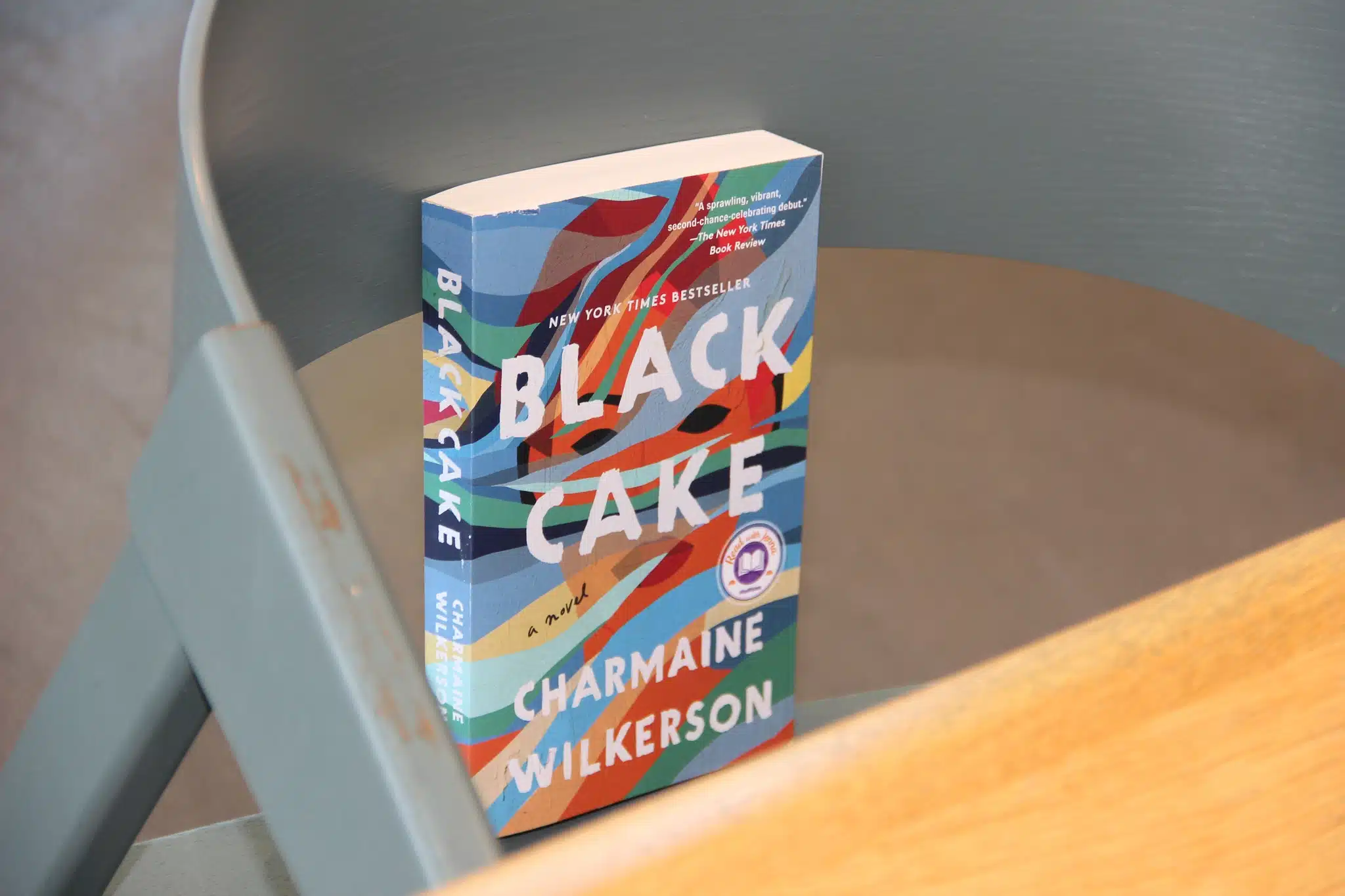
Charmaine Wilkerson’s first novel, “Black Cake”, follows a Jamaican family as its members navigate long-held secrets and complex relationships. The novel received wide acclaim upon release. Read the review here.
“Black Cake” is Charmaine Wilkerson‘s debut novel, and it quickly rose to success. The novel is a multi-character story about family secrets and — more pronounced — the complexity of family relationships across cultures, choices (or lack thereof) and borders. For these reasons, “Black Cake” has garnered a wide audience, a New York Times Best Sellers designation and a Hulu + series adaptation. Her followup novel, “Good Dirt,” has also received a great deal of acclaim and review.
Wilkerson’s experience and biography seem to inform the familiarity and emotion in this novel. She, too, is Caribbean-American. She has also lived in the same settings as the novel: the U.S, Jamaica and Italy.
This winding novel that always comes back to the tradition of home and making meaning. It is a compelling story of love, loss and grief.
‘Black Cake’ Summary: A Recipe Connects Generations and Heals Estrangements
What is first intrigue built around a posthumous message a mother has left for her two children, moves cautiously and meticulously to untie the knots that thread the multi-narrator novel that is “Black Cake” by Charmaine Wilkerson. Set in multiple locations across the U.S., the U.K., and an unnamed island in the Caribbean, “Black Cake” is a story about the familial ties that connect estranged family, and how migration — forced and chosen — have colored a tapestry of Black lineage and life.
The novel begins with the reader meeting two siblings who have been estranged for eight years. Benny and Byron have been brought together to their family home in California after the death of their mother.
Their mother, Eleanor, has left a video that the two have been requested to watch together. Recollections about the past, their personalities and propensities punctuate the narration of the video. Their mother reveals to them that they have a third sibling, one they haven’t met. But, to tell that story, their mother begins with a girl who grew up on an island, Covey.
After some time in the book, you can easily forget where you started. The author drew us in with the siblings and their dynamic and emotional scars they choose to show or hide, and then retains you through another story that transports you to a lush, small place.
Covey, we learn, is smart and athletic; she is strong-willed and curious. We learn the everyday nature of her life, receiving a generous insight into her adolescence. We see her grow up, develop a taste and affinity for the water, always swimming and then advancing to surfing. We learn her defiance, her desires, and her friendships and how she holds both in regard. After some time, Covey is forced to leave the island in a dramatic escape after the death of her arranged husband on their wedding night.
Spoiler Alert
Covey assumes a new identity and moves to the U.K., and is forced to start over. For her own safety, she must forget who she was and where she came from. Covey, we learn through the mother’s posthumous recording, is not their unknown sibling, but their mother herself.
The rest of the novel unfolds the relationships their mother and father navigated, how the island connected them as a couple, and then as a family unit, how and where their third sibling has ended up in the world, and the biggest question the book poses is how to make and remake home in your image and taste.
“Black Cake,” a traditional Christmas cake made throughout the Caribbean — and famously in Jamaica — is a metaphorical driver in this book. The cake is the symbol of the layered practices of preservation, travel and food that allow us as people to access memories, land and culture, to make and remake home.
“…Baking a black cake was like handling a relationship. The recipe, on paper, was simple enough. Its success depends on the quality of the ingredients, but mostly on how well you handle them, on the timing of the various processes, and on how you respond to the variables like the humidity in the air or the functioning of the thermostat.”
Books Like ‘Black Cake’
Readers of “Black Cake” may enjoy other multi-narrative constellations like “Girl, Woman, Other” by Bernardine Evaristo or “Kintu” by Jennifer Nansubuga Makumbi.
At The Rauch Review, we care deeply about being transparent and earning your trust. These articles explain why and how we created our unique methodology for reviewing books and other storytelling mediums.
Audience and Genre: Wide Readership For a Deeply Human Story
While “Black Cake” is deeply referential to Caribbean culture and life, the crux of the story is in human relationships. Wilkerson carefully unspools the lives of about eight or nine central characters, revealing at different times where their stories intersect, diverge and often intersect again. Sometimes the intersections are miraculous, where you may have thought two people would never find each other again.
The reader of this book is therefore someone interested in the human condition, and understanding how estrangement can happen before you can even trace why, or what value do you place on ‘the whole truth.’
“Black Cake” reads like historical fiction, speculating within grounded political and geographic contexts, while not requiring a literal identification with a particular Caribbean island. The audience can read and learn about racial dynamics in the Caribbean influenced by slavery and immigration, and not hold the author or characters to be definitively Jamaican or Guyanese.
The audience is wide because it’s a story about life and the struggle to realize home.
Perspective: Head Hopping
“Black Cake” is written from a third-person omniscient POV. We hear from or about more than 10 characters over the course of the novel.
This perspective aids in constructing environments, senses and journeys that build layered understandings of place, space and time. For example, while in the Caribbean, we see through the eyes of several characters.
Spoiler Alert
These POVs build out the world of Covey, who later becomes Eleanor, and is the late mother of Benny, Byron and their older sibling, Mable. The Caribbean chapters are very immersive, creating a stark contrast with the world of the videotape, and the worlds Benny and Byron occupy in California in the U.S. We learn about the calm of the bay that Covey swam in, as well as the social structures that both aided her Chinese father as well as later targeted him. We learn about the tradition of Black Cake, and how it is an heirloom: where fruits soaking in rum for months or years are used to make cakes that can also sit for years in freezers and ice boxes, pulled out for Christmas or anniversaries. All of this content privileges the depth of Covey/Eleanor, which in turn allows us to understand her children and friends she has loved and left behind.
Three Cs: Compelling, Clear, Concise
Compelling: A Secret That Becomes So Much More
This story reads in a breeze; it’s very inviting, very intriguing, but also carefully pulls the reader along. What is first intrigue built around ‘what is on the tape that the mother of these two children left for them to watch after she’s passed?’, moves meticulously to setting other truths free. So while one may keep reading because there are some family secrets Benny and Byron’s mother wants to reveal to them, it becomes obvious that there’s no spectacle here, and that the author is speaking a delicate, thoughtful language amidst the trauma and impossible choices some characters have had to make.
As secrets of a past life, murder, escape on her wedding night are revealed, Covey children and their emotional scars start to shift out of their stiff and unmovable positions. As siblings they are saddened by the horrors that happened to their mother. Nonetheless, her truth seemed to make their lives clearer. Of course, the promise of meeting their oldest sibling drives the siblings to finish the video from their mother, as well as make a choice about how to navigate gaining a new sibling after the loss of their final parent.
This novel is also compelling because of the miraculous intersections of the characters’ lives. We are able to see how certain characters are not lost to each other forever, and can hold onto memory until the physical reunites them again. Without spoiling, Wilkerson affirms that a small place like an island remains a small place even when you leave it.
Clear: Beautifully Unclear
As one reads “Black Cake,” the ‘endpoint’ constantly shifts, challenging the idea of a concise resolution for any particular character. The novel begins with two children who are struggling to reconcile their own estrangement, as well as process the death of their mother. The resolution is rooted in simply ‘finding’ their older sibling, but it shifts massively. As the narration expands, the reader can become motivated by other characters’ desires and journeys, wanting to see resolution, reunification, or karma come into play.
While the narratives of each character’s lives reveal more clarity on why they’ve made or been pushed to make certain choices, the story deepens, becoming more emotionally weighted.
Concise: Immersive
The novel’s paperback edition is about 370 pages, but it reads very quickly. Most chapters are between 3 and 5 pages. This structure gives the book an accessible rhythm and allows for multiple timeline jumps.
“Black Cake” is also able to be immersive through intimate histories.
While the island in the novel is only referred to as ‘the island,’ the author notes at the end of the book that personal histories and written histories from Jamaica informed the experiences and contexts of the characters. As such, the reader learns about the complex history and reality of immigration in Jamaica through lived experiences, rather than recounted, impersonal facts.
As a slave port, the majority of the population of Jamaica is Black, descendent from the continent of Africa. Additionally, there are a lot of mixed race people as a result of slavery- sexual assault, imbalanced power relations, etc. and a great deal of colorism that dominates social relations.
Some racial categorizations retain particular people’s origins: Chinese, Indian and pejoratives to match, depending on how people treat each other. Lin, Covey’s father in the novel, talks about not knowing China anymore, and that the distance was reified on two occasions: One, when he married a woman, a Black woman, who did not know Chinese traditions like how to cook for luck or prepare for New Year’s. And two, when his shop was burnt by his community for the mistakes of another Chinese man, but also for his past mistakes of gambling, drinking and debts. When losing everything, he realized he was firmly planted on that island, with nowhere else to go.
Character Development: Methodical Revelations
The characters in “Black Cake” are developed in a show-don’t-tell manner. Rather than listing each character’s backstory up front, Wilkerson opts to share glimpses of their experiences and how they have dealt with or reacted to those experiences.
This method of character development doesn’t dictate to the reader how you are meant to feel about any given person, nor do you at any time have a full picture of what has led them to make their choices.
The role of ‘the truth’ plays a role in the story.
Toward the end of the novel, when all ‘secrets’ have been revealed and the video is over and so are most of the ‘flashbacks’, suddenly, things open up for those who are still living in the 2010s, compared to the 1960s of Covey and Gibbs. Suddenly Benny can find where she may be going after struggling to realize her formative career. Byron gets to have another leadership position working with his mother’s friend, his auntie. Mabel, who goes by Marble, their sister, gained a new family and a long-awaited answer to who her birth mother was. Suddenly the conundrums are so faint, so silly, so dramatically shrunk in size, it could make you remorseful for how their size obscured what you could have known much earlier.
Prose Style: Lyrical and Descriptive, Packed in Short Chapters
The writing in “Black Cake,” as mentioned, carefully releases emotions, revelations and timelines. Additionally, Wilkerson’s writing is descriptive and emotional, and is able to lodge a great deal of depth in both ordinary moments and momentous events.
In describing a breakup, Wilkerson writes about Byron: “Byron had wiped Lynette’s number from his list of contacts on the night she’d walked out on him. He’d punched delete with a sense of satisfaction, as though she might feel the defiance in his gesture throbbing across the airwaves, as though it might lead her to regret her hasty exit.”
In another excerpt, she writes about how one moment changes all the moments to come. In this case, the end of girlhood and the thrust of adulthood, “As Bunny hugged Covey, as Covey wept and started to talk, Bunny felt the full weight of their girlhood crashing down on them.”
Setting: The Caribbean, U.S., U.K. and Italy, Oh My
The reader travels in and out of these settings, as well as timelines. The Caribbean is a setting of ‘back then,’ as well as the UK of the 1960s. Italy, however, becomes the setting that both Benny and their sister, Marble, end up in for their love and interest in culinary arts and culinary history.
The U.S. is where much of the contemporary story resides, which also resembles the history maps of power, and where opportunities and extraction are centralized.
Cultural and Political Significance: Humanist, Politically-Informed Story
“Black Cake” is a story that is a narrative accomplishment in terms of building out the worlds of numerous people, and threading their intersections with relief, excitement, resentment and miracle.
The characters of this story are still moved and pushed by demands of their interpersonal lives, which are equally shaped by the political histories of colonialism, slavery and capitalism. However, the beauty of the book resides in recognizing these systems in their push and pull, not by their literal name.
The same is with black cake as a dessert. Without the description ever literally stating that black cake is an heirloom, a cultural object or a tie to a layered heritage, it becomes understood that the cake remakes the island, and that the characters can re-spin it out of what they have, and reach for it when they want to remember a place or person or time. The cake, and much more broadly, the tradition, sits in the retina, nose and hands of the characters, connecting them through time and space.
Critiquing the Critics: Miracles, Coincidence or Convenience?
Some of the recurring critiques of the book are the very miraculous events and reunions of characters.
Covey, after escaping an island, is able to reconnect with her childhood lover by running into him in the streets of London, and her best friend after she gains fame as a swimmer and resides in the U.S. as well. The connection to the daughter is also made plausible through fame and a platform as a successful writer and commentator.
As such, many of these connections could seem far-fetched and very lucky for one person to experience over the course of her life.
But the convenience of these happenstances is often undercut by the suspenseful story that still drives readers to know what is yet to be revealed.
‘Black Cake’: Book vs. The Series
In 2022, Black Cake was optioned and commissioned for a TV series, distributed by Hulu. With the “Oprah executive directed” tag, both the novel and the series gained a great deal of momentum.
The eight-episode season was just as geographically diverse as the novel. The series was able to translate the show-don’t-tell elements of the book by leaning into visual montages and, perhaps most impactful, a soundtrack. When Covey is giving birth for the first time, the on-screen interpretation took us back and forth between her giving birth and her mother first teaching her how to swim and, most importantly, to breathe. This narrative parallel made for a very serious and emotional watch, capturing how alone Covey was feeling, and how vulnerable motherhood has been made to be. Additionally, the diegetic sound of waves, ocean and water is immensely significant in the series, which reflects the role of water in the novel as a portal into many worlds, seen and unseen.
The series is spaced out into one-hour episodes that are, in some ways, made up of several episodic events, given that each episode usually contains at least two time settings, shifting between Covey as a child and young adult, and then her children, who are in the present.
The series breathes life into the characters, but it is also somewhat heavy-handed in some of the social issues that the book touches upon, bringing them to the centre, rather than them being a force that moves people or discussions. The reality of anti-Black racism in the U.S. is largely expressed through Byron, emphasising how police brutality is largely directed at Black men. This plot point both doesn’t acknowledge how police brutality is weaponized against Black women, or a threat to someone like Benny, but also essentializes the issue as Black men vs the police, devoid of other factors or realities.
The nuances of race are handled delicately on screen, as is sexuality. The show was able to bring out more of the lived experience of queerness, particularly for Benny, where the book wasn’t so descriptive.
Overarching, the story felt true to the novel and even kept identifiable lines and passages from the original text. For the series to continue, one could assume more of the story would need augmenting, and the last episode of season one ends with Mable receiving her final recording and, immensely, finding out more about her father. If Black Cake had been renewed, one could assume the show would pick up from there, as well as continue to build out the lives of Benny, Bunny, and Byron.
Reviewer’s Personal Opinion: Heartfelt Writing Helped Sustain My Disbelief
This novel relies on reality to tell a family story. Some of these plot points and ways of reconnection are one-in-a-million kind of events.
However, the beauty of the writing and the bigness of the story are what really won me over.
The writing is poignant and evolves as the story progresses. At first, it’s easy to feel anger toward the children for their inability to resolve a disagreement that caused eight years of estrangement, given how their parents didn’t always have a choice about how to spend time. As the narrative unfolds, sympathy and acceptance grow, especially as the lasting influence of their mother and Covey comes to light.
While the reunions or events were quite miraculous, I found the premise and the promise of getting the love back that was taken or had to be abandoned to be compelling enough to suspend my disbelief at the circumstances.
Fiction that is grounded in reality, unlike magical realism or novels that have more pronounced spirituality or mysticism, is bound to convenience and happenstance. However, I could read the poetry into the timing of the novel. Everything was released exactly when it needed to be. To me, the role of time in the book was emotional, and reinforced the larger messages at play: that time on earth is limited in physical form but can be extended in many spiritual ways.
I enjoyed reading the book for its rhythm, for the suspense, for the characters’ choices, and to be on the mission of ‘finding out’.
‘Black Cake’: A Winding, Suspenseful Story
Black Cake is a story that is driven by escape, murder, migration, and resistance to dispossession. It’s a book that tells a relatable story about the lump in your throat you can form when you can’t quite face an emotion or tell the truth.
The story’s settings are described in lush detail and offer insight into the Caribbean and Caribbean cultures.
While the circles in this book are thrashed open and neatly sewn up at the end, the journey of reading the novel carries emotional weight, and immerses you into rooting for someone or something in the name of resolution, change, or karma.
Buying and Rental Options

Get recommendations on hidden gems from emerging authors, as well as lesser-known titles from literary legends.