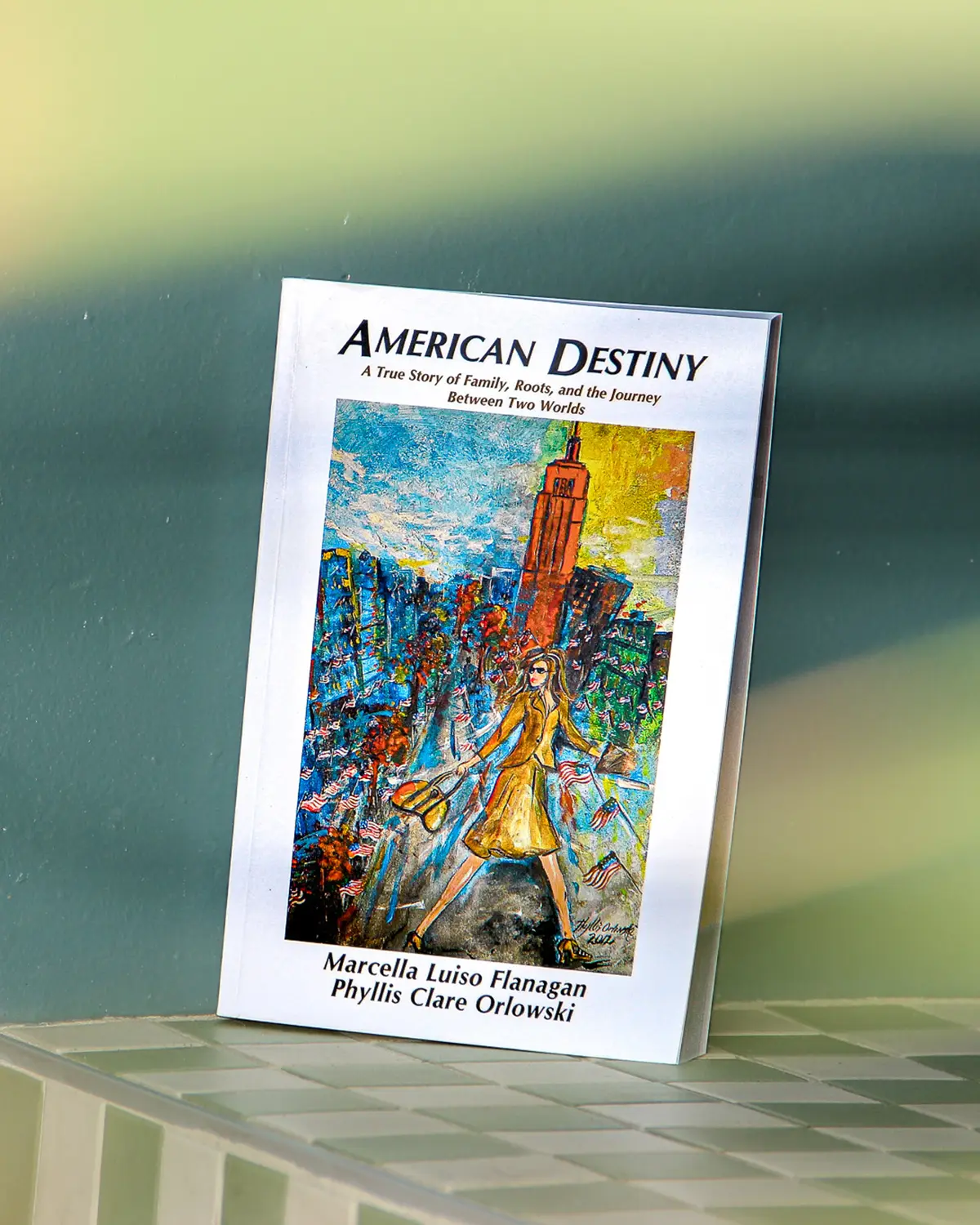
Editorial Note: Marcella Luiso Flanagan has always known her life was a story worth telling. At 91, she finally told it. “American Destiny: A True Story of Family, Roots, and the Journey Between Two Worlds” follows a family caught between postwar Italy and New York, and the woman at the center of it all: a girl who grew up between two worlds and went on to build a career that few women of her generation could have predicted. The excerpt published here captures one of those rare moments when everything lost comes flooding back. For more information, visit the book’s website.
Chapter 7: Finally, My Parents’ Birth Homes in Italy with Family
The train screeched to a halt in Acquaviva delle Fonti, where my mom was from, its whistle piercing the midmorning air. The station platform was already a sea of eager faces, a chorus of excited voices rising in unison as we stepped onto the platform.
“Benvenuti! Benvenuti!” (“Welcome! Welcome!”)
The shouts of welcome rang through the air as a crowd of relatives surged forward. I had never been enveloped in so many arms at once, kisses on both cheeks, tight embraces, and joyful exclamations. Some faces were vaguely familiar from stories and old photographs; others were complete strangers who greeted us with warmth as though we had known each other all our lives. My mother’s family, the Gentiles, were here in full force, parading us through the streets of Acquaviva, as we walked from the train station toward our grandparents’ home, the home where my mom was born and grew up in.
As we turned a corner, my breath caught in my throat. Before us stood a grand palazzo, a big mansion, built in 1848. Its façade worn with age but still standing tall, a testament to generations of family history. The streets rang with the triumphant strains of Giuseppe Verdi’s “Triumphal March” from Aida, sung by neighbors who had gathered to celebrate our arrival. The joy was infectious, lifting the weight of years spent away from this land. My parents returned, now with Lilly, Andy, and me!
The house was a stone villa, warm with age, its pink walls-tinged gold in the sun. Vines curled around the windows, and the front door stood wide open, as if it had been waiting just for us.
And then, they were there.
My grandparents!
Marzia, my grandmother, Nonna Marzia, my mother’s mother, was the first to rush forward, her arms outstretched. Her black dress brushed her ankles, soft with time but pressed to perfection. Her silver hair was pinned in a neat twist, and a cameo brooch, her mother’s, rested just at her collarbone. Her hazel eyes filled with tears as she took my mom’s face in her hands and whispered her name like a prayer.
“Cara, Angela.” (“Dear, Angela.”)
She held her, clung to her, and then looked at me.
“You,” she said, her voice breaking. She pulled me into her arms, holding me tightly against the scent of flour and rosewater.
Inside my grandparents’ home, the air was thick with the aromas of a feast being prepared. It smelled so good! The living room was a sanctuary of joy, a place where the war’s sorrow was momentarily forgotten. A long banquet table stretched across the room, set for what promised to be a lavish homecoming meal. A framed photograph of an old man sat in the corner of the room. I followed my mother’s gaze as she whispered, “That is Padre Pio. He protects our family and this house.”
She leaned closer to me and added, “One day, he will be named a saint.”
The table filled with platters of antipasto, mozzarella, prosciutto, basil-topped tomatoes, mortadella, salami, and an array of cheeses. Green and black olives glistened alongside pickled artichokes and roasted red peppers marinated in golden olive oil. Warm homemade bread and Nonna Marzia’s focaccia, thick bread-like pizza, arrived in endless supply, followed by steaming bowls of orecchiette pasta with sun-dried tomato ragu. The courses continued, stuffed rabbit, roasted lamb, vibrant salads, and grilled vegetables, each dish a celebration of Apulian tradition.
As the sun dipped lower over Acquaviva delle Fonti, its golden rays cast a honeyed light across the dry, ancient stones of the town. The sky was that soft, infinite blue that seemed to stretch forever in Apulia, and the air carried the faint scent of rosemary, baked earth, and the promise of celebration. Down a narrow lane, past crumbling walls dressed in ivy and the sweet songs of cicadas, the family villa opened its arms wide, like it too had been longing for this moment.
The courtyard had been swept clean, wide enough to hold laughter, stories, and thirty hearts that hadn’t beat in the same rhythm for nearly two decades. Long wooden tables stretched under strings of lights that bobbed gently in the breeze like fireflies frozen in time. Children ran barefoot, their sandals abandoned at the gate, their laughter rising and falling like a familiar and eternal song.
There was a low hum, pots clinking, voices rising in sudden joy, the scent of garlic and tomatoes stewing slowly in copper pots. Rabbit roasted on spits, bread lay heaped in baskets wrapped in white cloth, and olive oil shimmered in glass jugs. There were bowls of orecchiette con cime di rapa, (little ears pasta with broccoli rabe), handmade by the older women whose fingers moved with the memory of generations.
Our Nonna Marzia stood by the open door to the kitchen, radiant with energy. Her flour-dusted hands moved with grace as she offered slices of focaccia, her eyes scanning every face at the table, as if trying to memorize each one forever.
Grandfather Andrea, or Nonno Andrea, as Mom said I should call him, stood at the head of the table, a tall man with broad shoulders and a quiet presence. He wore a crisp, white shirt, a dark suit and tie, and a fedora he had set beside him. His eyes were moist as he looked around, those same eyes that had seen war, loss, and distance, now softened by joy. His hand trembled slightly as he raised his glass, the homemade wine catching the last of the light like rubies.
“La famiglia,” (“the family”), he said, his voice gravelly but strong. “Dio ci ha riportati insieme.” (“God has brought us together.”)
Tears welled in eyes that hadn’t seen each other in eighteen years. Some of the younger cousins were meeting for the first time, staring at each other in awe, already planning games. Older siblings clutched one another like children again. Aunts embraced tightly, kissing cheeks with the urgency of time lost.
Stories spilled like wine, of America, of the war, of births and deaths, of letters never sent but always meant. Someone brought out an accordion, and soon old songs floated up into the dusk like prayers. The courtyard glowed with laughter, music, and the scent of espresso brewing strong and sweet on a nearby stove.
I caught my grandmother Marzia gazing at my grandfather Andrea when she thought no one noticed, her hand resting on the table beside him, not quite touching but near enough to feel the warmth.
The feast stretched for hours, each moment filled with joy, stories, and the clinking of glasses. After the main courses, a rainbow of fresh figs and fruits was brought out, followed by plates of amaretti and almond biscotti, cookies, served with tiny cups of potent espresso and chilled limoncello, a lemon liquor.
And when the stars came out, sharp and brilliant over the rooftops, there were no goodbyes, only promises whispered under breath, clutched hands, and the silent vow that this reunion was not an end but a beginning.
As night fell, we departed by horse and buggy for Cassano delle Murge, my dad’s hometown, a few miles away. The ride took about one hour. The streets were quiet as we approached my dad’s “wedding” home on Via Convento. (Convent Road). Further up the road is the old convent. Before we could even knock, my grandmother, Angela, Nonna Angela, rushed out to greet us, her arms open wide.
“Mio figlio!” (“My son”), she cried, wrapping my father in a fierce embrace. Tears glistened in her eyes as she took sight of us all, her joy spilling over into soft sobs.
My grandfather Nicola, Nonno Nicola, followed close behind, his voice trembling with emotion.
“Caro figlio! Questo è la gioia più infinita abbracciarti con la tua bellissima moglie e famiglia dopo diciotto anni.” (“My dearest son, this is the greatest joy to hug you with your beautiful wife and family after eighteen years.”)
Neighbors gathered around, watching the reunion unfold, their faces reflecting the weight of years apart. Inside, the house was filled with the scent of another meal cooking. Though we had already indulged in one grand feast, the dining room table was set once more for another. My dad, however, had something else on his mind. He walked past the dining room, past the kitchen, until he reached the door that led to the attached barn. With a deep breath, he pushed it open. There, amid the warm scent of hay, stood a horse, a magnificent white stallion.
“Bianco!” my dad called out to his horse, choked up with emotion.
The horse lifted his head to the sound of his name. Then as if he understood every moment of the past eighteen years apart, Bianco let out a high-pitched whinny and trotted toward my dad. Tears streamed down my dad’s face as he reached out and stroked the animal’s mane. Bianco pressed his head into my dad’s chest, his tail swishing wildly, his body trembling with excitement. It was as if no time had passed at all. The moment stretched, untouched by time or the war that had kept them apart. It was the most profound reunion of all.
Later that night, back inside my grandmother Angela’s home, we sat down for our second feast of the day. By now, exhaustion had settled over me like a heavy blanket. While my sister Lilly remained bright-eyed and engaged in conversation, and my mom watched over my younger brother, Andy, my body gave in. I barely touched my food before my mom led me to bed. The last thing I heard before sleep took me was the gentle murmur of voices in the next room, the warmth of family filling the house like an unshakable presence. For the first time in my lifetime, I was in my Italian grandparents’ home. I had met both of them in one day for the first time in my young life, my mom’s parents in Acquaviva delle Fonti, and my dad’s parents in Cassano delle Murge.
Commitment is hard. Start with this free short story collection.