TLDR
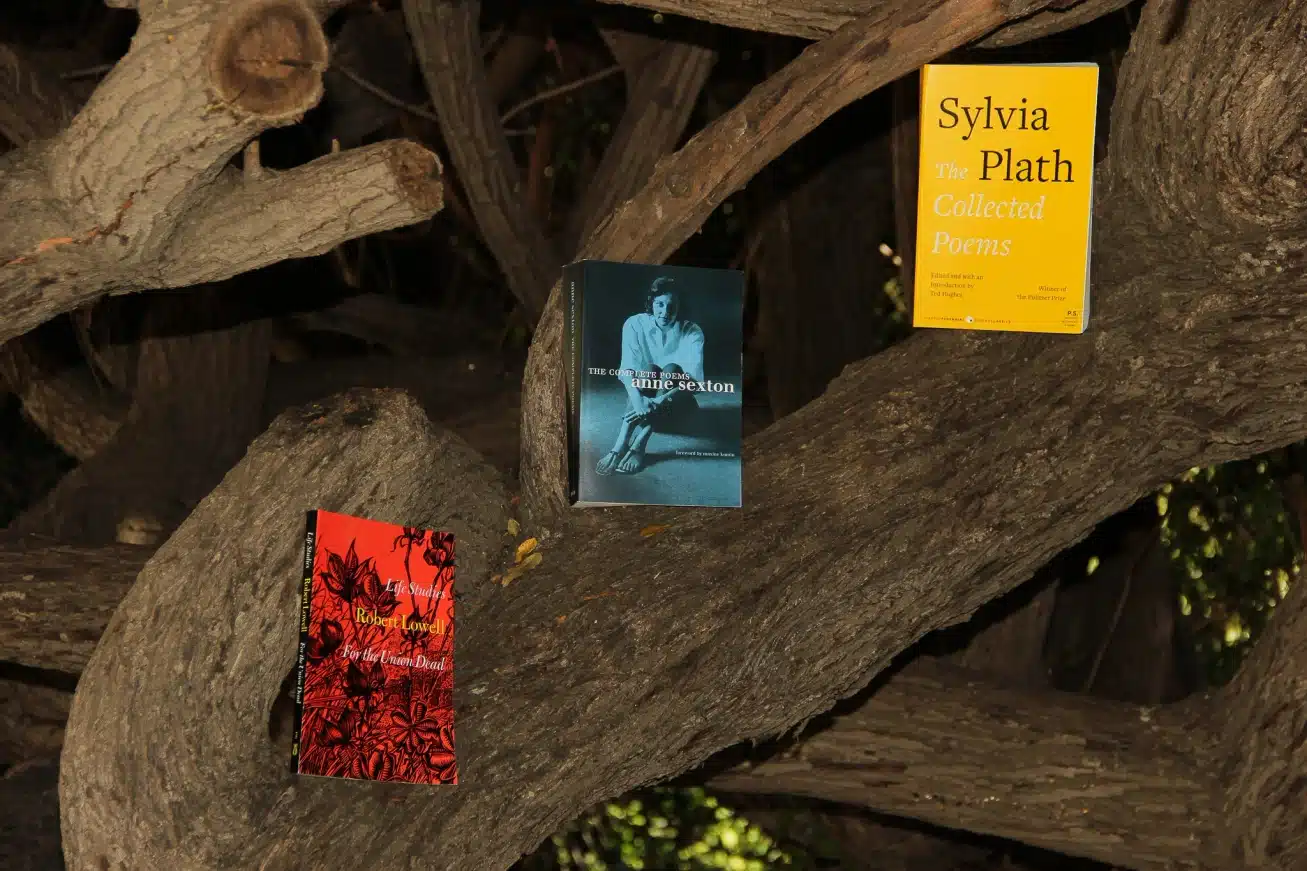
Confessional poetry, also known as 'poetry of the personal,' tends to focus on intense themes such as mental illness, trauma and sexuality. The term became popular during the 50s and 60s when critics were examining the work of genre-defining poets, including Robert Lowell, Anne Sexton and Sylvia Plath.
Often described as ‘poetry of the personal’ or ‘I,’ confessional poetry focuses on extreme moments of individual experience. These are predominantly in relation to the psyche or personal trauma. Their subject matter is often based on themes such as mental illness, sexuality and suicide, and are set in conjunction with broader themes.
What is Confessional Poetry?
The term, ‘confessional poetry,’ burst into common usage when literary critic M.L. Rosenthal referenced it in his review of Robert Lowell’s 1959 collection of poetry, “Life Studies,” for The Nation. Rosenthal’s take mirrored other critics, who cited confessional poetry as a revolution in poetic style. He claimed that though poetry had always utilized personal experience to some degree, the confessional poets removed the mask poets had previously worn to conceal their own lives. To create their work, these poets often used intense psychological experiences taken from their childhood or battles with mental illness. A decade later from Rosenthal’s coinage of the term, confessional poetry had become a popular form.
Who Were the Original Confessional Poets?
Emerging in the late 1950s and early 1960s, the term is generally associated with Robert Lowell, Anne Sexton, W.D. Snodgrass and — perhaps most famously — Sylvia Plath.
Robert Lowell is often credited as the founding member of the confessional movement, whose tutelage both Sexton and Plath were under. In “Life Studies,” Lowell gave a personal account of his life and familial ties. The collection had a significant impact on American poetry, with both Sexton and Plath referencing Lowell’s influence on their work. Comparisons were made between Lowell’s work and poet T.S. Eliot’s “The Waste Land” three decades earlier.
After being imprisoned as a conscientious objector during the second world war, Lowell remained politically active, protesting the Vietnam War. His personal life was also one of turmoil, involving marital and psychological problems. Suffering from repeated episodes of manic depression, Lowell was hospitalized in McLean Hospital in 1958, though earlier manic episodes had resulted in numerous stays at other institutions. Over a period of eight years, Lowell spent four stays in total at McLean’s.
Between being under the influence of young poets, such as W.D. Snodgrass and Allen Ginsburg, and his psychological issues, Lowell began writing more directly from his personal experience. This style can be seen in poems such as his “Waking in the Blue”:
‘Waking in the Blue’
“I strut in my turtle-necked French sailor’s jersey
before the metal shaving mirrors,
and see the shaky future grow familiar
in the pinched, indigenous faces
of these thoroughbred mental cases,
twice my age and half my weight.
We are all old-timers,
each of us holds a locked razor.”
The themes that emerged from the confessional poets — such as depression and sexuality, death, trauma, and difficult relationships — were original in that they were not usually discussed through poetry, seen as taboo. The confessional poets threw out the rules on poetry etiquette and replaced them with stirring accounts of their real lives.
Under the umbrella of confessional poetry, some poets made the subject matter their own. Anne Sexton, for example, held a particular interest with the psychological aspect of poetry. She began to write in accordance with the advice of her therapist. Her poetry exposed a window into her emotional state, with her life as a woman central to her themes. Topics such as abortion and menstruation, as well as addiction, were previously unknown to poetry as a genre. In poems such as “Buying the Whore,” she exposes a toxic relationship from a raw and original perspective:
‘Buying the Whore’
“You are the roast beef I have purchased
and I stuff you with my very own onion.
You are a boat I have rented by the hour
and I steer you with my rage until you run aground.
You are a glass that I have paid to shatter
and I swallow the pieces down with my spit.
You are the grate I warm my trembling hands on,
searing the flesh until it’s nice and juicy.
You stink like my Mama under your bra
and I vomit into your hand like a jackpot
its cold hard quarters.”
The confessional poets’ method of writing however was not merely a place to share their emotional trauma or personal lives. The structure and form of their poetry was also of deep importance to them. Their attention to the prosody, or patterns of rhythm and sound within poetry, were maintained throughout their craft. This style was different from the the rule-breaking work of the Beat poets of the 1940s and 1950s, although Lowell did initially bring some of their influence into his work.
Confessional poet John Berryman used the motif of his father’s death by suicide in his major work, “The Dream Songs.” This book features three hundred and eighty five poems relating to a character by the name of Henry and his friend, Mr. Bones:
‘The Dream Songs’
“All the world like a woolen lover
once did seem on Henry’s side.
Then came a departure.
Thereafter nothing fell out as it might or ought.
I don’t see how Henry, pried
open for all the world to see, survived.”
Sylvia Plath: How She Defined the Style
Arguably the most famous of the confessional poets, Plath wrote poems from an early age, publishing her first poem in the Boston Herald at eight years of age. However, her first collection, “The Colossus,” was published after she began studying with Robert Lowell.
Her work was esteemed by critics for its intense imagery. It was also seen as unique for her insistence of inserting the speaker of poems. The ‘I’ within her verse helped to create a vulnerable image of the female experience. Mental illness was also featured heavily, likely influenced by both the early death of her father when she was just eight years old and her own battles with depression.
Critics have pointed to the juxtaposition of what they reference as the ‘real’ Sylvia. On the one hand, the bright and gifted scholarship student, with an almost punishing need to pursue perfection. On the other, the subversive, terribly angry young woman who struggled against her own nature and depressive episodes. These two Sylvia’s appear in her interpretation of confessional poetry. The voice of the young woman, eager to please, for example in poems such as “The Applicant.” The loving mother in poems such as “Morning Song.” And the difficult relationship she experienced with her mother, Aurelia, in several poems, including “Medusa.”
Plath’s later collection, “Ariel,” which was published posthumously after her second, successful suicide attempt in 1963 at the age of thirty, showcases the fullest examples of her confessional poetry. Within this collection and her earlier work, Plath made the genre of confessional poetry her own, and is arguably the most revered proponent of the form.
This book follows an intense last three years of Plath’s life, in which she turned her writing inward, creating her deepest and most vulnerable writing. The poems written in this period reveal her confusion and anxieties, as she wrestled with her husband’s affair, the breakdown of her marriage, and her anxieties around being a good mother to her two young children.
One of the most recognizable examples of a confessional poem from the “Ariel” collection is “Daddy.” Whilst the poem is addressed to Plath’s deceased father and references the darkness of the Holocaust, it utilizes the sound and rhythm of a nursery rhyme:
‘Daddy’
“You do not do, you do not do
Any more, black shoe
In which I have lived like a foot
For thirty years, poor and white,
Barely daring to breathe or Achoo.”
The poem touches on a recurring theme of Plath’s poetry: suicide and depression. Plath also reveals her conflicted bond with her dead father.
Many of Plath’s poems within the collection show how women’s lives and bodies have been dehumanized and objectified. She returns to themes covered in her novel, “The Bell Jar,” in her insistence of the difficulties of female autonomy. In her poem, “Tulips,” from this collection, she references a bouquet of tulips by a woman’s hospital bedside. She feels they are watching her as she is put under anesthesia, showing the psychological torment and vulnerability of the female patient.
Editorial Note: Read our full review of “The Bell Jar” here.
Following this intense period of creativity, in which she shared her deepest vulnerabilities and created her most celebrated poetry, she ended her life.
Plath’s husband Ted Hughes went on to challenge the connection between Lowell’s confessional poetry and that of his late wife’s. Plath’s poetry, he felt, was more autobiographical in an emblematic way than that of Lowell. Later critics have since also questioned the confessional poet label as perhaps too simplistic a term for the work of Plath.
Writing in the introduction to “Letters Home,” in which she shares the correspondence between herself and her daughter, Plath’s mother Aurelia is keen to emphasise that she tried to dissuade her daughter from writing within such a confessional mode. Plath, however, formerly wishing to placate her mother, can be seen to rebel toward the end of her life, insisting on telling the truth of her life.
Editor’s Note: Read our author profile of Sylvia Plath.
Contemporary Poets Who Adopted the Confessional Style
Contemporary poets writing in the twentieth century who adopted this form of poetry include Marie Howe, winner of the 2025 Pulitzer Prize for poetry for her collection “New and Selected Poems,” Sharon Olds, who was similarly awarded the 2013 Pulitzer Prize for Poetry for her collection “Stag’s Leap.” Critics celebrated her use of the everyday minutia of a woman’s life within her poetry, such as in “Ode of Girls’ Things.”
‘Ode of Girls’ Things’
“I loved the things that were ours—pink gloves,
hankies with a pastoral scene in one corner.
There was a lot we were not allowed to do,
but what we were allowed to do was ours,
dolls you carry by the leg, and dolls’
clothes you would put on or take off—
someone who was yours, who did not
have the rights of her own nakedness,
and who had a smooth body, with its
untouchable place, which you would never touch, even on her,
you had been cured of that.”
The confessional poets’ pioneering style changed the landscape of American poetry. Their influence can still be seen in contemporary and modern poets of the 21st century. Poets such as Ocean Vuong and Kaveh Akbar have made this form their own. Whilst Vuong’s work speaks to war, immigration and queer identity, Akbar tackles his struggles with addiction and recovery, along with themes similar to the original poets, such as death and trauma.
Editorial Note: Read our author profile on Kaveh Akbar.
Within his poem “I Wouldn’t Even Know What to Do with a Third Chance” these themes emerge:
‘I Wouldn’t Even Know What to Do with a Third Chance’
“the beginning will start beginning again. I swear on my
head and eyes, there are moments in every day when
if you asked me to leave, I would.”
Like confessional poets such as Plath before him, Akbar has similarly ventured into semi-autobiographical prose writing, also called autofiction. His 2024 debut novel, “Martyr!,” a finalist for the National Book Award, tells the story of a bereaved writer searching for a reason to live. In what some critics have termed a “richly expansive prose,” Akbar creates an Iranian protagonist who is struggling with addiction and fragile mental health. Though the book is fiction, Akbar cleverly blends autobiographical elements similar to the author’s own.
Confessional Poets Left Their Mark On Modern Poetry
The confessional poets created a wholly new form of poetry, one based on personal experience and difficult emotions. Their work openly discussed trauma and death, sexuality and declining mental health, with which many of their authors’ were grappling. The impact of their work continues to influence 21st century poets, providing poetry that can reach out to modern audiences and allow readers to recognize that they are less alone in their struggles.

Get recommendations on hidden gems from emerging authors, as well as lesser-known titles from literary legends.