


TLDR
Fully experience "Night on the Galactic Railroad" off-page by watching the anime film adaptation, listening to our curated soundtrack and buying Paper Bento products that embody Miyazawa Kenji's vision.
Books are often the big bang that birth many experiences: TV series, movies, soundtracks , book clubs, notes scribbled in margins, narrators in our ears, even old-fashioned letters. “Night on the Galactic Railroad” is one of my favorite books. Over the years I have celebrated this tale in several ways. If you love this novel or are curious about it, use my guide to experience the book off page and beyond the typical aspects of a franchise.
About the Book
“Night on the Galactic Railroad” is a short novel written by Kenji Miyazawa in the 1920s, though it wasn’t published until after his death. The story follows Giovanni, a quiet and lonely boy who one night finds himself on a mysterious train traveling through the Milky Way. Beside him is his closest friend, Campanella. They move through starfields and strange stations, meeting passengers who come and go without explanation, while the two boys sit together in the dark and the light.
The train moves through the night, stopping at stations where strange, quiet passengers board and eventually disappear. No one explains where they came from or where they’re going. Giovanni holds onto a ticket he doesn’t understand. Somewhere along the way the journey stops feeling like a dream and starts feeling like a question about what really matters when you can’t hold onto anything forever.
The novella centers two boys who love each other in the way children often do: fully and without ceremony. The story is about what it costs when one of them has to go somewhere the other can’t follow. Miyazawa wrote about ほんとうの幸い, “true happiness.” He asks quietly whether we ever really know what true happiness is until we’ve lost something, something we didn’t think to name while we still had it.
Watch the 1985 Anime Film
The 1985 anime adaptation directed by Gisaburo Sugii is one of those rare films that understands its source material well enough not to explain it. The anime film excels at building a living, breathing atmosphere through finely crafted surreal imagery, deliberate pacing and an audio-visual experience that feels closer to a waking dream than a conventional animated film. The deceptively cute cat character design works as a kind of lure, drawing you into something far darker and more philosophically rich than it first appears.
Listen to Music that Fits the Mood
When a book stays with me, I tend to build a collection of songs that evoke a similar emotion or reminds me of a scene from the story. These are the songs that live in the same emotional space as the story: slow-moving, a little melancholic, beautiful in a way that makes you feel like you’re star gazing out in the woods. I put this list together from my own listening, and each one earns its place for a specific reason.
01 Galileo Galilei 鳥と鳥 (Tori to Tori)
The song pictures two boys as birds: one in a cage, one flying free outside. A friendship forms for just a moment before the free bird is gone. If you’ve read the book, you’ll recognize exactly what that feels like.
02 Tomoyo Harada 銀河絵日記
I found this one by accident, on the radio. The lyrics read like an epilogue to the story: Giovanni is there, the train is somewhere in the background, and Harada’s voice carries exactly the softness the book ends with. It’s the kind of song that feels like it was written for the readers who weren’t ready to say goodbye.
03 Aimer 六等星の夜
There’s a distance in Aimer’s voice. She’s right there, and you still can’t quite reach her. That’s exactly what it feels like to sit next to Campanella on the train.
04 Hajime Mizoguchi INFINITY ~夢の引力~ (Yume no Inryoku)
Mizoguchi wrote this piece as a direct response to “Night on the Galactic Railroad.” The beauty of it makes the sadness sharper, not softer. You finish listening the same way you finish the book: with a grief you can’t quite locate, and a boy named Campanella somewhere you can no longer reach.
05 Hajime Mizoguchi 世界の車窓から
This one is the train itself. The comfort of moving and the loneliness of moving at the same time. The sound of Campanella sitting beside you, for as long as that lasts.
06 Ryuichi Sakamoto Aqua
Very few notes, and yet time moves slowly through all of them. This is what it looks like to watch the galaxy from a train window. Sakamoto doesn’t push any feeling onto you, which is exactly Miyazawa’s temperature, too.
07 Masakatsu Takagi Girls
The air before the story starts. Pure and still, nothing has happened yet. Giovanni, before he steps out into the night.
08 Joe Hisaishi One Summer’s Day (Spirited Away)
There’s a train journey in “Spirited Away” where this piece plays, and the feeling is almost identical: moving through an unknown space, not sure where you’re going, quietly OK with not knowing. The piano asks nothing of you. It just moves.
09 Joe Hisaishi The Rain (Kikujiro)
Quieter and more interior than his Ghibli work. Piano with cello threading through it. The kind of piece that sounds like thinking slowly, which is exactly the pace this book deserves.
10 Aoi Teshima テルーの唄 (Tales from Earthsea)
A voice that sounds like it comes from somewhere very old and far away. The song is from a Ghibli film, but it belongs to a wider world than any single story. Put this on at the end of the playlist.
Write Into the Questions the Book Leaves Behind
This book doesn’t give answers. It poses questions and leaves space for you to sit with them. The prompts below work best after you’ve read, with a notebook open and no particular goal.
If you were on the Galactic Railroad right now, where would you want it to take you? Somewhere real, somewhere imagined, or somewhere you can’t quite name?
Miyazawa wrote about ほんとうの幸い, “true happiness,” but he didn’t mean personal happiness. He meant something closer to collective well-being. He believed individual happiness is impossible while others are suffering. What does that logic ask of you in your actual life today?
What’s a small thing you did recently for someone else, something they may not have noticed?
Is there someone you can no longer reach but still have words for? Write them in our comments section, if you want.
What would the child you used to be think of the life you’re living now?
On Writing by Hand
Japanese stationery culture has a word for this kind of slowness, even if it’s never stated outright: the idea that the tools you write with shape the quality of the attention you bring. I’ve spent years curating Japanese stationery for exactly this reason. For a book like this one, here’s what I would pick for you.
PAPER BENTO PICKS: What to Write With When the Thoughts Feel Slow and Worth Keeping
01 Shinzi Katoh 宮沢賢治幻燈館 Stationery
The most direct connection you’ll find between Miyazawa’s work and something you can hold. Designer Shinzi Katoh spent years illustrating scenes from Miyazawa’s stories. The collection that came out of it — including postcards, memo pads, flake stickers and files — looks exactly like what you’d want on your desk while sitting with this book. Each illustration is drawn from a specific story. Writing a letter on one of these postcards feels like the right way to use them.
shinzikatoh.com
02 Pent コトバノイロ 銀河鉄道の夜 Ink

This one was made specifically for the book. Penhouse’s コトバノイロ series translates Japanese literature into ink colors. 銀河鉄道の夜 became a deep blue-grey chosen to capture the melancholic atmosphere of Miyazawa’s story. You’re writing with the color of the night sky in the book. There’s no more literal way to be inside it.
Available via Penhouse / Rakuten
03 Pilot Iroshizuku Tsuki-yo (月夜) Ink
Tsuki-yo means moonlit night. The ink is a dark blue-black with just a trace of teal at the edges, the kind of color that shifts slightly depending on how the light hits it. On Tomoe River paper, it picks up a faint red sheen. It’s the ink equivalent of looking at the sky just after dark, before it turns fully black.
04 星屑ノート — Shubishusha, Kyoto
A small square notebook made by a Kyoto printer called Shubishusha. The pages have a fine stardust texture to them, like holding a piece of the night sky in your hands. The rules are light enough that you barely notice them. The margins are generous. It’s the kind of notebook that doesn’t try to organize your thoughts, just makes space for them.
keibunsha-books.com
05 Tsutsumu 夢の銀河 Letter Set
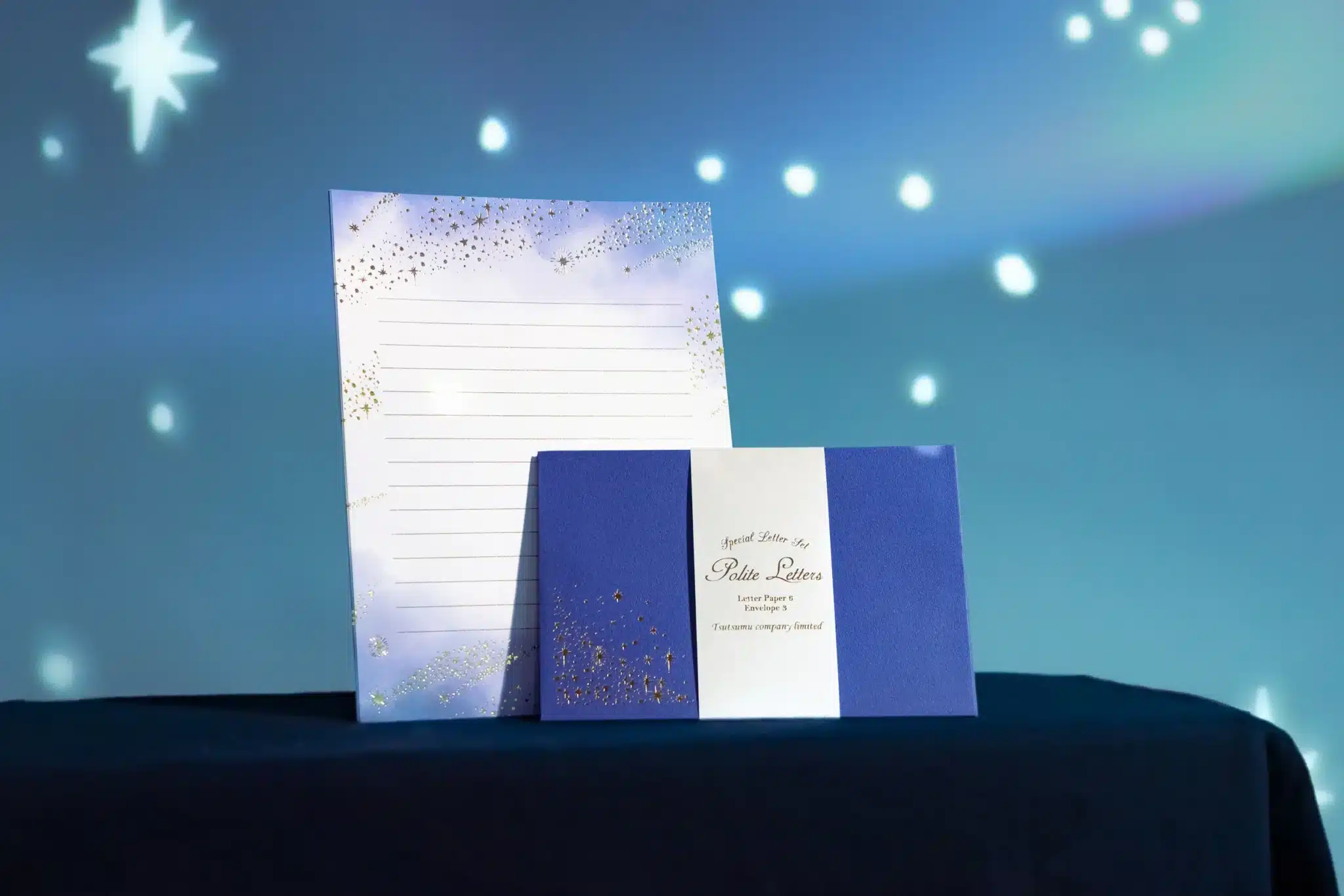
A watercolor night sky with gold foil stardust pressed over it. The paper is semi-transparent, so when you fold the letter into its envelope, the writing shows faintly through from the other side. Writing a letter to someone far away is one of the most galactic railroad things you can do. There’s someone at the other end of the distance. You don’t know exactly when your words will arrive. This set makes that feeling visible.
tsutsumu-shop.com
06 BGM Special 星座・夜空 Masking Tape
Washi tape with constellations and a night sky, gold foil pressed over the stars so they catch the light differently, depending on the angle. A strip along the edge of a journal page, or sealing the flap of the letter set above. Small details that make the writing feel like it belongs to a specific mood and not just a Tuesday.
hremon.com
07 Traveler’s Notebook
A notebook built for someone always on an adventure. The leather softens with use, the inserts swap in and out, and nothing about it feels precious or worth keeping safe. Giovanni is a boy who travels without a proper ticket. A Traveler’s Notebook is a book that travels without needing a plan.
Every box I put together at Paper Bento is chosen with this in mind: Japanese stationery that slows things down. If any of this resonates, you’ll find the current season’s box at paperbento.store.
End of the Line…For Now
There’s no single right way to sit with a book like this. But I hope something here gives you a quiet evening to try.

Get the latest of The Rauch Review in your inbox, discover books you won’t see in stores, stay up to date on the “Rauching to Judgment” podcast and more.




This piece introduced me to “Night on the Galactic Railroad” and its author. I’m excited to learn more.
As someone who has discovered fountain pens and inks, and has a hobby of it now, I really appreciate the shout to the Japanese makers who provide spaces for us to experience writing rather than simply selling products.