
As an Amazon Associate, we earn from qualifying purchases.
TLDR
Through the perspectives of Death and a teenage girl surviving during Nazi Germany, "The Book Thief" explores how ordinary people cope during periods of intense fascism and dehumanization.
“The Book Thief,” written by Marcus Zusak, has been a beloved modern classic since its publication about 20 years ago. In this review, I try to make the case that it’s a book fit for any serious reader, not only the young adults it’s been marketed to, and that its themes are just as relevant as ever: Clinging to humanity in dark times, and the everyday ethical dilemmas faced by ordinary citizens under the rise of fascism.
The Book Thief Summary: A Parable of Hope Through a Child’s Eyes
The Book Thief follows the course of a German orphan’s childhood as she’s caught in the crossfire of events that strike her town during World War 2. Along the way we’re introduced to her accordion playing, cigarette smoking, loving foster father and foul-mouthed, pragmatic foster mother; her neighbor Rudy, who becomes a close friend and accomplice in small-time thievery; and an outlaw Jew named Max who takes refuge in their basement. Along the way she steals several books that mean more to her than even their authors intended, taking an outsized symbolic weight and providing moral salve to outlast the dim years ahead.
Experienced through daily life in a small town outside Munich, readers experience the war and its unfolding atrocities through the eyes of ordinary, impoverished Germans who don’t resist the Nazis outright — that would be a death sentence — but make decisions, both petty and fateful, that find them in the moral crosshairs between right and wrong. Most of all, the book centers the orphan, Liesel: her suffering, her strong spirit, her inner life, and her way with words. Ultimately it becomes a tale that questions and heralds the human spirit when pitted against atrocities committed at an industrial scale.
“The Book Thief” brings to mind the childhood perspective of “The Diary of Anne Frank,” the lyrical wartime atmosphere of “All the Light We Cannot See,” and the reflective narration of “The Lovely Bones,” while adding a strange twist: the story is told by Death itself.
At The Rauch Review, we care deeply about being transparent and earning your trust. These articles explain why and how we created our unique methodology for reviewing books and other storytelling mediums.
Audience and Genre: Young Adult Fiction by Label Only
Since its release in 2005, “The Book Thief” became an outlier in the book market. Originally published as adult fiction in Australia, it came to greater fame marketed as a Young Adult novel in the U.S., yet grew to become a cross-generational phenomenon — and for good reason. The book holds up to any serious historical fiction an adult would enjoy.
Should we discount a narrative that portrays horrendous war tragedies if they’re somewhat softened through the experience of a young girl? After all, it’s through Death’s narrative gaze that we see war’s tragedies unfold. This perspective gives the book a moral gravity adults will fully appreciate, without being so explicit a teenager couldn’t enjoy it.
In some ways it’s a coming of age tale, common in Young Adult fiction. Nonetheless, it’s written with an experimental structure, stitched together from small chapters that often jump time frames and even intentionally spoil the plot, all narrated through an unlikely omniscient voice. It’s a coming of age tale, but it also deals with xenophobia, discrimination, poverty, fascist fearmongering, moral conundrums, bombs and a spate of deaths.
“The Book Thief” will appeal most to readers who are seeking a character-driven story using lyrical, stylized narration, a World War II story from unusual perspectives, and a book that cherishes the power of language and the stories we tell to survive harrowing times. Those seeking a fast-paced thriller plot or an explosive climax should look elsewhere.
Perspective: Dramatic Irony Embodied
“It kills me sometimes, how people die.”
You could say “The Book Thief” is written from a first-person omniscient perspective: Death itself is personified, though not in a heavy-handed way, and seems to float above the events of World War II, zooming in to clarify important details. Death takes an unusual interest in Liesel in her small town outside Munich. From that sense, it often becomes a third-person narrative, as Death draws us in to her experiences, privileging her memories and emotions. But the act of zooming out again gives the novel its beloved haunting charm, rendering individual lives as fragile footnotes to an inevitable, sweeping end; rendering suffering as a universal human experience.
It also has a knack for spoiling endings, which may deflate some readers, but has the effect of allowing the characters, their relationships and their inner lives to shine through. It’s dramatic irony, embodied.
Three Cs: Compelling, Clear, Concise
Editorial Note: We believe these three factors are important for evaluating general writing quality across every aspect of the book. Before you get into further analysis, here’s a quick breakdown to clarify how we’re using these words:
- Compelling: Does the author consistently write in a way that would make most readers emotionally invested in the book’s content?
- Clear: Are most sentences and parts of the book easy enough to read and understand?
- Concise: Are there sections or many sentences that could be cut? Does the book have pacing problems?
Compelling: An Engrossing Work that Rewards Sustained Reading
The Book Thief draws in the reader from the title to the very first pages, all with little fanfare printed on the back cover. Its premise is made very clear from the beginning: Death will be your narrator. Death introduces itself with lyrical foreshadowing that proves to be its hallmark, particularly its love of colors (which come to take on deeper significance as the novel goes on).
The book’s short sections and chapters each get titles that become clear upon further reading, just descriptive enough to intrigue: “a mountain range of rubble,” “death and chocolate,” “the smell of friendship.” From the very first chapter, Death lays out the basic plot of the book: “It’s just a small story really, about, among other things: a girl, some words, an accordionist, some fanatical Germans, a Jewish fist fighter, and quite a lot of thievery.” Throughout the book, Death is fond of giving away the plot without giving away the plot.
While World War 2 novels abound, readers may find the setting and perspective to cast the period in a new light: Set in small town Germany from the perspective of ordinary citizens, experienced through the lens of a young girl, Liesel, who readers will come to care for. Time seems to pass slowly, and though dramatic events certainly make their way through the town, it’s on a smaller, human scale interspersed with plenty of humdrum town life, chores, tomfoolery and adventure. And while this would seem to diminish the atrocities and persecution of Germany’s non-Aryan citizens, it actually makes it more haunting to imagine just how ordinary life could still be while the tragedy unfolded.
Clear: An Easy Read Without Being Elementary
“The Book Thief” is a very straightforward read from a technical perspective using clear language and plot devices. That’s not to say it’s dry or dumbed down to an elementary reading level. In fact, lyrical passages are deeply embedded into the narrative in a way that colors (quite literally) the story, striking strong moods: sometimes grave, sometimes lighthearted, sometimes darkly funny.
Even without the intentionally many titled sections, the plot would be easy to follow. In fact, Death goes as far as to spoil certain key tragedies before they’re narrated in later detail. But rather than having a deflating effect, Zusak seems to bet on the fact that readers can ease through the plot without doubling back, focusing instead on the world-building, characters, moral dilemmas, and musings on the human condition.
Concise: Light on Fluff, Heavy on Foreshadowing
“The Book Thief” feels like it had gone through a meticulous revision process, because there are few redundant passages. Every chapter either aims to delight, thicken the plot, deepen a character, or introduce a moral dilemma.
The pacing felt slow but appropriate to capture that passage of childhood where every day feels like a week. If readers approach the novel as a series of vignettes, they shouldn’t be bothered that the book doesn’t accelerate into a major climax like a thriller might. Even so, the weight of history and the dramatic irony not only of Death’s omniscience but also what readers already know of the war, all add an ominous weight to the unfolding events that do ultimately reach a tragic end, even if Death somewhat prepares us to meet it.
Character Development: Memorable Characters Beyond Playing Mere Roles
“The Book Thief” features characters developed well enough to be compelling beyond being mere pawns on the board of history, but not so densely as to become unrelatable. The characters, Death, Liesel, her foster father, and the Jewish runaway are all quite fleshed out while the supporting characters may feel a bit like the cast in a play, with repeated tropes. I think that contrast strikes the right balance in this case.
Death itself shows us its character through its love of colors, narration style, and its curiosity of humans who puzzle it to no end. It also has a dark sense of humor: “It kills me sometimes, how people die.”
We come to love Liesel Meminger, its main character, at first out of pity — she’s an orphan stripped of her family from a young age — and later for her unrelenting spirit, her ability to create intimacy with her foster father and Max, the Jewish refugee in hiding. She persists through dark times and wins their hearts (and ours) with her infectious love of books, an almost mythical reverence for them as physical objects that span time periods.
Her foster father, Hans Huberman, also emerges as a detailed and loveable character whose purity of heart is unrelenting from their first meeting to his eventual end. A World War I vet, he continually charms us with the accordion he picked up during the first world war. But he’s not without his scars, bad habits and flaws. He’s perennially poor, somewhat of a bohemian at heart, and loves smoking. He does smack Liesel once when she refuses to blend in with the emergent Nazism that comes to dominate the small town. But deep down he winces, and regrets it.
Even some minor characters are given a quick sketch of character building that brings them to life. There’s Liesel’s cursing, pragmatic foster mother, Rosa Huberman, characterized by tough yet loyal never-stated love; Rudy, Liesel’s best friend and fellow petty criminal, who’s always teasing her for a kiss; and Max Vandenburg, a runaway Jew with a love of fistfighting who eventually becomes a hideaway in the family’s basement.
Story: A Series of Vignettes, Only More Precious Because Readers Know the Outcome
“The Book Thief”’s plot is driven as much by character development as it is by the all-too-familiar inevitable events of World War II. But Death’s narration, the setting of small town Germany and the young girl as a protagonist give us a fresh perspective to witness the war’s usual flash points: Nazi party recruitment, surveillance, rallies, book burning, Kristallnacht, deportation and bombings.
There’s also this wincing tension between often placid moments of childhood paired with the dramatic irony of knowing the fate that awaits our characters. There are only a few plot twists for the better—and I won’t spoil them here—but they felt like redemptive outcomes amid so many tragedies. They balance out the fact that Death spoils those outcomes early on in the novel.
This foreshadowing may annoy some readers as a cheeky literary gesture. Death knows all, after all! But the effect is to deepen our relationship with what happens despite, not because of, the inevitable. It shifts our focus to the complicated, often unexpected humanity that sprung up here and there in Nazi Germany like flowers peeking through cracks in pavement.
Prose Style: Dark Humor Meets Tender Compassion
Author Markus Zusak, following perhaps in the footsteps of Kurt Vonnegut’s “Slaughterhouse Five,” has a way of weaving short sentences (“Here is a small fact: You are going to die.”) with philosophical asides that resist traditional war narratives. Like Vonnegut, there’s a special balance between showing and telling — or, more accurately, showing, telling and commenting.
By breaking the fourth wall, having the narrator reflect on events and speak directly to the reader, Suzak is able to take liberties normally unsuited to the genre. He creates explicit foreshadowing that somehow deflates suspense but increases our investment in the characters and the moral gravity of their plight. Rather than letting scenes stand on their own, he’s allowed philosophical commentary, pointing out the strange contradictions in war. From intimate renderings of Liesel’s inner life, he can zoom suddenly out with a starkly detached observation of humanity only personified Death could give. While certain readers may balk at the amount of interruptions, I’d argue that Zusak is able to strike a balance and weave them quite seamlessly into the reading flow without disrupting our immersion in the events.
Readers may also be surprised by the typographical and graphic inserts peppered throughout the novel. First, are the many chapter titles and subtitles given how short the chapters are. Some may interpret this pacing to be Young Adult handholding. I’d argue Zusak intentionally plays with the tension between headers and prose: the headers being a kind of poetry: obtuse, only hinting at what’s to come with specific, intimate details revealed only later. Death also loves inserting itself through bold headlines reminiscent of a newspaper.
Other narrative and graphic elements are also integrated within the novel, such as excerpts of the hideaway Jew’s illustrated book, “The Word Shaker.” It becomes apparent that Liesel’s own writings (spoiler) that end up incinerated during the bombing are what intrigue and inform Death to write “The Book Thief” itself, as if he’s collecting them from the ashes and preserving them for perpetuity.
But where a writer like Vonnegut leans heavily into satire and dark absurdity, Zusak balances dark humor with tender compassion, focusing especially on the love between Leisel and her foster father, the power of words for good and evil, and the moral choices of ordinary people.
Unlike a good majority of historical fiction, Zusak’s penchant for figurative, lyrical passages is inseparable from his world-building and narration. The importance of color (of skies, smoke, eyes, landscapes) becomes apparent from the very first pages and threads throughout the novel, to different effects: painting the setting, deepening a character, or foreshadowing a mood — quite literally.
Here are a couple examples:
- “The horizon was the color of milk. Cold and fresh. Poured out among the bodies.”
- Describing the foster father’s eyes: “…made of kindness, and silver. Like soft silver, melting.”
- Describing the Jewish quarter: “Schiller Strasse, the road of yellow stars.”
- And during the novel’s fever pitch passage about the holocaust, “Sometimes I imagined how everything looked above those clouds, knowing without question that the sun was blond, and the endless atmosphere was a giant blue eye.” The bitter irony.
Altogether, Zusak’s prose reveals a writer invested in the expressive potential of language itself. His figurative style uses simple language with unique juxtapositions and seeks clarity for the sake of emotional immediacy, giving us many quotable lines that capture the novel’s themes. Whether readers find this approach lyrical or occasionally overwrought will depend on taste, but it undeniably gives “The Book Thief” a recognizable voice, one that places equal importance on imagery and metaphor as much as plot in shaping the reader’s experience.
Dialogue: Varied, Distinct, and Integrated
In “The Book Thief,” dialogue appears sparingly to different effects. It serves to ground us to the present (“Nearly there.”) and tie us to the setting with occasional German banter and plenty of Schimpfen (cursing, scolding).
Dialogue also colors the characters. Scolding becomes an unpleasant, consistent and eventually endearing trait of Rosa Huberman, Liesel’s foster mother. It can add a tinge of weighty meaning, like when Max (the hiding Jew) briefly steps outside and describes, “There were stars. They burned my eyes.”
Or it can be thrown out with dry understatement. Among an air raid response team, someone quips, “Just once I want to be there when they hit a pub, for Christ’s sake. I’m dying for a beer.”
Conversations sometimes reveal the empathy fatigue of war. One instance is when the air raid squad deals with a fallen member:
“Each man tried not to look down at Reinhold Zucker’s openmouthed sneer. ‘I told you we should have turned him facedown.’”
And that’s the last they speak of it, showing there’s equal subtext in what’s unsaid.
The next thing we hear is, “Well, Huberman. Looks like you’ve got away with it, doesn’t it?” explaining how this means Huberman, with his broken leg but life intact, will be taken off the squad to a safer clerical assignment, indoors.
His superior offers his gruff endearment: “Boris Schipper finished his cigarette. ‘Damn right it sounds good. You’re lucky I like you, Hubermann. You’re lucky you’re a good man, and generous with the cigarettes.”
When characters speak, their voices feel believable, especially given their age. Liesel’s best friend, Rudy, teases instead of professing his feelings for her. Liesel possesses a blunt fearlessness when it comes to stealing, and Hans (her foster father) reassures her gently. They all feel distinct.
Overall, the dialogue meshes with the flow of the prose without distracting from the novel’s meditative, fable-like qualities.
Setting: Small Town Life During Unprecedented Horror
“The Book Thief” takes place in and around Molching, a fictional town outside of Munich, the birthplace and symbolic epicenter of Nazism. It’s also close to the infamous Dachau Concentration Camp that becomes relevant to the story. The book, while not laden with minute historical details, convincingly captures life near Munich as the war unfolds. It’s how Liesel’s childhood is able to flourish, in its way, because for much of the early war years, daily life remained relatively stable compared with occupied territories or battlefronts. You can feel how the war seemed to be happening elsewhere.
Despite that distance, the public still felt the war’s effects. Indeed, poverty and wealth became amplified — showcased in the novel between lowly Himmel Street made up of poor Germans, the Jewish street that becomes a desecrated ghost town, and the wealthy neighborhood hill laden with mansions. Molching’s townspeople experience rationing, propaganda, Nazi rallies and conscription, and the gradual disappearance of neighbors.
The war finally hits home with the climax of the novel in the form of allied bombs that begin as a rumor and end with devastation. In this way, the setting is vivid enough to place us there without pedantic details like exact dates, people or landmarks, though years and months mentioned are all accurate. While Zusak is not burdened with the minutest historical details, you can tell he knows his history well.
But our experience in the novel is mostly through the lens of Liesel, for whom the events are entirely new and not laden with the hindsight we now have decades later. Or we experience them through the eyes of Death, who often makes dark jokes about how busy he was in those years, how he treats everyone equally, and how he doesn’t understand why he’s being overworked.
I found the setting to be just the right balance of broad strokes and historical realism with a unique perspective. It allowed me to imagine something I was always curious about: What was ordinary life like within Germany, in those years? How did citizens of a town experience and enable Facism to flourish? In what ways did life still take on normalcy? How did citizens cope with their beloved sons dying in the war effort and the tide of war turning against them?
Rhetoric: A Focus on the Lived Ethical Dilemmas of Ordinary Citizens
Zusak’s stance on facism and genocide is nothing radical or controversial. His philosophy is clear and integral to his novel: that it was a horrible evil brought on gradually through propaganda and the moral decisions citizens made every day, until it reached a tipping point where fear overrode any later attempts at individual resistance.
Nevertheless, Liesel uses the very power of language to manipulate the masses to noble effect by reminding her town and us readers of our humanity. Ultimately, it feels like Zusak explores the way ordinary (non-ostracized) citizens navigated life under facism, and how even they were still ostracized in different ways, often through wealth divides, but also by the State, drafted into wars they didn’t necessarily support. It becomes a parable for the human capacity for both cruelty and kindness.
Rather than constructing a heavily political argument, Zusak focuses on the quieter ethical realities of ordinary civilians: the dangers of conformity, the seduction of propaganda, and the small acts of decency that persist even under fascist rule. The messages aren’t exactly subtle, but they’re embedded naturally into the novel’s structure and narration.
Cultural and Political Significance: Still Relevant in an Era of Neo-Fascist Resurgence
It’s obvious why “The Book Thief” continues to circulate heavily in curricula and still resonates with readers to this day. Interest in the original rise of fascism has rarely felt so pressing as in recent times, where fascist tendencies and movements are cropping up worldwide. The reading public is invested in understanding how fascism could arise and to find parallels in our time: How ordinary societies can become desensitized to authoritarian overreach.
Zusak’s novel deals with that question more from the lived experience on the ground, rather than a bird’s eye historian’s retelling. It’s more interested in the slower underpinnings: social pressure, indoctrination, fear and small ethical dilemmas that add up to something sinister.
It doesn’t offer some radically new interpretation but packages these themes in an emotionally intimate way. Told from interesting vantage points readers may not have experienced before, Zusak finds a way to make this historic tragedy feel personal without making it a brutal, dry history text.
Critiquing the Critics: The Same Takes, But With Different Tones
There are many parallels between what you might call consumer reviews like you might find on Goodreads versus critic reviews like you might read in The New York Times. The major difference is merely word choice and the feigned authoritative voice of the latter. In short? You’ll find the same praise across both outlets, and you’ll find similar criticisms, too.
The general positive response centers around the book’s symbolic depth, imaginative perspective (death, of course), unlikely setting (WWII from the eyes of a poor small-town German child), and lament over the unfortunate Young Adult marketing label slapped on after-the-fact.
Similarly, some of the negative responses are merely a flip side of the coin. Some readers and critics found the symbolism and figurative language to be overwrought and try-hard; death’s narration as interruptive telling (and spoiling) over showing; the small-town child perspective contributing to a directionless, episodic plot; and the treatment of tragedy and genocide with one too many feel-good metaphors.
Overall, negative reviews and sentiments are in the minority across consumer and establishment reviews alike. And while the criticisms offer valid counterpoints, you will often find the review to end with a positive overall impression.
Book Aesthetic: Many Covers, Some That Reference Scenes
The Book Thief has been printed and reprinted with dozens of covers. I’ll speak to the edition I got and then to the artwork I found most fitting to the novel, both in terms of optics — a book buyer’s first impression of what the book may be — and relevance to the actual depth of the novel.
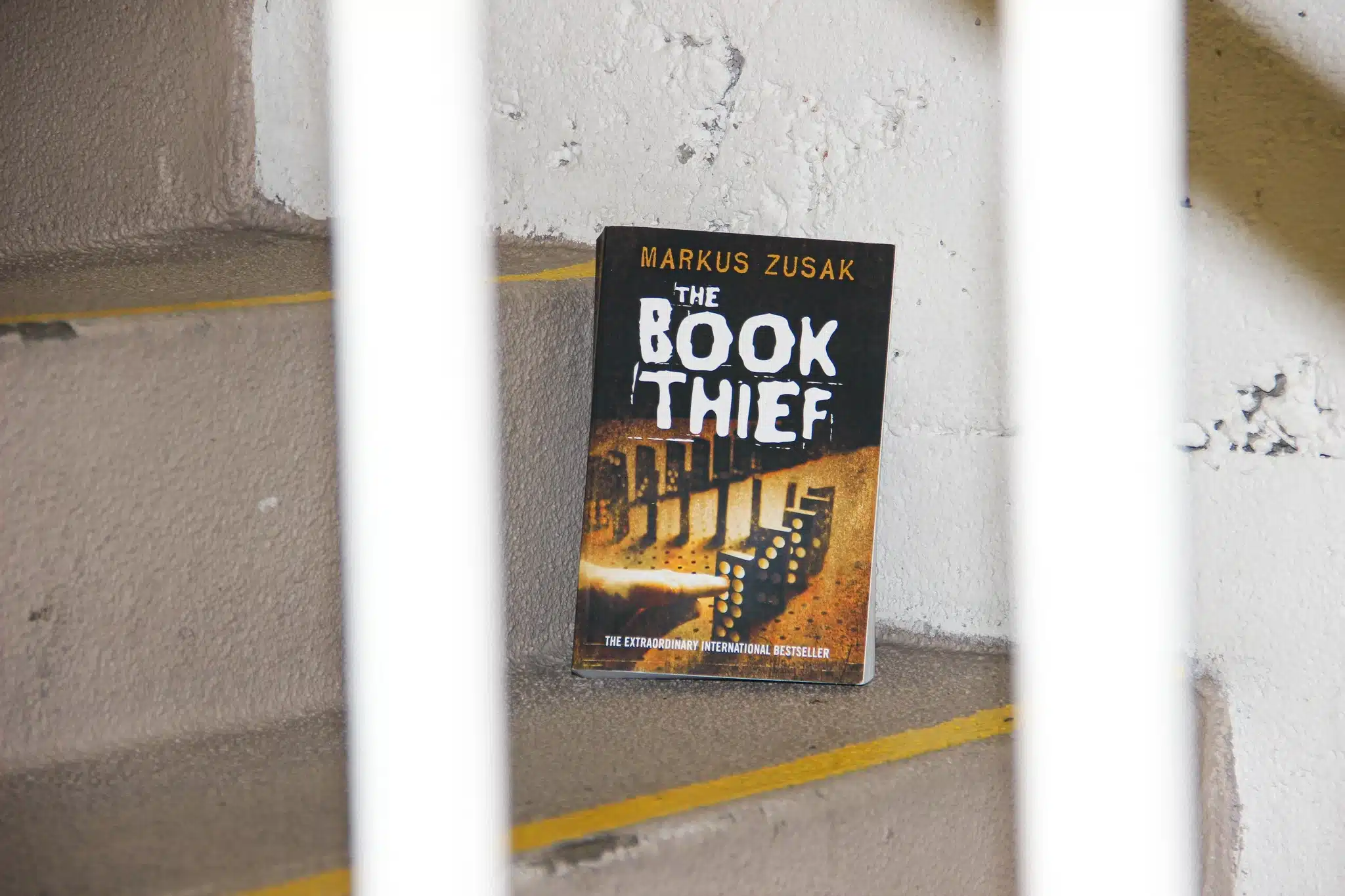
The edition I got features a finger on the verge of knocking down a winding row of dominoes. It’s a common metaphor for the deterministic march of history and a nod to a scene in the novel where Rudy, Liesel’s closest friend, has just set up a row of dominoes when conscription officers knock on the door. “He made three separate formations that led to the same tower of dominoes in the middle. Together, they would watch everything that was so carefully planned collapse, and they would all smile at the beauty of destruction.” We overhear his mother say, “Please. Not my boy.” But clearly the decision was already in motion. Then, “Rudy and his sisters each tapped a different domino and they watched them fall until the tower in the middle was brought to its knees. Kurt, his older brother, arrived in the room. ‘They look like dead bodies,’ he said.” While it’s not the only visually distinct metaphor in the novel, it makes sense they chose it for the cover.
My problem is with the general feel of the cover which definitely puts it squarely in the young adult category. Between the sepia-toned possibly computer-assisted image that hints to book buyers “This is a historical fiction,” and the choice of oversized splotchy font it’s clear they wanted it to feel at home on middle school library shelves, which pigeonholes the novel’s potential appeal to a wider audience.
The cover I feel most hits the mark features the wispy hand of death (evoking smoke rising) reaching down to interfere in the life of a small girl, portrayed simply as the “i” in “thief”. The font, clarity, and color-scheme remain simple and elegant, which appeals to adults as much as young adults.
‘The Book Thief”: Book vs. Movie
In adapting “The Book Thief” to film, director Brian Percival makes an understandable tradeoff: he prioritizes accessible charm over the novel’s grimmer philosophical weight. While Death’s narration is woven throughout the novel, with reflective and ominous interruptions, this narrator merely bookends the film, leaving the story to unfold more conventionally in between. It’s more streamlined, less unsettling. The film takes the sting out of the novel’s lingering sense of inevitability — the feeling that even joyful moments are foreshadowed by loss — once Death stops hovering over most scenes.
The film leans into a polished, sentimental aesthetic that tends to airbrush the severity of its subject matter. Molching, for example, is portrayed with snow-covered streets, warm lamplight, and storybook charm (plenty of quaint outfits and scarves akin to Harry Potter). Some critics dismissed this as outright Oscar-bait sentimentality.
But reducing the story to “Holocaust kitsch,” as New York Times reviewer Stephen Holden puts it, feels heavy handed. This take overlooks the intentional dramatic irony at the heart of the novel and the film. After all, it’s a story set in a small town where life still needs to find a way, through the eyes of a young child who still manages to have a childhood despite all odds, and whose understanding of catastrophe and grief come to her in waves as is expected for a child.
The performances in the film are equally divisive. Geoffrey Rush faithfully lends Hans Hubermann his warmth and humanity. In contrast, Rosa’s character (portrayed by Emily Watson) is reduced more to a trope, a strict, foulmouthed foil to Han’s warmth. The child actors, while strong, inevitably give the film a kitschy theater-like feeling at times, especially in their feigned German accents. In the book, readers are free to imagine more grit, contradiction, and moral ambiguity in every character. The film tends to reduce the imagination to definitive faces, voices, and clichés. But that’s partly the nature of the medium.
Ultimately, the novel proves the stronger medium for this story because it naturally lends itself to reflection and the reader’s imagination. It’s also in no hurry. Zusak’s prose allows readers to sit with contradictions, reflect on metaphors, and be stunned by Death’s emotionally distant but striking commentary. The film, by necessity and by the pressures of taste in the industry, streamlines these elements into a softer, more accessible narrative. That does not mean the adaptation was unsuccessful; it simply aims at a broader audience. Readers craving the philosophical weight and stylistic liberties of the novel will find the book more rewarding, whereas anyone seeking a wartime drama suitable for the whole family will still find the film worth an evening to watch.
Reviewer’s Personal Opinion: Not My Usual Genre But Compelling Nonetheless
Before reading “The Book Thief,” it had been a long time since I had read any fiction. My sweet spot is mostly poetry, to which I can say this book did not disappoint. As for World War II material, I did read Anne Frank and Elie Wiesel as a young man, which both particularly gripped me. Since then, from time to time I will watch history documentaries on the war and the Holocaust.
I have to say that life within small town Germany, especially among non-ostracized citizens, was a real blind spot in my vision of the period, and so this novel gave me an intriguing perspective that factual histories cannot always do justice. While I read along, I did all sorts of historical research along the way that filled in huge gaps in my understanding.
I find that the novel’s Young Adult label undermines the subtle but lasting claustrophobia of being a small child in a small town, helpless to the unfolding events. It’s hard for a privileged American like me to imagine my whole life completely enveloped and defined by a worldwide deadly conflict that could take my life. That alone makes the book worth reading. And the figurative language and death’s narration make it all the more unforgettable.
Conclusion: Greater Than the Sum of its Parts
In terms of our unique star rating philosophy at The Rauch Review, I give this book 5 stars — not because it was nearly perfect in every way — it wasn’t — nor due to my personal enjoyment, but because it is a cohesive work of art whose elements work together to create a sum greater than its parts.
While other readers may have knocked off a half a point due to a plot that sometimes wallows in episodic moments that don’t amount to anything, I would argue that this structure more accurately and compellingly captures childhood. While other readers may have knocked off half a point for “telling over showing,” I find this to be an unnecessary binary, more of a guardrail for MFA students than a dogmatic principle. “Telling” in this case, offers up unique philosophical commentary otherwise unavailable to Zusak.
Buying and Rental Options
E-Commerce Text and Audio Purchases
E-Commerce Audio Only
Physical Location Purchase and Rental Options
You can buy “The Book Thief” from many major stores such as Barnes and Noble, Target and independent bookshops. You can also rent the book from your public library.