
As an Amazon Associate, we earn from qualifying purchases.
TLDR
“The Five People You Meet In Heaven” by Mitch Albom follows an amusement park maintenance worker as he crosses to the afterlife. He encounters five people whom he also met in life, learning from them about his impact. The book is a leisurely musing on the decisions we make, how those choices impact others and the meaning we can find in everyday life.
“The Five People You Meet In Heaven” is a novel primarily set in the afterlife. Eddie, an amusement park maintenance worker, crosses over attempting to save a young girl from a falling fairground car. What happens next is fairly typical of the genre. We follow Eddie through the afterlife as he meets with five different people he crossed paths with during his lifetime.
Novels such as Alice Sebold’s “The Lovely Bones” cover similar grounds. But where Sebold’s novel encourages a sense of deep loss and anxiety through the murdered girl’s wish to help her family discover the identity of her murderer, “The Five People You Meet In Heaven” takes a more leisurely pace through its protagonist’s afterlife.
What is different about Eddie’s story is that he is a particularly ordinary everyman. Unlike some stories within the setting of the afterlife, or heaven, we don’t get the sense of justice or reckoning. Eddie isn’t necessarily being judged for his good or bad deeds. The people he meets are just there to show him how he impacted their lives.
The setting of “The Five People You Meet In Heaven” is also different from some within the genre. Although the afterlife setting would indicate the novel as speculative, the action is placed more generally in the real world. The people with whom Eddie converses throughout are placed mostly within settings in which Eddie would have originally encountered them.
The biggest strength of Eddie’s journey is that he is a likeable kind of person. Readers can resonate with his weaknesses and occasional bad decisions.
However, some readers may find the story a little too saccharine. The conversations Eddie has with the people from his past sometimes veer into the sentimental. Readers looking for some kind of religious understanding of heaven will also perhaps be disappointed.
Overall, the book would appeal to the general reader who wants to read an emotionally charged story that leaves them feeling uplifted and hopeful. It explores a fictional, imagined afterlife in order to examine philosophical questions about the meaning of one ordinary man’s life.
‘The Five People You Meet in Heaven’ Summary: An Afterlife With Some Unexpected Strangers
“The Five People You Meet in Heaven” tells the story of the sudden death of an 83-year-old man named Eddie, an amusement park maintenance worker, and what happens as he passes into the afterlife.
Eddie dies suddenly after attempting to save the life of a young girl from a falling amusement park ride. The accident is caused by a key getting stuck in the machinery, which Eddie realizes just in time to see the cars crash down toward a young girl. Finding himself crossing into the afterlife, he meets five people who had a significant impact on him whilst he was alive and who explain the meaning of his life to him. He also asks each one of these people whether he managed to save the little girl or not.
Rather than simply the members of his family or friends, however, the people Eddie meets are a peculiar bunch. He initially struggles to see how they could be the most important people for him to be connected with in heaven. But as he continues on his way into the afterlife, he comes to realise that there are no random events in life. He begins to see that these people have affected his life, as he has impacted on theirs.
The five people include a former amusement park worker known as the “Blue Man,” and his former Captain in the army where they were forced to work in a prisoner of war labor camp. He is re-united with his wife, Marguerite. He also meets the woman for whom the amusement park is named. But it is the fifth and final person that Eddie meets in heaven who causes the greatest heartbreak.
The book is a meditation on what it means to live a full life and the impressions and effects we have on the other people we meet.
Editorial Note: Read our list of best books about the afterlife.
At The Rauch Review, we care deeply about being transparent and earning your trust. These articles explain why and how we created our unique methodology for reviewing books and other storytelling mediums.
Audience and Genre: Realist Fiction with Speculative Elements
“The Five People You Meet In Heaven” works across genres and would appeal to a wide-range of readers. Though it explores the afterlife of an elderly American man, the themes it relates to are universal. All of us interact with others throughout our life. We all have an impact on one another. At some point, everyone dies.
The premise of this book sets one example of what ‘heaven’ might be like. But it isn’t about religion or beliefs or some esoteric idea of what heaven might be. It is far more about the impact our actions have on those around us as we move through life.
Insofar as the book reflects on the afterlife and is mostly based within it, it might be considered a speculative fiction or literary/high fantasy title. However the mode in which it is written is as a general fiction title. Though we see Eddie as he moves into the afterlife and meets the people he has interacted with during his life, this is written in a way that makes the story feel relatable and realistic.
Perspective: Eddie’s Experience is Key
The story is told from a third-person omniscient perspective. The action mostly follows Eddie as he moves through the day of the accident that takes his life, through to his experiences in the afterlife.
However, brief scenes feature the people left behind at the amusement park in the aftermath of Eddie’s death, mostly Eddie’s co-worker, Dominguez. The choice by the author to keep most of the action through the experience of Eddie is a good one. The small interludes following the aftermath of Eddie’s death appear just as links to show how life goes on without him. It is only Dominguez who really appears affected by the old man’s death, as Eddie had no family left.
Three Cs: Compelling, Clear, Concise
Editorial Note: We believe these three factors are important for evaluating general writing quality across every aspect of the book. Before you get into further analysis, here’s a quick breakdown to clarify how we’re using these words:
- Compelling: Does the author consistently write in a way that would make most readers emotionally invested in the book’s content?
- Clear: Are most sentences and parts of the book easy enough to read and understand?
- Concise: Are there sections or many sentences that could be cut? Does the book have pacing problems?
Compelling: Readers Will Care Deeply About Eddie
Mitch Albom’s book sets out an endearing story of one ordinary man’s life. Readers can’t fail to wish for Eddie to find some sense of peace after death. As a main character, Eddie appears as a working-class old man who has lived through some difficult times and experiences. His love for his late wife and her early death is heartbreaking. The way Albom portrays Eddie is to underline the very ordinariness of his life story, making him appeal to an everyman mentality. Readers will feel invested in Eddie’s exploration of the afterlife and wonder at who or why these particular people have been sent to guide him. Eddie’s meeting with his old army Captain is particularly emotional, and Albom writes the horrors of war especially well.
Clear: The Storytelling is Clear and Fast-Paced
The book is written in a clear fashion. Albom uses short interludes between the sections, which are ‘The First Person Eddie Meets In Heaven’ and so on, in which to interject Eddie’s birthdays throughout the years. These sections help to build a picture of Eddie’s life growing up, his relationship with his father, which is difficult, and his marriage. The interludes also help to fill in the blanks of Eddie’s life, such as the fact that he and his wife couldn’t have children together.
Although the book is set mostly in the afterlife, it is surprisingly easy to follow. Albom writes in a realist fashion, despite the setting. The plot of the book is quite simple to understand: Eddie must meet with the five people who have had the greatest impact on his life, before resting in peace in heaven. Albom also creates tension in Eddie’s repeated questioning of whether he managed to save the little girl in the amusement park. This uncertainty gives the impression to the reader that because Eddie is overwhelmingly disappointed in his life, he feels that if he has saved the little girl, then his death has not also been in vain.
Concise: The Story Unfolds Well
“The Five People You Meet In Heaven” is just the right length of story for the plot and experience of Eddie’s life to be explored and resolved. The style of setting out the sections by opening with “The First Person”…. Worked well for the book. It gave a clear introduction to what was coming up next in the story. The interludes with a couple of pages of details of Eddie’s birthdays past also worked well to link together the turning points in his life.
It didn’t feel that Albom wasted words, and neither did the book contain overwritten sentences. The ending provides for a resolution to Eddie’s journey through the afterlife and is as “good” as an ending can be where the central protagonist is already dead.
Character Development: Empathetic Characters
Eddie does not feel “unique.” He is not an unusual kind of character. However, he is very likeable. His very ordinariness is what draws a reader to him, in fact. He reflects the lives of many such working-class men who lived during the 20th century. He fought in wars, fell in love, and faced many disappointments.
Sadly, Eddie sees his life as being one of thwarted ambitions. He doesn’t feel he achieved very much and is disappointed that he remained working in the amusement part his whole life. However as readers, we recognize how his simple acts of kindness and hard-working sensibilities have contributed to the lives of others.
The author’s use of very short flashbacks was a useful way to develop empathy for the character of Eddie. In this way, we see the decisions he makes throughout his life, both good and bad.
The supporting characters around Eddie are not as well developed. Though, realistically, this is Eddie’s story. We see enough of his dead wife, Marguerite, in the flashbacks to recognize her as a sympathetic character. Mitch Albom got the idea for the book from the life of his deceased uncle who was also a grizzled World War II veteran. Perhaps this explains his skill at rendering such a believable, likeable old man for his main character.
Story: Engaging, Heartbreaking, Realistic
Eddie’s exploration of the afterlife provides an engaging look at the ways in which the people we meet affect our lives. Some scenes are heartbreaking, particularly when referencing the experiences of war. “The Five People We Meet In Heaven” shows the reality of a life lived by many men during the 20th century. The horrors of war and the ways this affected the behavior and mental health of soldiers is particularly powerful.
The book feels unique in tone and perspective, though the life of Eddie feels universal. The ending will be satisfying to most readers, although some who are looking for a more religious version of heaven may be disappointed.
Prose Style: Typical of Literary and Realistic Fiction
Although there are elements of speculative fiction within “The Five People You Meet In Heaven,” the book falls more in a general, literary or realistic fiction genre. The writing style is pretty typical of a plotty general fiction title.
Albom manages to show us the life of Eddie and the difficulties and traumas he has faced, without telling. It is easy to read between the lines and see the sad truth behind many of his decisions and the outcomes of his choices. He also appears as a man of his time.
Setting: Unique Setting That Felt Strangely Real
The author does not describe the setting of heaven in any particular detail. This scope actually made the reader forget that the book was based outside of the realm of reality. The backdrops to heaven represent the places where Eddie lived or where the characters encountered him. So the Captain features in the Philippines where the prisoner of war camp was, for example. The characters also appear at the age they were when either they knew Eddie, or when their story is based.
The story of “The Five People You Meet In Heaven” contains very little in the way of details around setting and far more dialogue. As ‘heaven’ obviously means different things to different people, Albom had represented it as such. Eddie’s late wife, Marguerite, features as a young woman perpetually attending weddings because, as she tells Eddie, this was what she wished for.
This scenery allowed for a separation between the religious beliefs around heaven and the fictional place created by the author. The idea is similar to Alice Sebold’s narrative technique in “The Lovely Bones,” which features a young murdered teenager and her idea of the perfect ‘heaven.’
Rhetoric: Everything In Life Has An Impact
“The Five People You Meet In Heaven” is not a highly suggestive book on the idea of heaven or the afterlife. The author does not explore the idea of judgement or forgiveness in any heavy way in this book. Instead Albom allows for an unfolding of the life of one ordinary old man and the ways in which both he and the people he has met have impacted one another’s lives. The story does not attempt to moralize or suggest that there are good or bad people. Instead it explores the decisions made and enacted throughout the entirety of a life.
The author does not appear to wish to engage in any debate about religious beliefs or the need to be one kind of person. He does show, however, that everything we do and everyone we meet can have a significant impact on us and vice versa.
Critiquing the Critics: Not Much Criticism of This Book
Consumer reviews of “The Five People You Meet In Heaven” are overwhelmingly positive. Many readers describe finding the book “comforting” as well as “thought-provoking.” Reviewers tend to see the book as providing profound lessons on life and death. Many readers find Eddie human and likeable. The book appears to have appealed to both readers and critics alike, spending 95 weeks on The New York Times bestseller list.
Book Aesthetic: Doesn’t Fit the Content Well
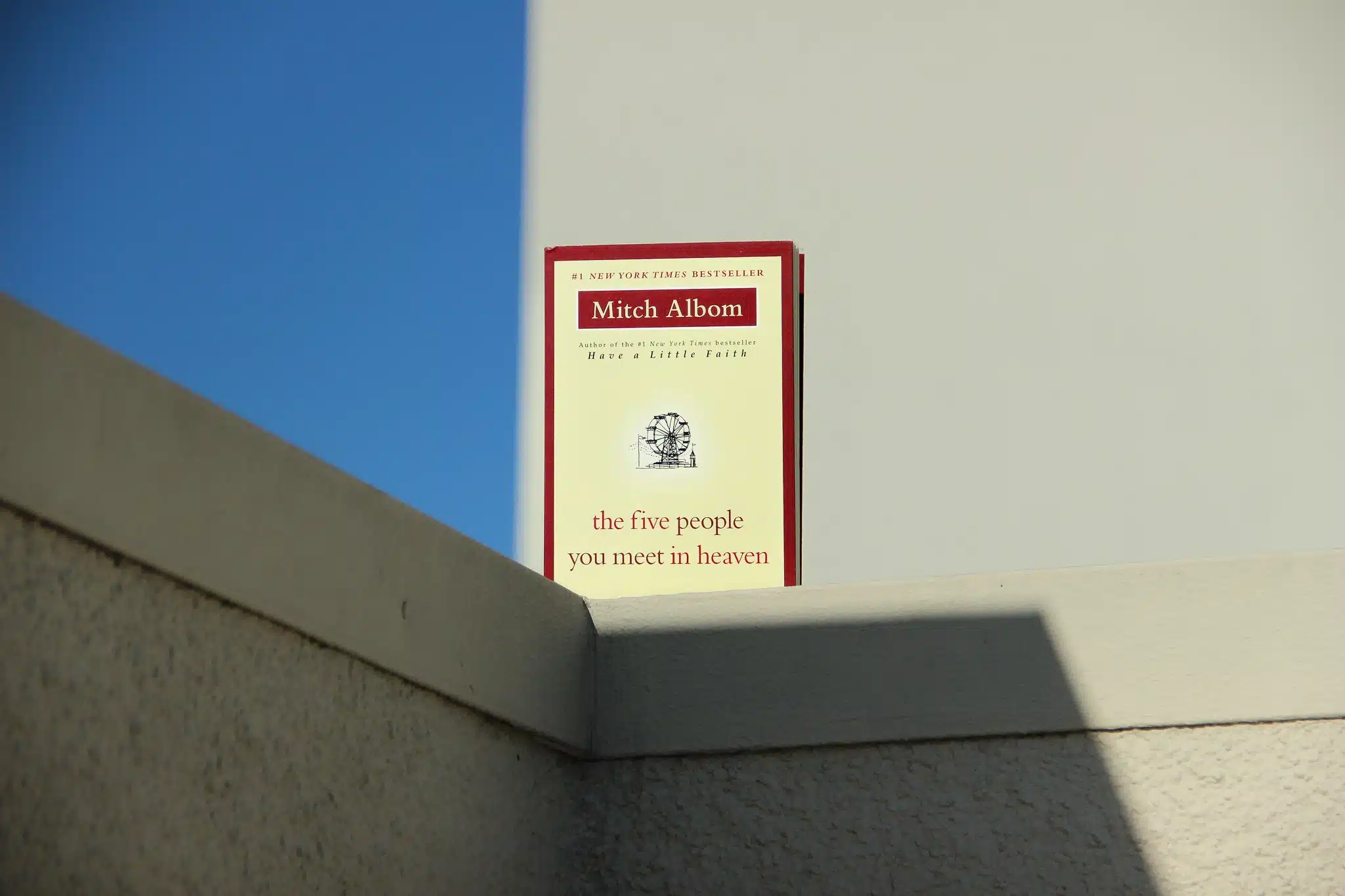
The book’s cover features a silhouette of a ferris wheel set against a dark blue background. It contains the title of the book and the name of the author, as well as the title of another bestselling book by Mitch Albom, “Tuesdays With Morrie.”
Having read the book, it is clear that the amusement park at the centre is key to the story. Nonetheless, the cover doesn’t give a good idea of what the book is about. It is a story mostly set in the afterlife, and this fact is not represented here. Although the very title of the book would likely indicate something closer to the themes of the story, the lettering suggests a book more akin to the self-help genre.
‘The Five People You Meet In Heaven’: Book vs. Movie
A 2004 made-for-TV movie was adapted for the small screen by Hallmark Entertainment. It stars Jon Voight in the role of Eddie and was directed by Lloyd Kramer. Though the movie was found to be heartwarming by some viewers, it received somewhat mixed reviews, with some critics citing it as slow-paced.
Reviewer’s Personal Opinion: A Heartwarming, Life-Affirming Read
Although I do not hold religious beliefs or ideas around an afterlife, I found myself captivated by “The Five People You Meet In Heaven.” Mitch Albom creates the story of an everyman that felt real. I could imagine him being a member of my family. For this reason, his experiences in the afterlife were emotional to read. I particularly found the experiences of Eddie and his Captain during the war — as well as his marriage to Marguerite — relatable to older family members.
There was a real clarity for me when reading about the decisions and experiences of wartime and the ways in which these can reverberate through the years within a family. I recognized my grandparents in Eddie and Marguerite, and the way WWII affected their marriage and future lives. For this reason, perhaps, I warmed to Eddie. Despite his knack for pessimism and sometimes dubious choices, he felt likeable. His honesty and dedication to his beliefs were heartwarming.
Unusually, there are not any dislikable characters in “The Five People You Meet In Heaven.” Although, as stated previously, much of the focus is on Eddie and his movement through heaven.
One very brief, lowkey scene that I found particularly emotional was when Dominguez is required to accompany an agent around the former apartment occupied by Eddie throughout his married and widowed life. We know from previous exposition that Eddie and Marguerite moved there to be in the same building as his mother after his father died. After he lost his wife, Eddie never moved on.
Through Dominguez’s eyes, we see a neat and simple home in which Eddie has a permanent view of the amusement park. Through the agent’s eyes, however, the omniscient narrator relates the man’s contempt for what he sees as the pitiful life of the apartment’s former resident. This attitude from the agent resonated deeply in the ways in which outsiders may see a person’s life as small. In contrast, we have learned throughout the rest of the narrative about the ways in which Eddie has impacted others, and we agree it is something to celebrate.
‘The Five People You Meet in Heaven’: A Life-Affirming, Emotional Journey Into The Afterlife
I believe that “The Five People You Meet In Heaven” works as a book of general fiction. It also contains elements of speculative fiction. It is a heartwarming and emotionally charged story with wholly likeable characters. Albom creates a structure which moves at a fairly fast-pace whilst providing a thought-provoking look at how we impact the people we meet throughout our lives.
I have awarded “The Five People You Meet In Heaven” five stars because I believe it just works as a feel-good, thought-provoking novel about the meaning of life. As someone without a religious idea of heaven, I enjoyed the way in which Albom presented his version. I found his interpretation of heaven as something that would be comforting to believe in.
Buying and Rental Options
Online copies of the book are available on:
The book is also available in many physical stories, mostly of major retailers such as Waterstones and Barnes and Noble and is usually found on the general fiction shelves. The book can also be found in most physical library collections in both the U.S. and the U.K. as well as on the Libby library app. It is unlikely that consumers will need to wait too long for this title as it has wide availability.
Audio versions:
Books Like ‘The Five People You Meet In Heaven’
‘Teach Me How To Die’ by Joseph Rauch
Joseph Rauch’s “Teach Me How To Die” contains similar themes as “The Five People You Meet In Heaven” and is similarly a realistically delivered story told in a speculative fiction setting.
Walter Klein is a man dying of terminal cancer, for which he has chosen no treatment. A widower who adored his wife, he courts the idea of finally dying and putting an end to his misery. Though he has contemplated suicide, he does not wish to cause suffering to the people in his life after his death. When he does die, he finds himself crossed over to the afterlife where he meets with Vincent, his guide through the next process.
Similar to Eddie, Walter is a man who has lived a fairly uneventful life. He has experienced difficulties, mostly through his estranged relationship with his mother and an unfortunate incident with his mother’s former boyfriend. Walter also shares similarities to Eddie in his love for his wife, who has died.
Similar to “The Five People You Meet In Heaven,” through the themes of memory, we explore key scenes from Klein’s life as he waits for judgement. “Teach Me How To Die,” however, more fully explores ideas around religion, choice and judgement. It also leans more toward the speculative element in its portrayal of a whole system within the afterlife, with more in depth details of the hierarchy of levels to achieving peace after death.