
As an Amazon Associate, we earn from qualifying purchases.
TLDR
Emily Brontë’s “Wuthering Heights” shocked critics and readers upon its release. For modern audiences, it continues to spark heated debates, especially when considering film adaptations that take liberties with the plot and ultimately alter the story.
“Wuthering Heights” is a multi-layered novel written in 1847 by a 27-year-old reclusive member of the famous Yorkshire family, the Brontës. Living on the isolated Yorkshire Moors, where the novel itself is set, Emily Brontë created a dark, multigenerational Gothic tale of violence, depravity and what happens when love turns toxic.
Brontë’s original novel has seen a huge surge in interest due to the release of Emerald Fennell’s 2026 movie adaptation. The film was released in cinemas on Valentine’s Day, highlighting the romance element often seen in screen adaptations of the book. As is to be expected, Fennell’s changes to the plot and characters have been divisive for die-hard fans of the novel. As I set out below, there is a case for both to be appreciated as standalone pieces of art.
Whilst modern cinema-goers may fall into the romance of the story, a reading of Brontë’s novel is still a worthwhile endeavour. To fully appreciate the continued interest and divisive opinions that this classic novel elicits, we must consider the original text as Brontë intended it. The book contains a powerful consideration of the result of childhood trauma, abuse, alcoholism, the consequences of a society bound by class and ideas of foreignness.
‘Wuthering Heights’ Summary: Emily Brontë’s Genre-Defying Novel
The story is told initially from the perspective of a newcomer, Mr. Lockwood, who is renting Thrushcross Grange, one of the two homes featured in the novel. Lockwood visits the other home in the novel, Wuthering Heights, to introduce himself to his landlord, Mr. Heathcliff. The narration then switches to the main house servant, Nelly Dean, where she begins to tell Lockwood the story of the depravity that has befallen the two families.
The story that unfolds tells of a young male orphan, or ‘foundling,’ known only as ‘Heathcliff.’ The original owner of Wuthering Heights, Mr. Earnshaw, brings the boy to live with himself and his two children, Catherine (Cathy) and Hindley. Nelly has always been a part of the household since she was a young girl, and continues to take care of Cathy throughout her life. There is also a God-fearing servant named Joseph.
Heathcliff was discovered starving on the streets of Liverpool. His exact country of origin is never revealed, but he is often seen to be of African or Romani descent. Though Cathy loves Heathcliff almost from the start, accepting him into the household, her brother Hindley feels jealousy at his arrival. When Mr. Earnshaw dies, Hindley treats Heathcliff like a servant, using violence and bullying tactics against him.
What follows, through Nelly’s narration, is a story of an obsessive love between Heathcliff and Cathy. Cathy later decides to marry the son of the family at nearby Thrushcross Grange, Edgar Linton. Whilst he is caring and wealthy, she does not share the same passion with Linton as she does with Heathcliff. Heathcliff, heartbroken, leaves the Earnshaws for several years. When he returns, he is a wealthy gentleman in his own right. Finding that Cathy still holds an affection for him, their passion reignites. Heathcliff then sets about wreaking revenge on all of the people who have wronged him.
Books Like ‘Wuthering Heights:’ Gothic Romance and Domestic Novels
Many titles may appeal to readers of “Wuthering Heights,” particularly Victorian domestic novels such as those of the other Brontë sisters. Charlotte Brontë’s “Jane Eyre” contains similar Gothic elements to “Wuthering Heights,” as well as a central, dominating male figure. The subverted ideals of the Victorian home also similarly feature in this novel. Anne Brontë’s novel, “The Tenant of Wildfell Hall,” features the depravity and abuse caused by alcoholism.
At The Rauch Review, we care deeply about being transparent and earning your trust. These articles explain why and how we created our unique methodology for reviewing books and other storytelling mediums.
Audience and Genre: Fans of Classic English Literature and Gothic Novels
Although “Wuthering Heights” is most commonly described in the Gothic Romance genre, it is unarguably a genre-defying novel. It features quintessentially Gothic elements, such as a dark and foreboding setting and supernatural elements, as well as the typified Byronic hero. The romance through Cathy and Heathcliff’s enduring passion, which continues after death, is something many readers take away from the book (often due to cinematic representations).
But what some call ‘romance’ is actually a deeply toxic obsession. It is also a part domestic/realist narrative, examining Victorian societal norms. Brontë questions class, imperialism and property inheritance through her portrayal of Heathcliff’s ‘foreignness.’
Perspective: First-Person Narration Storytelling
Unusually, the book opens from the first-person perspective of Lockwood, newly arrived in the area and visiting the home of his landlord, Heathcliff. He meets Nelly Dean, a servant who has been with the family since she was a young girl. She then takes over the narration, effectively telling the story of the family over a 30-year period.
Whilst this narrative choice sounds a little confusing, it is easy to forget that the narrative voice changes. The story unfolds continuously between the two characters. Nelly Dean appears to have been a good choice to tell the story of the two families involved because she is an eye witness to the history but separated by class and role.
Three Cs: Compelling, Clear, Concise
Compelling: An Investment of the Doomed Lovers
The story of “Wuthering Heights” centers around the doomed passion of Cathy and Heathcliff. Many readers may find it difficult to care for either of them in the second half of the book. Cathy is often selfish and headstrong. Heathcliff is increasingly violent and vengeful.
Arriving as a foundling and then being badly treated after the death of Mr. Earnshaw, it is easy to find sympathy with Heathcliff initially. Again, when he discovers that Cathy has married someone else, he could be empathized with. However, Brontë’s decision to show the violent and depraved behavior he exhibits as the book continues makes this sympathy increasingly difficult.
In the final section of the book, redemption comes with the younger generation, Cathy’s daughter (also Cathy) and Hareton Earnshaw, the son of Hindley Earnshaw. Both characters can be seen to break the cycle of violence and toxicity at the end of the novel.
Clear: Confusing to Read Because of Name Reuseage
Even bearing in mind the classic nature of the language used within the novel, Brontë’s text has been criticized for the complexity she perhaps unnecessarily brings to the characterizations.
The original version of “Wuthering Heights” contained the book in two volumes. In the first Volume of the novel, which runs from chapter 1 to 14, the book features the first generation of the Earnshaws and the Lintons. Volume II begins again at chapter 1 to 20 and features the second generation of the families and Heathcliff’s revenge plot. This structure is how the story appears in the Oxford World’s Classics edition from which this review is written. Some versions of the book have dispensed with the original volume structure and run as a continuous story in chapters.
In the second volume, where the younger generation of the two families begin to mix, Brontë chose to name the children of the two families with the same or similar names. Cathy’s daughter is Cathy, Hindley’s son is Hareton, Heathcliff and Isabella Linton’s son is named Linton…and so on. This name reuse becomes very confusing for the reader. It can be useful to have at hand a family tree setting out the characters. Some editions, including the Oxford World’s Classics, contain the family tree at the start of the novel.
Whilst the plot itself is not particularly difficult to follow, some readers may find the relentlessly bleak and violent nature of the story to be difficult to read.
Concise: Not Too Long, Could be Condensed
In many film versions (see below) directors have chosen to shorten the book to the first central storyline of the obsessive love between Cathy and Heathcliff. Volume II, however, follows the full unfolding of Heathcliff’s revenge plot and introduces the multi-generational element. Many fans of the novel see these arcs as essential parts of Brontë’s story. The juxtaposition of the two story arcs shows the redemption through the younger generation and ultimately a happier ending for them than their older counterparts.
However, it is also this second part that causes perhaps the most confusion. As mentioned, the similar names used for the characters becomes cumbersome at times. It can also make for a difficult read in terms of content. The violence and abuse of the younger characters within volume II can cause distress for some readers. This upsetting content is particularly visible when readers come to the book from a screen version and begin to realize that this is not a typical Gothic romance novel.
For this reason, there could be a valid argument that the second generation storyline of the book could have been cut. This view is certainly how most screen adaptations have taken the story.
However, there are positives to the choice of including the revenge storyline in volume II. Whilst the first half unfolds the obsessional love element of the novel, the second half provides redemption and a hopeful new beginning. It also shows that violence, jealousy and hatred can be overcome in the next generation.
Although the book is considered a classic piece of English literature, the language and plot are not specifically difficult to read — other than similarities with character names mentioned above. It is also not that long at less than three-hundred pages.
Character Development: Characters Evolve Due to Circumstance
The book contains perhaps too many characters for some readers. As previously stated, the first and second generation of characters cause confusion due to their similar names.
There are interesting differences and nuances, as well as a sense of circularity between the first and second generation. Cathy and Heathcliff are the central characters of interest, and therefore the most developed. The book shows them from young children to adults. They retain a closeness, an obsessive kind of love for one another. This obsession causes jealousy and eventually cruelty to other characters on the part of Heathcliff.
“He’s more myself than I am. Whatever our souls are made of, his and mine are the same.” – Cathy, “Wuthering Heights.”
The periphery characters are perhaps less developed, providing more of a background for Cathy and Heathcliffe’s toxic love story. This cast includes the second generation characters. Nelly is perhaps one of the most enduring characters in the story. Because she stays with the family throughout, she doesn’t particularly develop into a woman in her own right.
Story: A Fascinating Portrayal of Obsessive Love and Revenge
The story covers just over a 30-year period. It begins at the end, when the second generation of Earnshaws and Lintons live at Wuthering Heights. However, in Nelly’s story, she takes the newcomer Lockwood back to the beginning when Cathy and Heathcliff were children.
The book is a unique perspective of toxic love. This novel subverts the genre of the period. Brontë’s depiction of sadistic violence and degradation through the character of Heathcliff was criticized on publication.
Surprisingly for such a dark novel, the ending of the book contains hope in the form of the new generation, free of their parents’ abuse and not destined to follow similar paths. This positive conclusion works well to round out the difficult parts of the book and likely went some way to making it a popular classic.
Prose Style: Surprisingly Easy to Digest
Despite “Wuthering Heights” being a classic book, the prose moves along at quite a jaunty pace. It uses colloquialisms relevant to its time and setting (Yorkshire), especially through the character of Joseph, an elderly servant at the Heights. This dialectical choice makes these sections cumbersome to read, at times. But it does not form the largest part of the book.
The prose style is typical of a realist novel written during the 19th century. As was common in such novels, pathetic fallacy is used, particularly in reference to the surrounding landscape. “Wuthering Heights” itself is a reference to the ‘wuthering’ of the wind around the Yorkshire Moors.
Dialogue: Mostly Clear But Contains Some Old Dialect
Mostly the dialogue flows quite naturally and moves the story along sufficiently. However, as mentioned, the strong Yorkshire dialect used by the character of Joseph can make heavy work of the reading at times. He often mumbles, and would likely have been a realistic character recognized by Victorian readers. For modern audiences, less so. As Nelly is telling the story, the book contains quite a lot of dialogue, and this element adds to the ease of moving the story forward.
Setting: Draws on the Natural Landscape
The setting of “Wuthering Heights” is perhaps one of the most famous aspects of the novel. Situated between two houses around five miles apart from one another in the middle of the desolate Yorkshire Moors. This was a setting familiar to the author, as she lived there herself, in an isolated parsonage whilst writing the book.
The novel brings the natural landscape of the Moors into the narrative, with Cathy and Heathcliff running wild on the isolated cliffs and moorland as children. Later, it is the site of their romantic meetings, and later still, the haunted place where Heathcliff believes he hears the ghostly Cathy calling to him.
Other than the beautiful but foreboding Moors, the interior of the two homes at the centre of the novel are given full descriptions. The contrast between the two is stark, with the old farmhouse at Wuthering Heights appearing run-down, cold and isolated. Thrushcross Grange, the home of the Linton’s, in opposition is comfortable and grand. The houses represent the differences between the fortunes of the households, as well as the wildness and gentility of the people who inhabit them.
Rhetoric: Class, Poverty and Foreignness
Connections to class have been pointed out through criticism of the novel. Brontë would likely have been aware of issues around colonization. Heathcliff represents the ‘foreign’ element when he arrives at the Heights. He is unkempt and rough. His provenance is never fully explained, though he is thought to be of foreign origin. Despite Cathy loving him all her life, she explains to Nelly that she must marry Edgar Linton when he proposes. She feels that to marry Heathcliff would be degrading to her. He is not a man of means. This class difference will cause embarrassment for her.
“It would degrade me to marry Heathcliff now; so he shall never know how I love him: and that, not because he’s handsome, but because he’s more myself than I am.” Cathy, “Wuthering Heights.”
The Linton’s, in opposition, represent wealth and indulgence. The two children, Edgar and Isabella, fight over such frivolous things as who gets to play with their fluffy pet dog.
It is unclear through Brontë’s portrayal of Heathcliff’s descent into abuse and violence whether she wishes to show the result of the abuse he suffers as a child, or whether she is pointing out that it is his very foreignness that causes him to behave in a depraved way when he is wronged by others.
Cultural and Political Significance: A Resurgence Due to the Movie
The book has seen a huge resurgence recently due to the release of a new adaptation. It also appears that there has been something of a renaissance of late in the reading of classic books. An internet interest in so-called ‘slow reads’ of classic books has been encouraged as an antidote to short-form content and distractions of the modern era. It appears that there is a real thirst for connection and meaning from longer classic texts at the moment.
Critiquing the Critics: A Divisive Novel
“Wuthering Heights” has long divided critics. Hailed as a genius work of art by many, it is also sometimes seen as relentingly bleak. Many come to it from seeing movie versions, and are then disappointed to find it is a book of violent revenge. Some die-hard fans welcome its complex characters and haunting atmosphere. Whereas some readers find the story bleak and the narration being given by Nelly as a wasted opportunity for suspense.
Whilst literary critics of the era had strong but mixed ideas about the novel, often based on the darkness of the subject matter, there has remained one constant: the book has always elicited strong feelings. Though often divisive, they are rarely neutral.
Book Aesthetic: Landscape is Key
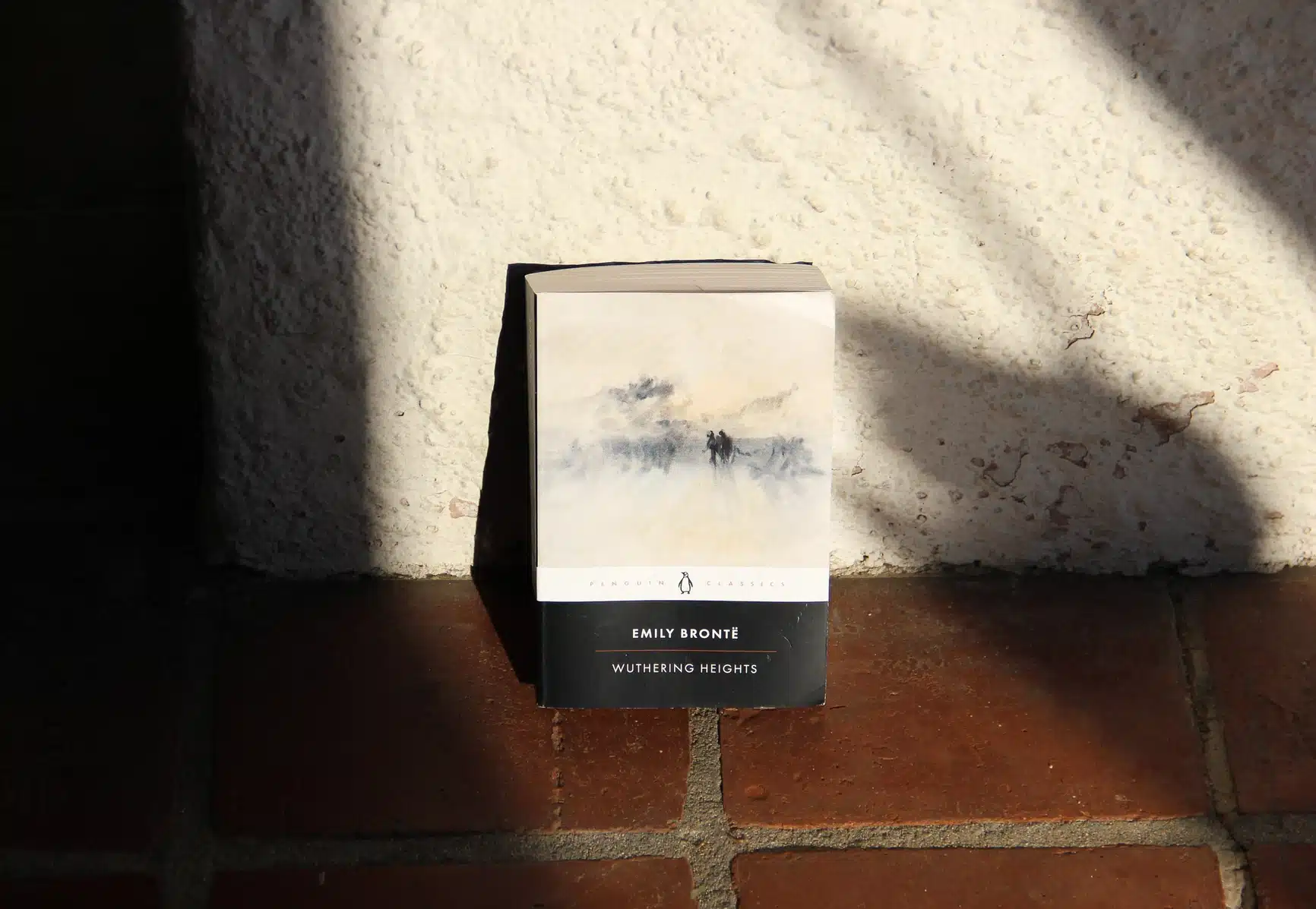
Although there are many book versions of “Wuthering Heights,” many of these feature a picture of the desolation of the Yorkshire Moors and the situation of the house of the title. The Oxford World’s Classics edition from which this review was taken features a bare and wind-blown tree and moorland grasses in black and white. The dark clouds add a sense of foreboding and there is the hint of a remote building in the distance. This cover illustration hints at the darkness of the text and points towards the Gothic genre. Other editions have chosen to feature stills from the movies of the book, with Cathy and Heathcliff embracing. These point towards the romantic register of the book with which more readers may feel an affinity.
‘Wuthering Heights’: Book vs. Movie
There have been at least eight movie versions of “Wuthering Heights,” most of which have focused on the romantic entanglement of Cathy and Heathcliff. Perhaps the most famous until recently has been the 1939 version starring Merle Oberon and Laurence Olivier as the doomed lovers. This early version downplayed the violence of the novel and subsequently fed into the belief that the book was merely a romance novel.
Viewers have often been critical of Hollywood’s decision to cut the second half of the book, featuring the next generation of the Earnshaw and Linton family. Only the 1992 version, starring Juliet Binoche and Ralph Fiennes covers the entirety of the book and has been seen as a truer representation to the novel.
Much has been made of the 2026 version by Emerald Fennell. The controversy and divided opinions on this cinematic feast has been wild. In titling the story “Wuthering Heights” (in speech marks, thus indicating a nod toward the deviation from the original), Fennell has recreated an artistic version of a classic. This strategy was risky, with so many die-hard fans of the book. She has also cut out many of the original characters.
Fennell’s admission that she wished to create a version that signified her love for the book as a teenager goes some way toward understanding her directorial choices. As with most other versions, she cuts the action with Cathy’s death, eliminating the second generation entirely. This choice appears to have been a contentious point for some critics and audience viewers.
However, it is difficult to see how she could have kept this part into the movie without making Heathcliff, played by Jacob Elordi, a sadistic and abusive male lead. She also faced criticism due to featuring a blonde, Australian Margot Robbie in the part of the dark and wild Cathy Earnshaw, and a distinctly white actor as Heathcliff.
Fennell has made a sumptuous and cinematic feast of opulence and ultimately, destruction. Where the book has been portrayed as a romance by earlier screenwriters and directors, Fennell shows her doomed lovers for the dark and destructive people they are. Though they are in love, she shows their downfall in terms of their own choices and their bad treatment of others.
The central characterization of Cathy’s self-centred, precocious nature comes through. As does the cruelty to which both Cathy and Heathcliff will stoop to continue the toxic cycle. The film is also a highly sexualized version of the book.
Reviewer’s Personal Opinion: An Original and Rewarding Read
I first came to this book as a teenager many years ago, returning as a mature student, and finally again for this review. My opinions and feelings around the text, themes and characters of the novel have changed with each reread. This growth is something I feel has only enriched my opinion of the book.
Whilst as a youthful teenager, Cathy and Heathcliff’s doomed love felt tragic and romantic. From an adult’s viewpoint, they appear selfish and abusive. Cathy is contemptuous of anyone else’s feelings and wishes to both marry for money and keep Heathcliff as a kind of ‘pet.’ Heathcliff abuses anyone who gets in his way in an effort to wreak revenge on Cathy’s desertion in marrying Edgar Linton. His abuse of the young and innocent Isabella Linton is sickening, as is his treatment of the second-generation Cathy and Hindley’s son, Hareton. Both are kept as servants and physically and emotionally abused. It is difficult from this perspective to see how the book has remained a popular favourite.
But the dark depravity speaks to me as a groundbreaking novel marking a watershed in Victorian literature that continues into the current day. The fact that readers and students continue to debate the book and that such controversy and anger is raised when a new movie version appears is testament to Emily Brontë’s powers as a storyteller. What she created in her single published novel at the age of 28 is quite simply a masterpiece. To inspire so many alternative versions and to give us two characters who signify doomed, obsessive love to rival that of Shakespeare’s “Romeo and Juliet” is something quite extraordinary. Cathy and Heathcliff will continue to remain in the literary and cultural zeitgeist, as Emerald Fennell’s recent, divisive movie has proven.
For new readers approaching the book following the movie: beware. The contents are quite shocking. That a young woman from an isolated corner of the Yorkshire Moors could envisage such a story is astonishing.
‘Wuthering Heights’: A Watershed Novel That Is Not For the Faint of Heart
I clearly enjoyed a return to this novel, though ‘enjoyed’ is perhaps the wrong term. It is not an enjoyable read per se. My reasoning behind offering the book a five star review is that it holds up as deserving of the title ‘Classic.’ Though points could be deducted for the confusion over character names in the second half of the book, I feel that this is nit-picking. In the era it was written, it would have been likely that family members would name their progeny with family names. It also adds to the idea that whilst later generations can be scarred by the past, they can also choose to learn from earlier mistakes, changing the future.
Buying and Rental Options
E-Commerce Text and Audio Purchases
The book is available on most e-commerce platforms as well as direct from the publisher’s websites including the following:
- Amazon
- Brontë Shop
- Daunt Books
- Waterstones
- Harper Collins
- Penguin Random House
- Scholastic Classics
- Barnes and Noble
E-Commerce Audio Only
There are also various audio versions of the book including:
Physical Location Purchase and Rental Options
Most physical bookstores will have copies of “Wuthering Heights,” including:
- Waterstones
- Barnes and Noble
- As well as many smaller, independent bookstores.
Digital Rental Options
The older movie versions are available on streaming platforms such as:
- Amazon Prime
- Cinema Paradiso
- YouTube

Get recommendations on hidden gems from emerging authors, as well as lesser-known titles from literary legends.