
As an Amazon Associate, we earn from qualifying purchases.
TLDR
In “The Screwtape Letters,” author C.S. Lewis creates a satirical Christian novel from the perspective of a demon as he extends advice to his young nephew in the form of 31 letters. Read our review of one of Lewis’ seminal works.
“The Screwtape Letters” is C.S. Lewis’ ninth book and his first major success as a Christian writer. It is a satirical, Christian apologetic epistolary novel that is written from the perspective of a senior demon as he offers letters of advice to his nephew (a more novice demon) about how to bring a man to the dark side.
C.S. Lewis is best known for “The Chronicles of Narnia,” a series he wrote eight years after “The Screwtape Letters.” The series is now receiving renewed interest after its recent screen adaptation by famed director Greta Gerwig. The Christian themes in “The Chronicles of Narnia” are more subtle (at least to me, a Jew and lifelong atheist… I thoroughly enjoyed the series as a child and was not aware until recently that it has a huge Christian cult following). In contrast, “The Screwtape Letters” is saturated with religion in a way that cannot possibly be missed.
Each of Screwtape’s 31 letters hammer home the point: the devil is cunning, and he will do anything to tempt and win you over.
I was not Lewis’ target audience. I do not believe in the devil, nor was I swayed toward Christianity over the course of the book. Still, I was surprised by how much I took away from the novel. Though written nearly a century ago, Lewis offers societal critiques and observations that still feel uncannily fresh today.
‘The Screwtape Letters’ Summary: Two Demons Wage a Campaign of Subtle, Recurrent Corruption
C.S. Lewis’ “The Screwtape Letters” is structured as a series of 31 letters written by a senior demon, Screwtape, to his younger nephew, Wormwood. Wormwood has been assigned to corrupt an ordinary human man, referred to only as “the patient;” over the course of the novel, Wormwood works to steer the patient away from God (in Screwtape’s words, “the Enemy”) and toward damnation.
Early in the correspondence, Wormwood suffers a major failure when the patient converts to Christianity, prompting Screwtape to repeatedly correct his nephew’s instinct toward reckless, obvious sin. Instead, Screwtape insists on a quieter strategy: distraction, moral complacency, misplaced priorities and gradual compromise. The patient’s life unfolds largely off page — through love, belief and the pressures of the outside world — while Screwtape refines Wormwood’s approach, emphasizing long-term erosion of faith. The patient ultimately becomes a case study in how small choices, habits and attitudes shape a person’s inner life. In turn, it is Lewis’ goal that the reader becomes a case study as well.
I read this book from a nonreligious perspective. At first, I did not fully grasp how deeply Lewis’ outlook is rooted in Christianity, nor how seriously he hopes to guide readers toward a Christian way of life. When I first began reading, I briefly wondered whether Lewis was truly on the side of the devil. That is how convincingly he writes from Screwtape’s perspective, and how sharp and clever the satire. Though I did not take away the theological message Lewis intended regarding God and the devil, I still found many of his observations on morality and human nature compelling, insightful and strikingly relevant.
Books Like ‘The Screwtape Letters’
This list is from my perspective in the 2020s, not necessarily the way Lewis intended the book.
‘Good Omens: The Nice And Accurate Prophecies of Agnes Nutter, Witch’ by Terry Pratchett and Neil Gaiman
Like “The Screwtape Letters,” “Good Omens”’ main characters are two devils. While the plot differs from this point out (“Good Omens” is about the birth of the son of Satan and the coming of the End Times), this novel is similarly satirical and deals with comparable themes of sabotage, duty and the battle between good and evil.
‘The Gospel According to Jesus Christ’ by José Saramago
While coming from the opposite perspective of Lewis, “The Gospel According to Jesus Christ” is also a religious satire novel. The book, a fictional retelling of Jesus Christ’s life, depicts Christ as a complicated human character. Though this is an anti-religious book (contrasting “The Screwtape Letters,” which is certainly pro-religion), it is equally provocative and philosophical.
At The Rauch Review, we care deeply about being transparent and earning your trust. These articles explain why and how we created our unique methodology for reviewing books and other storytelling mediums.
Audience and Genre: Religious Satire, But Not Only for Christians
“The Screwtape Letters” is a Christian apologetic (i.e. defends Christianity) novel. Unsurprisingly, the novel has typically appealed to practicing Christians; it is a book that is often discussed within church, youth group and bible study spaces.
However, considered with a grain of salt, this book holds appeal for the nonreligious as well. Removed from its historical and religious context, the book’s critiques of morality and societal pressures could easily apply to contemporary concepts like the manosphere, beauty industry and political echo chambers. If nonreligious readers can separate the book from its author’s original intent, I think anyone who enjoys fables, self-reflection and moral debate would find this book to inspire nuanced thought.
There are some readers, both religious and secular, who view the novel within the category of afterlife fiction such as “The Inferno.” The book does involve hell, and it discusses some of the same moral issues as typical afterlife novels. Nonetheless, most afterlife novels focus far more on worldbuilding.
Perspective: All Screwtape, All The Time
The novel is written from the first-person perspective of Screwtape (that is, apart from one single page, out of 175 total, that is written from the first-person perspective of Toadpipe, Screwtape’s secretary). The style remains consistent as well, with each chapter comprised of one letter from Screwtape to Wormwood. Though Screwtape’s letters imply that he has received replies from Wormwood, we don’t see those replies ourselves.
Three Cs: Compelling, Clear, Concise
Editorial Note: We believe these three factors are important for evaluating general writing quality across every aspect of the book. Before you get into further analysis, here’s a quick breakdown to clarify how we’re using these words:
- Compelling: Does the author consistently write in a way that would make most readers emotionally invested in the book’s content?
- Clear: Are most sentences and parts of the book easy enough to read and understand?
- Concise: Are there sections or many sentences that could be cut? Does the book have pacing problems?
Compelling: Words That Prompt Self-Reflection and Growth
The most compelling part of “The Screwtape Letters” is Lewis’ thought-provoking writing.
On page 13, for example, Lewis wrote, “Your patient must demand that all his own utterances are to be taken at their face value and judged simply on the actual words, while at the same time judging all his mother’s utterances with the fullest and most over-sensitive interpretation of the tone and the context and the suspected intention.” This section prompted my own self-reflection about the hypocrisy I demonstrate in spats with my sister.
Later, on page 60, Lewis wrote, “The Christians describe the Enemy as one ‘without whom Nothing is strong’. Nothing is very strong: strong enough to steal away a man’s best years not in sweet sins but in dreary flickers of the mind over it knows not what and knows not why, in the gratification of curiosities so feeble that the man is only half aware of them, in drumming of fingers and kicking of heels, in whistling tunes that he does not like, or in the long, dim labyrinth of reveries that have not even lust or ambition to give them a relish, but which, once chance association has started them, the creature is too weak and fuddled to shake off.”
This section encouraged me to think about my priorities in life, and how to actively not live a life of “Nothing.”
On page 78, Lewis writes, “We want a whole race perpetually in pursuit of the rainbow’s end, never honest, nor kind, nor happy now, but always using as mere fuel wherewith to heap the altar of the future every real gift which is offered them in the Present.”
This section inspired me to think about the importance of rooting my thinking in the present, and the consequence of ruminating about the future.
And, on page 84, Lewis writes, “The real fun is working up hatred between those who say ‘mass’ and those who say ‘holy communion’ when neither party could possibly state the difference…”
This section made me wonder about religious difference and simultaneously supported an unpopular thought I’ve always held: that it makes no sense that different Christian sects upset and oppose each other when, small differences aside, they have all the major things in common: the same holy book, the same God, the same house of worship.
Throughout the book, Lewis as Screwtape prompts the reader to evaluate their own morals, priorities, actions and beliefs. For this reason, anyone interested in self-examination will likely find the writing stimulating.
Clear: Published in 1941, And It Shows — Also, Run-On Sentences
Lewis published this book in 1941. The writing style certainly reflects the time period. Though Lewis’ musings are evergreen, his prose can be dated and hard to understand.
For example, on page 66, Lewis wrote, “I have known a human defended from strong temptations to social ambition by a still stronger taste for tripe and onions.” (When was the last time tripe was popular? I’m sure many readers wouldn’t even know what it is!)
Lewis can also be a bit long-winded. On page 107, he writes this run-on sentence: “As a result we are more and more directing the desires of men to something which does not exist—making the role of the eye in sexuality more and more important and at the same time making its demands more and more impossible.”
As a result, some of Screwtape’s letters might need a second re-reading before their meaning can be easily discerned.
Concise: Short and Bittersweet
All in all, the novel is short: clocking in at just 175 pages. In an age where the average novel is far above 50,000 words, ‘The Screwtape Letters’ is certainly concise.
Still, the book runs into a pacing problem at the end. Out of the book’s 31 letters, Screwtape spends about 30 advising Wormwood how to ease along the corruption of the patient. Over the course of these letters, we can see the patient take steps both forward and backward. As a result, we are kept on our toes: will the patient be claimed by heaven or hell? We keep reading to find out.
It was surprising to me, then, when the patient’s fate is determined swiftly in Screwtape’s final letter. Though it is shown beforehand that the patient is leaning in that direction (no spoilers!), his mind does not seem yet made up. Thus, his ultimate destiny feels hurried at the end. I would’ve preferred to see the struggle play out a bit further, to increase the impact and believability.
Character Development: All About The Patient
There are four main characters in The Screwtape Letters:
- Screwtape
- Wormwood
- the patient
- Toadpipe (and, as mentioned before, Toadpipe exists for no more than one page).
Though Screwtape “writes” every letter, and Wormwood is mentioned in every letter, we never learn much about either of them. We receive no backstory for either of their characters, nor do we learn their personalities or personal motives.
The only character we learn about — and can develop a more complex understanding of — is “the patient.” While Screwtape and Wormwood remain one-dimensional (all we know about them, really, is their aspiration to claim souls), we receive a layered picture of the patient. We learn about his family background and dynamics, his history of religious belief, and the types of friendship he keeps. We follow him as he joins and leaves churches, and as he falls in love and gets married. Not only do we gain extensive knowledge of his external life events, but also his internal beliefs. Though we never hear from the patient himself, nor from Wormwood, Screwtape’s letters paint a detailed picture of the patient’s outer world and inner emotional landscape. It is the patient with whom we are most familiar when the book ends, and whose storyline is wrapped up neatly. Just as Screwtape and Wormwood really have no beginning, they also have no end.
‘The Screwtape Letters’ Story: Timeless, Stimulating and Dangerous?
Overall, the novel tells an interesting story. As Screwtape attempts to advise Wormwood on how to win over the patient, the book leads the reader through a nuanced journey about the battle between “good” and “evil,” the spectrum of morality and the reality of societal pressures.
Still, the story is about religion at its core. While nonreligious meaning can be gleaned, Lewis intends for the story to lead readers toward Christianity. For those who have religious trauma, this story could be dangerous if you are ill-prepared.
On page 38, Lewis writes, “Now it may surprise you to learn that in His [God’s] efforts to get permanent possession of a soul, He relies on the troughs even more than the peaks…”
Though Lewis means to imply that people can rely upon God when they are weak, I (through my skewed religious lens) viewed it another way: that religion often preys upon the weak. For those who are “weak:” This story (more so, its motivations) may yet be too strong for you.
Prose Style: An Impassioned, Annoyed Uncle
Screwtape’s “writing” is poetic and emotional. His lines are flowery, expressive, and drawn out. His word choice makes it clear that he is zealous about performing well in his job as a demon. He is fervent about his allegiance to the devil, and equally so by his hatred of “the Enemy” (God).
In his analysis of the patient, he is meticulous and clinical.
His tone makes his feelings about his nephew clear; he obviously wants to advise Wormwood, but also feels endlessly frustrated by his nephew’s laziness, lack of creativity and insubordination. Screwtape’s writings are just as much love letters to his nephew (and about his feelings toward “good” and “evil”) as they are hate mail.
Setting: War-Torn England and Hell
Lewis wrote “The Screwtape Letters” from Oxford in 1940, and he chooses this same time and place to set the world within which “the patient” exists. Throughout the novel, Screwtape asks about the patient’s feelings toward the war. As the book goes on and the “second German war” is mentioned, we grow to understand that the patient lives in London during the Blitz.
Screwtape, on the other hand, writes from his office. Though we never receive a description of Screwtape’s surroundings, we are meant to understand that he reports from the hellish underworld. Wormwood, lastly, exists on Earth — presumably residing close to the patient, as he engages in his daily efforts of temptation.
Rhetoric: Persuasion Toward Conversion
While Screwtape passes the novel attempting to aid Wormwood in a successful soul possession, Lewis devoted the book to influencing the reader toward Christianity. It is helpful context to know that Lewis wrote “The Screwtape Letters” not long after recommitting to Christianity himself. Though Lewis grew up in a practicing Christian family, he became an atheist at 15.
Years later, he was brought “kicking, struggling, resentful” back to religion by his Oxford colleague and friend J. R. R. Tolkien in 1931. (Yes! The same Tolkien who wrote “The Hobbit” and “The Lord of the Rings!” And, just as I had no idea that “The Chronicles of Narnia” is a Christian series, I was equally unaware that “The Lord of the Rings” is a story rooted in Christian values.) In fact, “The Screwtape Letters” is dedicated to J. R. R. Tolkien.
Lewis wrote Screwtape as a character who is cunning, conniving, charming and brilliant. Screwtape is subtle in his temptation, but unwavering. He will stop at nothing to claim human souls for the devil.
Lewis hoped that his depiction of Screwtape would persuade readers to be wary of the (real) devil. He wanted the reader to know that, like Screwtape and Wormwood, the devil will stop at NOTHING to claim YOUR soul.
On the reverse side, Lewis wrote about God with an abundance of love and admiration. On page 65, Lewis wrote, “Of course I know that the Enemy [God] also wants to detach men from themselves, but in a different way… When He talks of their losing their selves, He only means abandoning the clamour of self-will; once they have done that, He really gives them back all their personality, and boasts (I am afraid, sincerely) that when they are wholly His they will be more themselves than ever.”
In modern language: Lewis wants readers to know that, once they commit themselves to God, they will feel more themselves than ever.
I found these portions of the book to be overly heavy-handed. Though Lewis is aiming to write from the perspective of the devil, Screwtape’s hatred for “the Enemy” is too transparent; it cannot block out nor cover Lewis’ impervious devotion to God. And, of course, Lewis is not trying to hide his commitment to Christianity (for he hopes it will inspire the readers to commit as well). Nonetheless, his heavy-handed messaging can be a hard read at times for those of us who do not wish to be converted.
Cultural and Political Significance: An Intellectual Tome That Withstands Time
Culturally the book helped reassert Christian moral thought in a largely secularizing war-torn Britain. Lewis’ decision to write from the devil’s point of view allowed him to critique modern habits — distraction, passivity, moral relativism, intellectual pride — without sounding overtly preachy. This narrative made the book accessible even to readers who did not share his faith, contributing to its lasting cross-cultural appeal.
Politically, “The Screwtape Letters” is skeptical of grand movements and abstract causes. Lewis implied that ideologies become dangerous when they replace personal moral accountability. War, nationalism and progress are treated not as inherently virtuous nor evil, but as tools that can be exploited when individuals surrender ethical reflection to collective thinking. In this way, the book functions as a quiet warning against moral outsourcing — whether to governments, institutions or historical inevitability.
Ultimately, the book’s enduring significance lies in its insistence that cultural and political outcomes are shaped less by dramatic choices than by ordinary habits of thought. It suggests that the health of a society depends on the unseen moral lives of its individuals. This message continues to feel relevant in any era marked by polarization, distraction and ideological certainty.
Critiquing the Critics: Countless Proponents and Opponents, and a Hopeful Middle Ground to be Found
Many fans of “The Screwtape Letters” are devoted Christians, while many opponents find the book oppressively Christian. Both stances make complete sense to me, given their context.
For those who are already Christian, or are willing or open to becoming more committed, the novel is a wanted reminder (among other things) that the devil is bad and God is good. On the other hand, for readers with religious trauma, devout atheists and members of other religions, “The Screwtape Letters” can sometimes feel fanatical, heavy-handed and undesirably persuasive.
Though I’m an atheist myself (that is just a matter of my opinion, and I feel no judgement toward anyone that feels differently), I personally still found a lot of value in this book. The significance for me was not in any messaging about God, but the heavy-handed God bits were easy enough to skip past in favor of the parts that provoked helpful thought.
I certainly make no attempt to convince advocates nor adversaries of the book that they are wrong. Instead I hope that the book, for all its clever musings, might be taken with a grain of salt.
Book Aesthetic: A Reference to Letter-Writing
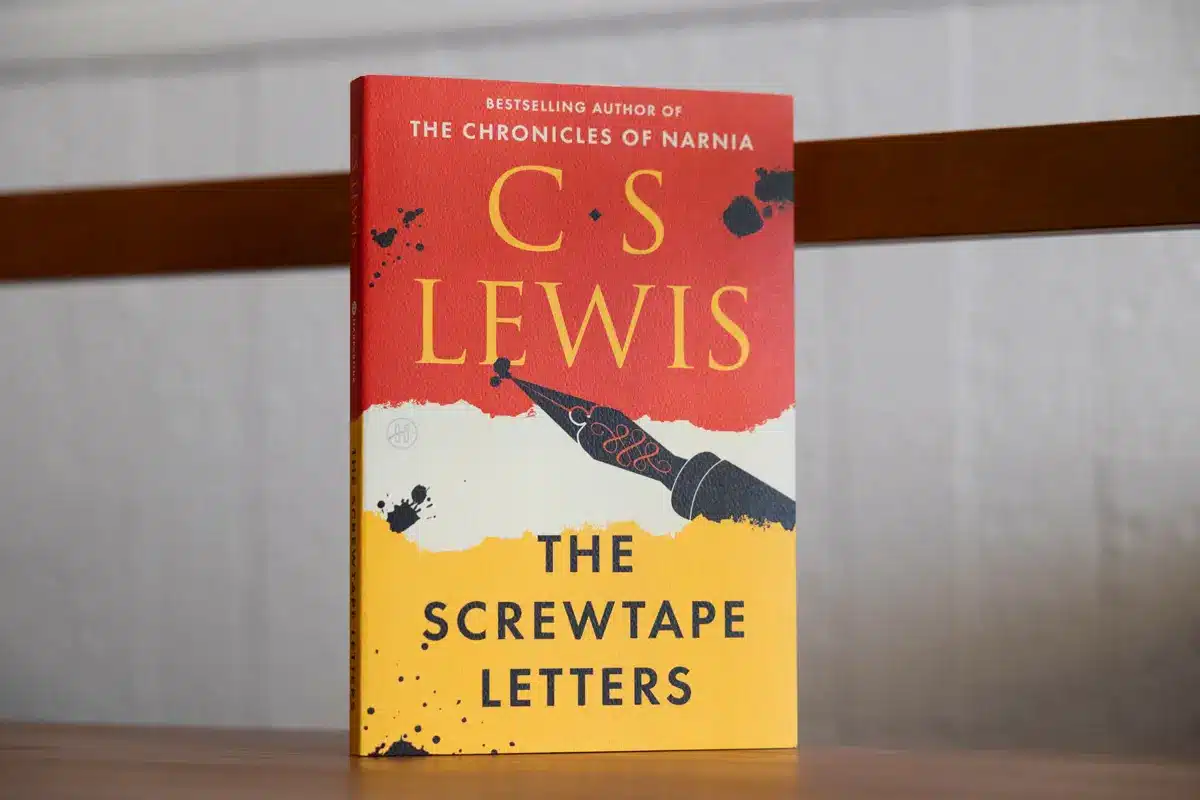
While “The Screwtape Letters” has had multiple covers throughout the years, its most popular cover is a bold design of red, yellow, black and white. In the center of the page (underneath Lewis’ name and above the book title) is an illustration of a fountain pen. The pen is caught in the middle of leaving a blotch of black ink right on the E in Lewis.
There are also four additional ink blots spread across the cover: an effect that looks so real I once worried I had accidentally smudged ink onto my page. Because the entire book is a collection of penned letters, the centered writing device feels apt.
Reviewer’s Personal Opinion: A Surprisingly Enjoyable Read for This Jewish Atheist
When I first began reading “The Screwtape Letters,” Lewis’ satire was so convincing that I genuinely did not realize it was a Christian book. In fact, I thought it to be the opposite.
Though Lewis’ motives did become increasingly clear as I continued to read, so too did his obvious brilliance. For example, on page 4, Lewis drops this nugget (spoken from the perspective of Screwtape): “But the best of all is to let him read no science but to give him a grand general idea that he knows it all and that everything he happens to have picked up in casual talk and reading is ‘the results of modern investigation’.”
This line stopped me in my tracks for, even though it was written nearly a century ago, the same could just as easily be said about today’s “manosphere.”
Similarly, on page 107, he says, “…we thus aggravate the female’s chronic horror of growing old (with many excellent results) and render her less willing and less able to bear children.”
Does this not describe the current beauty industry?
As I continued to read, Lewis’ writing prompted countless self-reflection on my own familial relationships, priorities, and vices. Though I expected to be turned away by the excessive religiousness, I found the book to be an unexpected and cerebral delight.
Later, Lewis writes, “…spring is always felt as a novelty yet always as the recurrence of an immemorial theme,” on page 136.
In this way, reading a good book is like spring.
The Screwtape Letters Review: Understandably Controversial, Satisfyingly Intellectual
In the end, “The Screwtape Letters” succeeds not because it persuades every reader to accept Lewis’s theology, but because it compels them to look more closely at themselves. Even read outside its Christian framework — as I did — it remains a sharp, unsettling examination of how easily habits, distractions and small moral concessions shape a life. Lewis’s greatest achievement is not conversion but confrontation: By inhabiting the voice of a devil so convincingly, he forces the reader into an uneasy self-awareness that lingers long after the final letter. That enduring relevance, rather than its religious intent, is what gives the book its lasting power.
Buying and Rental options
E-Commerce Text Purchases
E-Commerce Audio Purchases
Physical Location Purchase and Rental Options
“The Screwtape Letters” can be purchased almost anywhere books are sold. You can find your local independent bookstores via IndieBound. You can also rent “The Screwtape Letters” from your local library, either in person or by using the app, Libby.

Get recommendations on hidden gems from emerging authors, as well as lesser-known titles from literary legends.