
As an Amazon Associate, we earn from qualifying purchases.
TLDR
Rachel Weaver's memoir, "Dizzy," has excellent prose that illustrates her fight to diagnose and treat debilitating dizziness. We would have liked more development of characters in Weaver's personal life and less pages on environmental adventure flashbacks. Nonetheless, the overall memoir is stellar and worth reading for anyone interested in chronic illness.
“Dizzy,” a memoir by Rachel Weaver, vividly illustrates the torment of having chronic illnesses that are debilitating and difficult to diagnose. As someone who shares this torment, I deeply related to her story.
The word, dizzy, is technically accurate. Nonetheless, we should invent a synonym that embodies the intensity of Weaver’s dizziness. Her symptoms were so severe that they often left her unable to walk, drive, read and think clearly. She felt these sensations nearly every waking moment of every day for many years.
To empathize with Weaver, you don’t need to have a similar illness. Anyone with a debilitating, difficult-to-diagnose-and-treat chronic illness will relate to her journey through the American healthcare system. Or perhaps you have a loved one with severe health issues, and you’ve wanted to understand their perspective.
Other elements broaden the memoir’s appeal beyond the central medical mystery storyline. Because of Weaver’s adventurous pre-dizzy background, the book frequently reads as a series of environmental thriller short stories. On a universally relatable level, we see her navigate romantic relationships, family tragedy, career shifts, parenthood and financial hardships.
A minority of readers might not appreciate the narrative structure of frequently switching back and forth between her post-dizzy and pre-dizzy lives. Many of the pre-dizzy pages do not have a discernible thematic connection to the main storyline. Like me, you might feel some of these scenes would have been better dedicated to developing other characters who are more significant figures in Weaver’s personal life.
If you lose interest in the flashbacks around the middle of the book, I recommend skipping them until you finish the story. You are unlikely to miss any crucial details.
Either way, “Dizzy” is a unique, well-written memoir. We are lucky that someone with an interesting chronic illness story happens to be a skilled professional author.
‘Dizzy’ Summary: A Mixture of Medical Mystery, Health Care Nightmares, Adventure and Regular Life
After suddenly developing incapacitating dizziness, Rachel Weaver spends decades seeking an accurate diagnosis and an effective treatment regimen. We see her encounter common American for-profit health care obstacles such as poor insurance coverage, medical debt, long waits for appointments and emotionally unintelligent doctors/staff. Meanwhile she offers us glimpses of her pre-dizzy era exploring the wilderness and risking her life. Given these youthful adventures, she hadn’t imagined that the greatest threat to her life would be a mysterious illness. Weaver also discusses her author ambitions and romantic relationships, as well as a family tragedy that shaped the rest of her life.
At The Rauch Review, we care deeply about being transparent and earning your trust. These articles explain why and how we created our unique methodology for reviewing books and other storytelling mediums.
Audience and Genre: Several Elements, But a Literary Memoir Above All
The cover and style of “Dizzy” present as a literary memoir, and ultimately it is a literary memoir above all else. When I write “literary memoir,” I mean the narrative prioritizes Weaver’s mental and emotional experiences over technical medical details and environmental thriller aspects.
Medical analysis might be particularly interesting for readers who have studied medicine, but you don’t need this knowledge to understand “Dizzy.” People who enjoy wilderness/survival tales will enjoy the scenes of Weaver’s pre-dizzy backstory, but ultimately these scenes are more important as parallels to the illness storyline.
Three Cs: Compelling, Clear, Concise
Editorial Note: We believe these three factors are important for evaluating general writing quality across every aspect of the book. Before you get into further analysis, here’s a quick breakdown to clarify how we’re using these words:
- Compelling: Does the author consistently write in a way that would make most readers emotionally invested in the book’s content?
- Clear: Are most sentences and parts of the book easy enough to read and understand?
- Concise: Are there sections or many sentences that could be cut? Does the book have pacing problems?
Compelling: You Will Feel for Weaver and Mike
You will care about Rachel Weaver. Because of her writing skill, readers feel the depth of her suffering.
Her husband, Mike, seems like a wonderful human being. Once they get together and show the relationship isn’t going anywhere, readers will want their family to have a happy ending.
Other emotional hooks will depend on your personal background. For example, I’m an author as well, so I was particularly invested in the details about writing her books, editing them, finding an agent and finally getting a traditional publishing deal.
Clear: Sharp Prose, Outdoorsy Lingo and Some Story Structure Confusion
At a line level, the prose is clear.
As part of illustrating the mindset and lifestyle of her pre-dizzy years, Weaver drops a few brand and animal names that only fellow conservationists/intrepid explorers will know: Evinrude, Cessna, goshawk — to name a few. I learned what a “sextant” is. When referring to the front of a ship, Weaver writes “foc’sle” instead of “forecastle.”
It will take only a few seconds for readers to look up these words. Stripping out this verbiage would have made the book a little easier to read, but we would have lost a spice that helps contrast her two lives.
Based on my experience and some critical reviews, it’s fair to assume a portion of readers won’t understand some of the plot structure choices. I explore these plot structure issues further in the plot section below.
Concise: Too Many Wilderness Exploration Flashback Pages
For at least the first third of the book, the flashbacks to adventurous, healthy Weaver feel necessary and valuable. It’s easy to see the juxtapositions and thematic connections between specific details in her two eras.
As the book progresses, however, the wilderness flashbacks feel increasingly superfluous. We already understand the gist of that phase in her life. It becomes harder to form meaningful connections between the two types of scenes. The pace drags.
I kept thinking that maybe one of the flashbacks was going to show a key injury or stressor that might have played a role in her developing vestibular migraines. By the end, I realized that none of those scenes were trying to establish a possible cause or contributor to her illness. Some of those scenes could have been cut in favor of developing other characters, perhaps with less pages spent overall.
Fortunately the flashbacks stop around the last chunk of the book.
Character Development: Excellent for Weaver, Lacking for Others
As expected of a memoir written by a skilled author, Weaver does an amazing job developing herself as a character. There is also a bit of development for her father, the main source of her adventurous mindset. In the beginning, we get a somewhat fleshed out sense of her toxic ex-boyfriend, Karl.
Otherwise the character development is lacking. Weaver mentions a strained relationship with her mother, but we barely learn anything about her mother or their mother-daughter dynamic. Her brother is in the story as a minor character with a few lines dedicated to him.
Mike, her amazing firefighter husband, is a steady presence in much of the book. Nonetheless, I wouldn’t say we get much character development on him. We know he is kind, funny, supportive and a calming presence. I wanted to know way more about him and their relationship. The juxtaposition of his firefighting and her loss of adventure seems like fertile literary ground.
I’m harping on the character development point because the book definitely had room to explore more characters. Many of the superfluous adventure flashback pages later in the book could have been spent showing us interesting details about her mother, Mike, her brother, even a little more on her father.
Story: Small Issues With Structure and Labeling
Overall, the story works. It’s easy to follow the threads. We’re excited to know what happens with Weaver’s illness, career, money problems and family. The ending is satisfying.
In the beginning, there are problems with structure and labeling. The opening section of the book, “BEFORE,” is about Weaver falling through the ice while skating alone on a frozen river in Alaska. Unlike the other sections of the book, this one does not have chapters within it. Then we go to the “YEAR ONE” section, meaning the first year of her dizzy life.
This structure initially made me think the ice injury was a possible cause of her dizziness. Quickly going from “BEFORE” to “YEAR ONE” led me to believe that we were done with the before times. Instead we spend most of the subsequent pages of the book switching back and forth between present and past.
Because of this structure, I spent the entire book thinking one of the flashback pages might reveal or hint at possible past bodily/mental traumas that developed the dizziness. Ultimately readers will see there isn’t any apparent cause. Weaver ruminates on the ice incident multiple times, yet it doesn’t seem significant to the story. If there is a poetic significance, I didn’t pick up on it enough to feel like that incident is important.
Prose Style: Wit, Versatility, Poetry and Outdoor Metaphors
The prose shows off how clever Weaver is. She occasionally weaves in a few techniques such as using italics to express inner thoughts and turning brand names into verbs. Her informal style allows for smooth deviations from normal grammar.
Because of her outdoorsy background and the flashbacks, many of the metaphors in her dizzy symptom descriptions are about nature: rivers, seas, ground, fish. Regardless of how much a reader loves nature, everyone will appreciate this unique language.
Setting: Alaska vs. Medical Offices
We see wild, cold Alaska in all its glory. Conversely, we see the literal and emotional cold of the medical offices where doctors constantly disappoint Weaver. We see the warm, hippie-style alternative medicine spaces as well. The descriptions for these settings are thorough.
Much of the story takes place in Colorado, but we see little simply because Weaver’s eyesight degraded.
Rhetoric: The Nightmarish American Private Health Care System and Its Emotionally Unintelligent Doctors
All of us know the American health care system is terrible and that many doctors have less EI than the canned fish Weaver used to eat. Still, it is interesting to see these intricacies in a memoir.
Like me, Weaver goes back and forth on how sympathetic we should be when dealing with doctors. They are stressed, overworked. On the other hand, there’s no excuse for being a jerk to your patients.
Doctors are as fallible as the rest of us. There are times when their patients know better.
Cultural and Political Significance: A Shifting Medical Landscape and Wildlife
The book is timeless because people will always have chronic illnesses such as headaches. Simultaneously, the story demonstrates the impact of medical advances. Toward the end of the story, Weaver’s main doctor follows the release of a new drug that further alleviates her symptoms.
Scenes of Alaska remind us of nature’s beauty and the importance of conservation. If not for the work of conservationists like Weaver, we likely would have even less of the natural world left.
Authenticity: Transparency on the Limitations of the Memoir and How It Was Written
In the acknowledgements section, Weaver discloses that some material in the book originally appeared in publications such as magazines and anthologies. When I first read this page, I worried the book would feel stitched together. I had this criticism of “Listen, Liberal,” another book that draws from pieces published before the book was written.
Fortunately the book does not feel stitched together. I was able to appreciate the transparency, and I worried over nothing.
The author’s note page provides further transparency by explaining that Weaver couldn’t remember everything clearly because of her symptoms. The note also has the typical disclaimers of names being changed, some events being consolidated, etc.
Weaver presents herself as flawed, vulnerable. Throughout her relationship with Mike, she wonders why he puts up with her illness. She even contemplates suicide. You may think this memoir omits some details about people in Weaver’s life, but she doesn’t hold back any of her thoughts and emotions about the illness.
Critiquing the Critics: Apparently I’m the Tough Critic for This Book
Before I researched other reviews of this book, I assumed my relatively small criticisms would be standard. Nope.
Most consumer reviewers think this book is pretty much perfect. The title has a rare score of 4.5 on Goodreads, the harshest of all book review platforms. All critic reviews, except mine, are 100% positive.
So far I’ve only seen one consumer reviewer who thought many of the Alaska pages were superfluous. I have yet to see another review that calls out the structural/section labeling problems.
One consumer reviewer claimed the book did not have a resolution. I disagree. Weaver receives sufficient diagnosis and finds enough treatments to live with her condition. I think that ending qualifies as a resolution.
Book Aesthetic: A Visual Representation of Dizziness
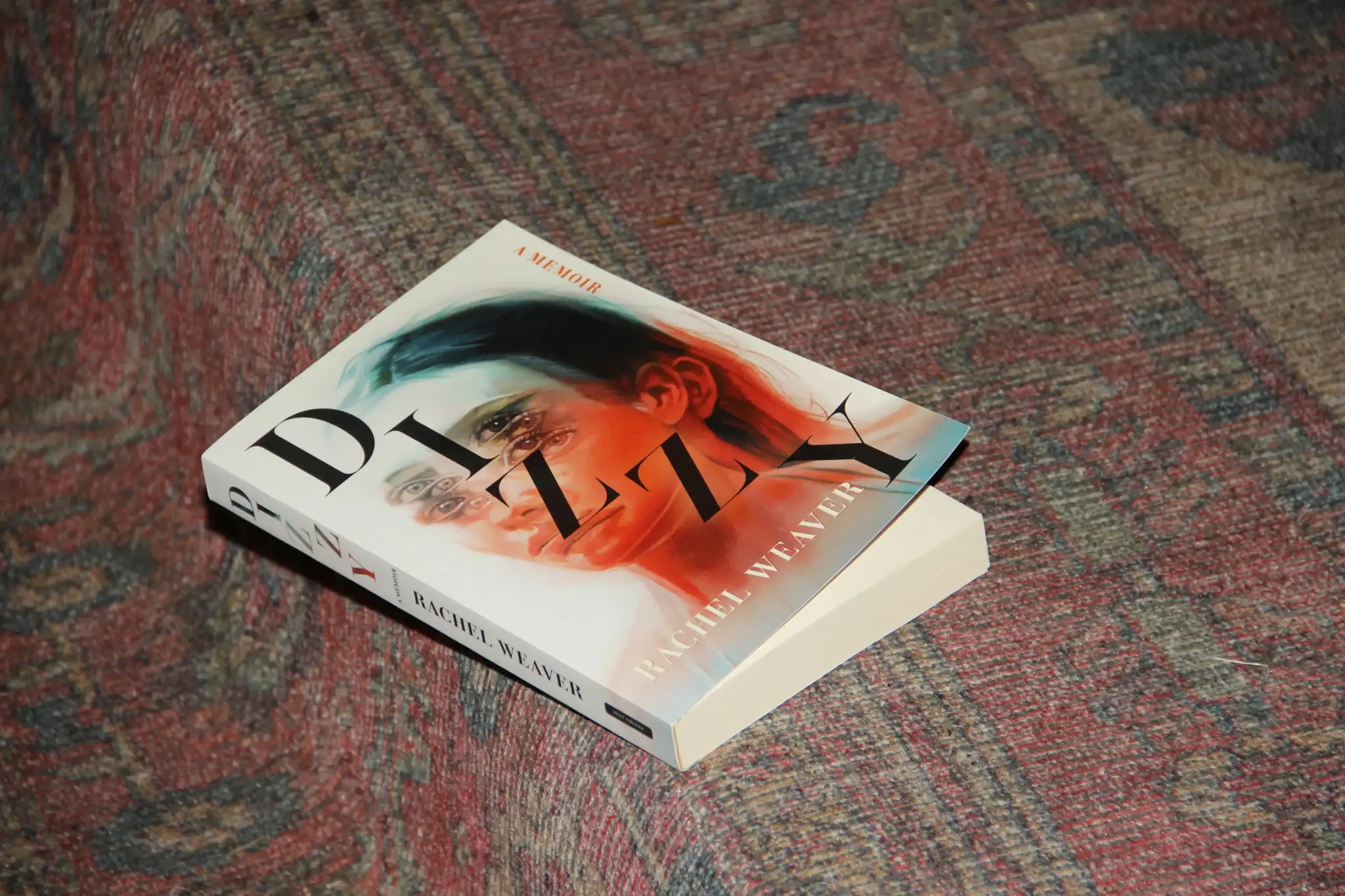
The book cover is appropriate and straightforward. The blurred illustration of a young weaver’s headshot demonstrates her affliction. “DIZZY” is written diagonally from top left to bottom right.
Michael Vrana, the cover designer, did a great job! “Dizzy” belongs in his impressive portfolio.
There is a credit on the back cover that reads “PAINTING BY ALEX GARANT.” I assume this credit means Vrana based his design on a painting by Garant. If you look at her website, you’ll see several paintings that are similar to the “Dizzy” cover. Kudos to her as well!
If you see “Connective Tissue” in parentheses on the Amazon headline, don’t be confused. Connective Tissue is the name of the series of which “Dizzy” is a part.
Reviewer’s Personal Opinion: I Thought My Chronic Health Symptoms Were Bad
Memoirs like this always make me grateful for the parts of my body that do work normally. I need glasses for distance, but I have always been able to see well enough. I haven’t had chronic issues with dizziness.
It’s impossible to overstate how much willpower Weaver has. I think most others in the same situation would have given up or succumb to suicide.
Similar to Weaver, I have spent more than two decades living with debilitating chronic health issues that have been difficult to diagnose and treat. For the first eight years, none of my health care providers had any idea what the problem was or what to do. All the tests said I was fine. My first therapist finally figured out a portion of the problem, but it was still difficult to fully treat. Then I developed a treatment-resistant version of that illness, along with other illnesses. At my lowest point, I almost made a suicide attempt.
Reading “Dizzy” helped renew my willpower. As I write this review, I’m in what I hope is the final stretch of my own saga.
Conclusion: A Unique, Well-Written Memoir With Minor Problems
I gave this memoir a 4 out of 5 because I do think the issues I mentioned are enough to disqualify it from 5 stars. If you’re like most of the people who rated and reviewed this book, you won’t care much about those issues. The writing is excellent. That’s what matters most anyway.
Buying Options
E-Commerce Text and Audio Purchases
E-Commerce Audio Only

Get recommendations on hidden gems from emerging authors, as well as lesser-known titles from literary legends.