
As an Amazon Associate, we earn from qualifying purchases.
TLDR
An 86-year-old man mysteriously arrives in a small Georgia town, introducing himself only as “Theo.” He begins gifting the portraits to their rightful owners, helping them to see themselves differently so they can experience healing and reconciliation. Read our review to learn how this heartfelt and mysterious tale unfolds and why it's special.
“Theo of Golden,” by Allen Levi, tells the story of an 86-year-old man who mysteriously moves to the small Georgia town of Golden, introducing himself only as “Theo.”
After viewing beautiful pencil portraits of local townspeople created by a local artist in The Chalice coffee shop, Theo purchases them and gifts them one by one to their subjects. The town’s new guardian angel befriends everyone he meets and commits all his time and energy into helping and supporting the local townspeople.
Through the lens of Theo, every fascinating detail of an outdoor scene, a person’s face or a sunset is noticed in detail and with appreciation. He dedicates every waking moment to uplifting and helping others.
The elderly Theo is cast as an empowered and vibrant main character – a welcome experience after reading countless books that cast elderlies as almost useless, riddled by illness and decline.
Kendrick, another character, tells someone during the story that Theo taught him that “God gave us faces so we can see each other better.” This idea is a strong theme in this book and an invitation to readers to see people, not just on the surface, but inside their hearts. Few readers could walk away untouched by the intensity of Theo’s observations and the loving way he gives without expectation of reciprocation.
Although some critics declare “Theo of Golden” to be preachy and overly sentimental, a reader must have a heart of stone not to be moved on some level by this originally self-published novel that catapulted to a New York Times bestseller.
‘Theo of Golden’ Summary: Elderly Man Lives with Purpose and Vigor
“Theo of Golden” is a feel-good book about an 86-year-old man who mysteriously arrives in the small Georgia town of Golden. Theo brings uplift and healing to many townspeople, largely through gifting them their portraits, created by a local artist.
“Theo of Golden” offers a refreshing perspective on older adulthood, something rarely seen in literature and unmentioned in advertisements for this book. Theo savors every moment of his golden years. He takes long, reflective walks and even heads out on a day-long biking expedition with the emotionally troubled homeless woman, Ellen. He’s not one to dwell on aches and pains or be bogged down by thoughts of physical decline.
Levi’s novel speaks to the longing we all have to be seen. Not just on the surface. But seen and appreciated with depth and feeling.
Books Like ‘Theo of Golden’
“Theo of Golden” is a one-of-a-kind novel. I haven’t yet come across any books that are similar. I would argue that books recommended online as similar, including “The Correspondent” and “The Extraordinary Life of Sam Hell” simply aren’t. The main character in “The Correspondent” is a somewhat mean-spirited elderly woman going blind and aging uncomfortably. I found that book depressing and didn’t finish it. It has no resemblance to the feel-good experience “Theo of Golden” offers. Theo inspires while Sybil grates.
Robert Dugoni’s “The Extraordinary Life of Sam Hell” shares the story of Sam, a boy born with a form of albinism that makes him have red eyes. Same is relentlessly bullied at the Catholic school he attends growing up. Life’s hardships move him away from the Christian faith his mother ingrained in him. Toward the end of the book, he gravitates back toward the Christian foundation he grew up with. Christian faith as a theme is the only similarity to “Theo of Golden.” Dugoni’s novel demands a lot of the reader emotionally and makes for a stressful read.
At The Rauch Review, we care deeply about being transparent and earning your trust. These articles explain why and how we created our unique methodology for reviewing books and other storytelling mediums.
Audience and Genre: Inspirational Literary Fiction With a Christian Secondary Theme
Readers who are Christian, believe in God or a divine presence, and/or follow a spiritual path will likely connect to “Theo of Golden.” Readers who lean toward inspirational works may also enjoy it.
Editorial Note: Read our review of “Mere Christianity” here.
Older adults seeking a fresh perspective on the “golden years” — uninhibited by tiresome narratives about illness, achy bodies and decline — will find this book amazingly refreshing.
In our turbulent world, many people are starved for uplifting books and literature. The intended audience could be anyone open to an inspirational experience, wanting to connect more with others, or who have some faith or desire to believe that there may be some divine order to the universe.
“Theo of Golden” is listed under the genres of Christian literature, Christian fiction, spiritual fiction, contemporary fiction, inspirational fiction and literary fiction. I have never read a book that was remotely similar to this one. It’s one of a kind.
“Theo of Golden” is an ideal title for this book. Theo establishes himself early on as the star of the show and he somehow manages to make each person he meets feel like the real showstopper.
Perspective: Third Person, Omniscient Point of View
“Theo of Golden” is told entirely from a third person, omniscient point of view. The story is also told from a very close perspective, with the narrator seeming to think and observe very similarly to Theo. Most of the narrative is in past tense.
Three Cs: Compelling, Clear, Concise
Editorial Note: We believe these three factors are important for evaluating general writing quality across every aspect of the book. Before you get into further analysis, here’s a quick breakdown to clarify how we’re using these words:
- Compelling: Does the author consistently write in a way that would make most readers emotionally invested in the book’s content?
- Clear: Are most sentences and parts of the book easy enough to read and understand?
- Concise: Are there sections or many sentences that could be cut? Does the book have pacing problems?
Compelling: Theo, the Grandfather or Uncle We all Wish We Had
Readers of all ages will connect with likeable Theo. He’s everyone’s dream grandfather or uncle, a man kind to the core who is genuinely interested in others. Once readers connect to Theo, they will be curious to know more about his mysterious past. Readers will also be drawn into the lives of the townspeople as the portrait bestowals take place and details of their lives are revealed.
The plot centers around Theo’s gifting of pencil portraits to their subjects. Each encounter is deeply touching. He sees each person the way they have never been seen before. Journalist Kathryn Lesker grew up overweight and, eventually, her father left her. She has always seen herself as fat, unattractive and unworthy. Theo helps transform her view of herself. Here is her reaction when she sees studies the painting Theo gives her for the first time.
“The realization that someone had paid such attention to her face – her face – that someone had drawn her with such tenderness, had deemed her worthy of such meticulous effort and artistry, reduced her to meaningful silence.” And after she verbally responds, spellbound, Theo says, “the artist simply drew what he saw, and what he saw — who he saw — is a work of art.”
Every reader wishes other people would appreciate every detail of his or her face the way the artist and Theo uniquely were able to. Theo and the artist, Asher, both had a gift of noticing and bringing out the uniqueness of each person. Theo saw and then was able to ask the right questions. This gift helped each person share past pain and see themselves differently so they could move forward with a renewed perspective about themselves and their lives.
Clear: Writing Matches Theo’s Intelligence
References to different artistic creation movements such as cubism and impressionism are mentioned. Cultural references sometimes required me to do some online research to better understand the context. Levi’s prose matched the intelligence, education, cultural exposure and global perspective of the main character, Theo. The book has been professionally edited and there were no noticeable typos.
The plot centers around Theo gifting portraits to their rightful owners.Via this experience, he opens an opportunity for recipients to see themselves differently and heal from past trauma.
There was another subplot of learning about Theo’s past, why he came to Golden and what his connection was to people in the town. A final subplot involved Ellen finding her lost daughter, Willa. There were no noticeable plot holes.
Concise: Relaxing, Descriptive Read
“Theo of Golden” isn’t a fast-paced read; it’s a story where readers immerse themselves in characters and their day-to-day lives. The relaxed pacing seems to urge readers to slow down and stop hurrying. Levi’s writing shows Theo’s vigilant penchant for observation and detail. Theo takes leisurely walks, observing as he goes. He sits and observes the subtleties of a sunset. The encounters he has with people he meets, and their struggles raise the tension and moves the story forward.
Multiple Spoilers in the Below Paragraphs
The story’s length felt about right. It begged for a scene where Theo tells Asher he’s his father and where Ellen meets her daughter, Ella.
Readers are given a steady dose of Theo’s kind encounters with others. Tense scenes in the novel occur sporadically. But, overall, “Theo of Golden” is a relaxing read, ideal for someone with an over-active nervous system (Isn’t that all of us these days?).
The reader learns about Theo’s identity at the end of the novel through letters. His death is sudden and surprising.
Character Development: A Character-Driven Novel
“Theo of Golden” is a character-driven novel. Theo and the person behind each portrait drive the story. The depth of character development and the personal interactions make the story compelling to read.
Characters are developed through dialogue and present events as well as flashbacks. In the case of Theo, he often only shares tidbits of information through thoughts or dialogue, which make the reader long to know more about his background and why he’s in Golden.
Readers meet a kind, strong, well-educated character in Theo. Readers learn early on that he’s secretly extraordinary and suspect his arrival in Golden isn’t random. He notices fine details, speaks five languages and has sufficient resources to hire Mr. Ponder to handle his financial affairs. Theo has a sense of humor. Readers are introduced to Theo’s microscopic way of observing details and are invited to become more observant as the story moves forward. Theo doesn’t want to be recognized or for attention to be drawn to himself during his kind acts. He even asks a journalist not to publish an article about what he’s doing.
The evolution of Theo’s character takes place before the start of the novel.
Spoiler Alert
Before the story begins, Theo, who is now known in the art world as Zila, grows up in Portugal, lives in countries around the world and becomes a famous artist, his work often auctioned for million-dollar prices. His sudden escalation into fame and glory cloud his perspective, costing him the love of his life and leading to a marriage to a wealthy woman with a penchant for the bottle. After his wife and daughter tragically die in a car accident (due to his wife’s intoxication), a devastated and broken Theo struggles to move forward, and eventually does, deciding to dedicate his remaining years to a life of spiritual discipline as a kind of recompense for the guilt he feels over his daughter’s death.
As Theo meets people in Golden, largely through the portrait bestowals, he gently gets them to open to him until they share past experiences. Minnette, a CPA and the first recipient of a portrait, carries sadness because she has been trying to satisfy her father’s expectations instead of pursuing the life she’s called to live. The bookshop owner, Tony, shares the horrors of serving in Vietnam and how it scarred him. The homeless woman, Ellen, tells Theo about the day her newborn daughter was taken from her. The journalist, Kathryn, tells Theo how her father left her. By empathizing and offering insight into their painful experiences, Theo helps them see themselves and their experiences from a fresh perspective so they can move toward growth, self-acceptance and reconciliation.
Asher follows an artistic path very different from his father, Theo. He never deviates from his spiritual path. He consistently creates sketches for the sake of art. By sketching the people of Golden, he expresses love, empathy and focuses on each individual whose face he portrays. He has minimal aspiration for fame or money. At one point, Theo praises his son’s art for its purity.
Theo’s gifts to others bring healing to his own life. He financially supports and bonds with Lamisha, a young girl hospitalized and partially crippled after a tragic car accident that ended her mother’s life. In one scene, he reads a book to Lamisha that he once read to his daughter, Tita, before her untimely death. Lamisha helps fill the void from the loss and Theo eagerly steps in as a kind of surrogate father.
Theo’s anonymity is an asset to his mission. It allows him to gift the portraits and other support without people being distracted by his fame or status.
People Theo meets experience transformation because of their encounters with him. He’s gentle, kind and a good listener. He seems to listen to God for direction during each conversation. Author Allen Levi shared in an AARP interview that his late brother, Gary, inspired Theo’s character.
Story: An Ending That Might Disappoint and Shock Some Readers
“Theo of Golden” is an engaging story, but it isn’t a page-turner. Readers meet Theo, care about him and gradually feel invested in the lives of the other townspeople he meets. This character-driven story revolves around the lives of Theo and the townspeople of Golden.
The plot revolves around Theo giving portraits created by a local artist to their rightful owners and learning about Theo’s past.
Because Theo leads the introductions to each character the reader meets, the title seems appropriate and sets the stage for a character-driven story.
Spoiler Alert
The ending may disappoint some readers. Theo’s violent death throws him back into the spotlight of news headlines. It feels unjust for a man who bestows so much goodness on others.
Headline news and letters reveal Theo’s identity. Theo’s letter to Asher reveals their father-son relationship.
Prose Style: Descriptive and Formal
Levi’s prose is precise, deeply descriptive and leans toward formal. Even though “Theo of Golden” is written in third person, the narrator speaks in a voice equivalent to the well-educated and culturally knowledgeable Theo.
There is a good balance of showing vs. telling in the story. Dialogue and narrative felt balanced.
Below are some examples of Levi’s skilled writing.
In the scene below, Theo and Asher discuss what makes good art. Theo shares how he believes love must be a central part of it. What’s interesting is how Theo speaks his thinking process out loud. Some readers might be anxious for him to get to the point. But this dialogue demonstrates how Theo is a deep and detailed thinker.
“Yes, I have thought about it. In fact, I’ve thought about it a great deal. And I’ve asked others about it. But I don’t know if I have an answer either. Other than this. It might not make a lot of sense, but for anything to be good, truly good, there must be love in it. I’m not even sure I know fully what that means, but the older I get, the more I believe it. There must be love for the gift itself, love for the subject being depicted or the story being told, and love for the audience. Whether the art is sculpture, farming, teaching, lawmaking, medicine, music or raising a child, if love is not in it – at the very heart of it – it might be skillful, marketable, or popular, but I doubt it is truly good. Nothing is what it’s supposed to be if love is not at the core.”
Theo gifts a 1947 bottle of port wine to Tony on his birthday. His explanation of why he is giving him that bottle is a testament to the acuteness of his memories and how he notices every detail as he moves through life. “I worked that vineyard in 1947, that very vineyard. I was fifteen years old but strong enough to be of some help. It might well be. That these hands,” Theo holds out his open palms, “these very hands cut the grapes whose juice is in this very bottle. It is possible that these feet, when they were much younger, of course, danced on those grapes in the winepress.”
He goes on. “When you drink this port, you taste the hillside of my childhood. You taste the sunlight and the Duoro. You taste the strength of the vine, the sweetness of the fruit, the sweat and labor of the harvesters, the oak in the barrels. You taste the music of the accordion, the laughter of the children, and the prayer of the priest. You taste a young man’s joy and an old man’s memory.”
On a bicycle ride with Ellen, Theo remembers riding a bicycle as a youth. “If Ellen had been able to see the picture in his mind at that moment, she would have beheld a little boy on a simple child’s bike, painted red with a basket on the front, pedaling vigorously through Pinhão, en route to the local baker for bread and cheese. The scent of crushed grapes is rich in his nostrils; his feet, ankles and calves are stained slightly purple; and his elbows are spread wide, like bent wings, as he speeds by tile-fronted shops and houses in the Portuguese sky. At intersections, he glances downhill to the Douro, where boats are loading and unloading.”
“But all Ellen could see was an old man, a very happy old man whose face was radiant with sunlight and youthfulness.”
At Theo’s funeral, a description of light coming through the church windows sets an example of how Levi’s descriptions seem to be written through the lens of an artist.
“The radiance of the evening sun through stained glass dappled the sanctuary. The slow movement of color would have been undetectable from minute to minute, but over the course of the hour, patches of red, lavender, melon, gold, and emerald shifted kaleidoscopically across the room.
“The sun was a brush; the west window its palette; the floor, walls, ceiling, and congregants its canvas; an angel somewhere, the artist.”
During his eulogy for Theo, Father Lundy says, “God, in his sublime goodness, has always sent others, mysterious others, to walk with us – prophets, preachers, friends, teachers, artists, storytellers, wives and husbands, children, songbirds and rivers, even hardship and loss – to help us see clearly. They are the ones who make our hearts burn within us, who call us out of our indifference, our lethargy, our death and defeat. They call us to be fully alive, or at least more alive than we were before we met them.
“And so…Theo.”
And then Father Lundy expounds on the love Theo gave to everyone he met.
Readers learn how Theo sees his son Asher in the final letter he leaves behind for him. Once again, he notices details so many would overlook. “So much about you reminds me of another, of a girl I met many years ago when I was a young man in Spain. The movement of your hands when you sketch, the intensity of your eyes, and the tilt of your head when you paint all take my thoughts to that girl.”
The last paragraph of the book encapsulates how everyone in Golden felt about Theo. “On the first anniversary of Theo’s death, Tony had a plaque engraved in Theo’s bench at the Fedder. All who read it are told that this was a place where heaven and earth met in the form of an old Portuguese man. They are told that all, who choose to be, are capable of saintliness. They are also told that faith, hope, and love endure, but the greatest of these is love.”
Symbolism is a major literary device shing through in the novel. The Oxbow River is symbolic of time, healing and life’s ups and downs. The portraits symbolize the innate desire we all have to be seen. Spiritual and scriptural references appear often in the book.
Foreshadowing occurs in the violent scene where Cleave appears at a meeting with Theo instead of his girlfriend, Theo, and he destroys her portrait. Readers see that something violent could happen even in the usually peaceful town of Golden. Violence breaks out again near the end of the novel, indirectly leading to Theo’s death. Foreshadowing of Theo’s death occurs after scenes when the narrator indicates that Theo never saw that person again.
Simile and metaphor are often used to allow readers to see a scene the way an artist or musician might view it, noticing every minute detail.
The author’s writing style suggests he is well-educated and well-versed in art, music, and history.
Dialogue: Theo Gets People to Talk
The dialogue between characters feels natural and realistic. Theo knows how to initiate a conversation and gain peoples’ trust so that they share their experiences.
There was a good balance of narrative and dialogue. The dialogue moved the story forward, helping readers get to know different people in Golden and understand their lives and their struggles. It was always easy to tell who was speaking. Most of the time, it wasn’t Theo.
Setting: Golden, Georgia
The setting for most of the book was the small Georgia town of Golden. The city is depicted as a quiet, meditative place where everyone knows each other. But there’s no hint of a gossipy community. There seems to be a relaxed unity between most of the townspeople.
There are special places in the town such as the Chalice coffeeshop where the paintings are displayed, and the Fedder fountain, where Theo often meets people. These establishments serve as frequent backdrops for different scenes.
Flashbacks take readers back to Theo’s childhood home in Pinhão, Portugal, a small town in the northern part of the country. He often talks about how he worked in the vineyards and sometimes compares a childhood scene to an event happening in the present.
The author uses setting as another device to show Theo’s ability to see and notice every detail. Readers experience flowers, the Oxbow River, sunsets, light in the church and more in incredible detail — the way Theo sees them.
Rhetoric: Have Faith, Notice Details, See People
The author wove several themes into “Theo of Golden:”
- God’s existence
- humans as God’s messengers
- seeing people beyond what’s superficial
- taking notice of beauty in daily life
- the power of compassion to help people heal from painful past experiences
The novel didn’t seem preachy. Readers walk through life with Theo at age 86. After having made mistakes in the past, he has chosen to spend his final years living a Christian life and helping others.
Levi persuades readers to have faith, to notice details, including the depth of what’s in each person we meet. Theo’s gifting of portraits is symbolic of him recognizing each person, truly listening to what they have to say, and seeing them beyond the exterior, to the depth of what’s inside them. Theo recognizes the suffering each person has experienced in an aspect of his or her face, and he acknowledges this and opens each person up to talking about it so that healing can begin to happen.
Cultural and Political Significance: Love and Compassion Still Live
“Theo of Golden” feels relevant in this era where older adults in America are often sidelined and values are being lost in our culture. 55-to 60-year-olds are often offered early retirement packages, as if a few gray hairs mean they’re no longer useful to a company. A president lacking ethical standards is embraced by too many, greed is the norm, and people lash out with hateful rhetoric or even violence when someone disagrees with their views. Theo opens the readers eyes to a different world, where love and compassion are king.
Books featuring older adults usually focus on their illness, disability and the inconvenience they cause others. Theo allows readers to see how many seniors live: with dignity, vitality, curiosity and enthusiasm.
Political divisions cause division and anger between people around the world. Social media, purported to enhance connection, is making people feel isolated and hostile.
“Theo of Golden” affirms the value of kindness, of human connection, of really seeing people instead of considering them a means to an end. People in today’s world can benefit from this book. It can lift someone out of depression, offer an unemployed person a purpose (Anyone can spend the day being kind, right?), and motivate positive change.
Critiquing the Critics: Is the Book Actually Too Sweet?
“ ‘Theo of Golden’ broke every rule in publishing. It’s an unprecedented bestseller,” according to The Wall Street Journal.
USA Today characterized the book as “An emotional and heartwarming tale.”
82% of the more than 149,000 reviews on Amazon were 5 stars. A minute percentage of Amazon reviewers deemed Levi’s writing to be racially biased. I disagree. If anything, the story sets an example of how desperate some immigrants are to move to the United States (because they have family here or are trying to escape war or gang activity) and shows how disadvantaged they are in unfavorable situations (in this story, a fatal car accident). This theme seemed very accurately portrayed.
About 1% of Amazon readers found the book to be “boring” or “syrupy sweet” or described it as Christian in a bad way. I understand that a reader who leans toward thrillers might find this a bit of a slow read. I also recognize that some people are turned off by anything that remotely suggests that there is a higher power.
Nonetheless, their assessment that these characteristics define it as a “bad” book worthy of a two-star review seems comparable to a person who hates romance picking up a popular romance novel and then slamming it for being what it is intended to be. If you don’t like anything uplifting, read something else instead of bashing a book that can transform someone’s life.
“Theo of Golden” was number one in the Literary Fiction category on Amazon the week of July 20, 2026. That fact speaks much louder than a handful of sour grape reviews.
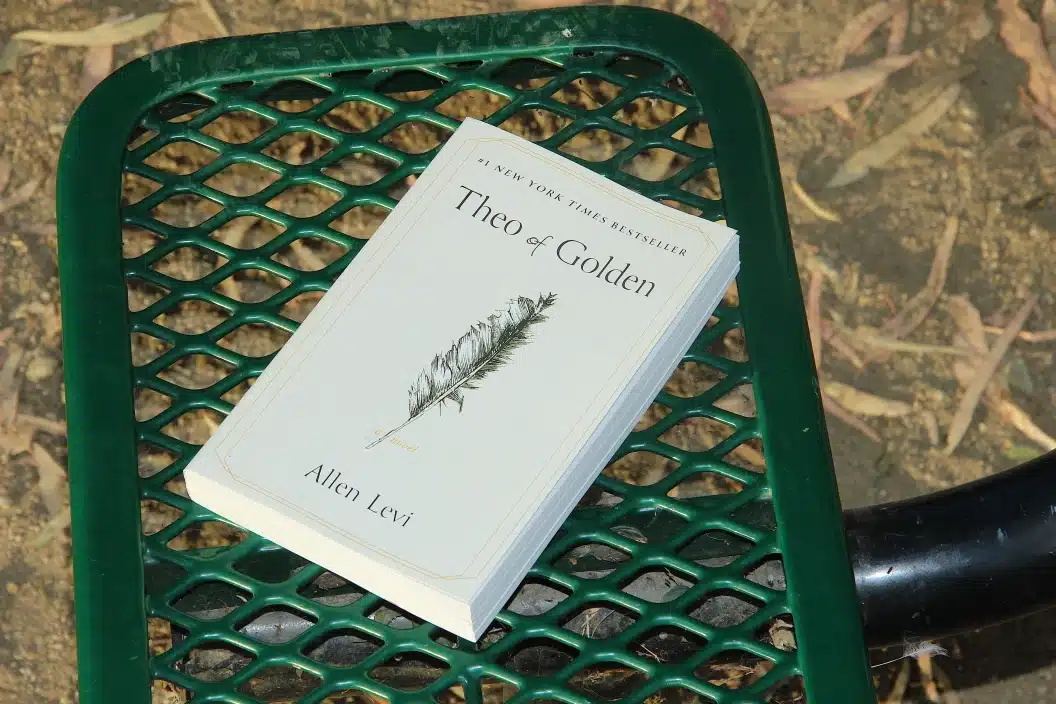
Book Aesthetic: Simple, Focused on the Feather Visual Theme
The “Theo of Golden” cover is simple and plain white, with gold lines around it and a sketch of a large feather in the middle. Feathers appear often in the novel. The fountain known as the Fedder, situated on a Promenade in the center of Golden, was named after a child who saw a falling feather he believed came from an angel and mispronounced it as “fedder.” A homeless woman named Ellen gives Theo a piece of wood with holes to insert a collection of feathers. He helps Ellen earn income by selling her unique creations and helps her to find her lost daughter.
At the top of the cover, before the book’s title, it reads “New York Times Bestseller.”
On the back is a sketch of the bench where Theo meets people. Below it is a book description and biography about and photo of author, Allen Levi.
The cover is unique in its plainness, almost like Theo walking into the town of Golden, introducing himself with a simple name no one knows and keeping his fame a secret. There’s nothing loud or noticeable about it.
Reviewer’s Personal Opinion: Theo, A True Christian and a Model for How Senior Years Can be Savored
The book resonated with me on so many levels. The author’s choice to make an elderly man, Theo, the central character, was wonderful, given how older people are often sidelined in our society. I found it refreshing to read about an older character who walks every day, eats wisely, is mentally acute and doesn’t complain about aches and pains. As an active older person, I find it annoying to read books that portray older people as sick, disabled and losing their mental faculties.
Theo’s choice to devote his final years to kind acts was also significant. It made me wonder how different the world would be if many people made this choice.
I also found Theo’s approach to Christian living inspiring. He’s a Christian who lives love. He doesn’t just go to church and then turn around judging and criticizing people. He considers the world his family. To me, that’s true spirituality, true Christianity.
I loved how Theo saw people beyond what other people see. Sometimes it’s easy to see someone as an old person, an overweight person, or someone who forgets to brush their hair.
At a yoga retreat recently, I was invited to gaze into the eyes of another attendee for more than five minutes. The first days of the retreat, I kept confusing her with another woman who had a similar body shape. But after I looked deeply into her eyes and her heart, I never made that mistake again. I saw so much beauty, so much depth. And I felt a deep connection. I happened to be reading “Theo of Golden” on that trip, so I reflected on how Theo saw into the depth of each person. We all want to be seen. Few make the effort or take the time to see us.
Spoiler Alert
An altercation between drunk men and two of Theo’s friends indirectly led to his death. The author “needed” Theo to die so that his identity as Zita could be revealed. It was heartbreaking that Theo’s life ended while he witnessed his friends being violently beaten.
I would have liked to experience a scene where Ellen reunites with her daughter, Willa.
Although I found the book ending disappointing, it was written in a way that incited emotion and deep respect for Theo and all that he accomplished spiritually and as an artist.
I found all the central characters likeable. Levi does an excellent job developing unique, multidimensional characters.
Theo was my favorite character. I was drawn to the way he noticed beautiful details instead of letting the routine of the day interfere with their notice. I disliked Pearce and Cleave. Pearce only cared about work and was rude and thoughtless and Cleave abused his girlfriend and destroyed her portrait out of jealousy.
I have never met Allen Levi. Before taking a trip to Ireland, I posted on Facebook, asking my friends to recommend a book that was fun to read and that portrayed older people free of disability and illness. Someone recommended “Theo of Golden.” After reading the description, I ordered a copy.
I asked to review “Theo of Golden” because it is unique and inspirational. It’s the perfect book to help someone slow down, stop looking at their phone for a while and start to notice what’s going on around him or her. It invites us to savor beautiful moments instead of rushing through the day, missing beauty, missing the opportunity to connect with someone, missing the present moment, which is all that is guaranteed.
Conclusion: Sacred and Impactful
“Theo of Golden” is a sacred and impactful story. As a reader, I felt called upon to be more observant of beautiful moments instead of blindly rushing through my days. I also felt inspired to be kinder to strangers because you never know what that person’s life looks like and how one kind word might touch him or her.
Theo’s sudden death was a surprise, as the author must have intended. Although it deprives Theo of the opportunity to tell Asher in person that he was his father, it felt aligned that he would remain silent until his death to honor his former girlfriend Gammy’s request.
A meeting between Ellen and her lost daughter, Willa, would have been rewarding to read.
Theo’s letters, the eulogy and peoples’ reflections on his life shared after his passing are deeply touching. Reading on without Theo’s dynamic and beloved presence felt heartbreaking.
Buying and Rental Options
E-Commerce Text and Audio Purchases
E-Commerce Audio Only
Physical Location Purchase and Rental Options
“Theo of Golden” is available in most bookstores, including independent bookstores. It is listed under the genres of literary fiction, contemporary fiction, inspirational novel, and Christian fiction.
Digital Rental Options
“Theo of Golden” is available in most libraries and can be found on library apps such as Libby and Overdrive. To get the book from Libby from the Tucson, Arizona libraries, the e-book has a 21-week wait and the audiobook a 26-week wait.

Get the latest of The Rauch Review in your inbox, discover books you won’t see in stores, stay up to date on the “Rauching to Judgment” podcast and more.