
As an Amazon Associate, we earn from qualifying purchases.
TLDR
After a stress-induced meltdown during the pandemic, doctor Artemis Nicche faces past trauma with the unlikely support of her cat’s spirit. The novel has plenty of heart and interesting afterlife worldbuilding, but it suffers a bit from clunky sections, small plot holes and passages where perspective is unclear.
“Raising Artemis,” by Christine A. Baker, calls on readers to believe in an afterlife, “superiors” or spiritual guides, and caring pets who orchestrate the lives of their owners. The book is rife with touching scenes of pet and owner interactions that any dog or cat lover will deeply connect with. Choppy sections of mostly unnecessary narrative later in the story detract from the reading experience.
I received an advanced review copy of ‘Raising Artemis,’ which will be released in late 2026.
‘Raising Artemis’ Summary: Pet Spirits Help a Doctor Recover From Trauma
Artemis Nicche, a physician overwhelmed by the number of patients dying at Sterling Hospital during the COVID-19 pandemic, makes a critical error while treating a patient. After she is given a two-week leave, her deceased cat, Lucy, and two newly adopted dogs and a cat, support her recovery from mental breakdown and help her embark on a new direction in life.
Books Like ‘Raising Artemis’
“A Street Cat Named Bob” by James Bowen is a memoir about a man who overcomes homelessness and addiction after taking in a stray tomcat he names Bob. Like “Raising Artemis,” this book centers around a supportive relationship between pet owner and pet. The cat, Bob, supports the author, facilitating positive changes in his life. The memoir differs from “Raising Artemis” in that there are no metaphysical elements.
Editorial Note: A PR company approached us for this review because they saw Susan’s review of “Remarkably Bright Creatures” by Shelby Van Pelt. Some readers may believe the books are similar. Others may think the animal similarity is not enough.
At The Rauch Review, we care deeply about being transparent and earning your trust. These articles explain why and how we created our unique methodology for reviewing books and other storytelling mediums.
Audience and Genre: Cat and Dog Lovers Who Are Open to the Idea of the Afterlife
“Raising Artemis” has a narrow audience and will appeal most to cat and dog lovers who believe in an afterlife and yogic spirituality. The book falls into the genres of contemporary fiction, magical realism, metaphysical fiction and pet fiction.
The novel stands alone in its uniqueness. Pets play starring roles in the book. Lucy, a now-deceased cat that lived with Artemis for 15 years, is the narrator.
Readers who lack a strong connection to animals or that don’t believe in life after death or other metaphysical elements will not connect with the story. “Raising Artemis” seems to be written for pet owners who feel a strong connection to their animals, believe they are highly intelligent, and believe in an afterlife.
Perspective: Deceased Cat, Lucy, Narrates the Story
‘Finding Artemis is written from a third person point of view. Lucy, a deceased cat that Artemis owned for 15 years, is the story’s narrator. After her passing, Lucy continues to watch over Artemis.
The perspective worked most of the time. Lucy, now existing in spirit form, can follow Artemis any place she goes to tell her entire story. Lucy and the other pets have telepathic abilities and can sense Artemis’ thoughts.
Occasionally, when Artemis descents deep into internal dialogue, the point-of-view feels awkward.
Three Cs: Compelling, Clear, Concise
Editorial Note: We believe these three factors are important for evaluating general writing quality across every aspect of the book. Before you get into further analysis, here’s a quick breakdown to clarify how we’re using these words:
- Compelling: Does the author consistently write in a way that would make most readers emotionally invested in the book’s content?
- Clear: Are most sentences and parts of the book easy enough to read and understand?
- Concise: Are there sections or many sentences that could be cut? Does the book have pacing problems?
Compelling: Unsympathetic in the Beginning, But Better Later On
The narration of the book by deceased cat, Lucy, sets the stage for a unique, metaphysical read where animals play a leading role. Scenes where pets offer comfort to Artemis are touching and will bring out deep emotion in readers who deeply love their own dogs and/or cats or work in settings where they support rescue animals.
After Artemis faces an emotional crisis early in the story, readers will likely be curious to see if her deceased cat, Lucy and her newly adopted dogs and cat can help her recover.
Although readers will likely empathize with Artemis, the breakdown scene felt overexaggerated. A minor medical mistake or crying after an experience seems plausible. Instead, after a patient accidently disconnects an electrode on his heart monitor, Artemis rushes into the room and not only tries to do chest compressions on him when he is speaking, but she proceeds to declare a time of death. This scene struck me as ridiculous.
Artemis subsequently becomes argumentative after she’s asked to take a two-week leave, making her seem not only incompetent, but also unlikeable. Some readers might not be compelled to stay with the story long enough to witness her shift in character.
Clear: A Bit More Professional Editing Needed, and Some Confusing Story Points
Baker’s writing style was pleasing to read overall. The author avoids complex words and run-on sentences.
‘Raising Artemis’ has been copyedited. No noticeable typographical errors appeared in the text.
Content editing could have been better. Starting in Chapter 41, the text gets choppy and becomes narrative-heavy, which slows the pacing and detracts from the reading experience.
The plot centers around Artemis’ pets helping her find a path to healing, not only from the losses of patients at the hospital, but of the loss of her younger brother, Jack, that she suffered as a child.
The plot around her brother’s death fell flat for me. Jack climbed a tree and fell to his death when they were children. Artemis recalled being up in a tree at the time, even though she had been on the ground with their dog, Sam. Lucy and Sam remembered the event accurately, which is alluded to early in the book. Artemis continues to carry guilt that she hadn’t been there to save him.
Somehow, when she went back to visit her childhood home, she recalled the correct view of what had occurred and realized she had indeed been on the ground when Jack fell. She had urged him to climb down from the tree before he fell. But, after the fall, she never touched her brother or screamed for help and just watched as life left his eyes. For some reason under this scenario, she no longer felt guilty. To me, there wasn’t much difference — being in a tree when he died or on the ground and not saying or doing anything. I found this point baffling and found it confusing that the author committed so much text to developing this plot point.
When Artemis first meets Shiny, one of the two dogs Artemis adopts at the shelter, Lucy transmits a “hello, old friend” thought to the dog. At first, it felt like Shiny could be a dog Lucy and Artemis knew before that has come back to this life as a female dog. Since Artemis felt like she’d seen the dog before, it felt like it could have been Sam. But, later, when Artemis is remembering time she spent with Sam, Sam is commenting about how she remembers their time together. I found this scene confusing. Later, the animals send Artemis a message to change Shiny’s name to Maggie, a preferred name.
At one point, Jessie projects to Lucy, “Do you think she recognizes me?” It was unclear to me what dog she had been in a previous life. I found this whole “dogs in other bodies when they are still in spiritual form” concept completely confusing.
Concise: Unnecessary Sections
Chapter 41 up until the Epilogue didn’t work well. Small sections of narrative were parsed together, and these sections made for choppy reading. Even one section that includes narrative about a sick cow fell flat because readers are thrown into the scene without grounding. The adding of the livestock barn to the shelter seemed unnecessary to the story.
Fortunately the Epilogue felt satisfying and made up for the lacking sections later in the story.
The language was easy to understand. I didn’t find consulting a dictionary necessary when reading this book.
Character Development: Dogs and Cats Play Lead Roles Alongside Artemis
Artemis and all her pets (live and deceased) play the lead roles in this novel. It was unique having dogs and cats as lead characters. Hospital workers, her best friend, Mel, and the volunteers and workers at the animal shelter play supporting roles in the novel.
Lead cat, Lucy, says animals witness all the ups and downs of their human’s life and that is what helps them to really see the individual the way no person can. Pets are painted to solely exist for the sake of supporting their human, which feels far-fetched. The pets would be more interesting and have more dimension if they had their own purposes and desires.
The timeline in the novel is linear, but there are many flashbacks to earlier events. Lucy sometimes explores the difference between animal and human thinking processes.
Artemis experiences personal growth during the novel. She moves away from her traumatized state to find joy at the animal shelter, eventually becoming the executive director. She learns to value relationships and her spiritual path over the achievements that most people think are worthy of pursuit. Lucy shares the growth taking place with the reader.
I sensed the author’s presence and opinions in the story. This part of the reading experience wasn’t enough to detract from my enjoyment of the novel.
Story: A Pet-Driven Spiritual Journey in the Material World
Readers must be comfortable with the metaphysical and spiritual elements of the book to want to continue reading. On page one, they will learn that the story is being told by a deceased pet, a cat named Lucy. They will also learn that this cat can read Artemis’ mind and, in some ways, manipulate her thoughts.
There are references in the text to “connection to all living things,” “Spirit,” “superiors,” “true authentic self,” and a “deep soul voice.” Much of the text has a metaphysical or yogic perspective. There is a scene when Artemis is reminded of the meaning of her name by a spiritual guide. She has a blissful experience and recalls happy childhood memories and then feels a strong connection to all living creatures.
Lucy, like the other deceased pets in the story, can read Artemis’ mind. These dogs and cats can also insert “clues” into Artemis’ mind to support her. This mental data is written as a truth for other deceased pets who choose to continue to stay with their owners after their material life ends.
I found it off-putting that the pets could control Artemis’ mind. That aspect of world building seemed over the top. Most of the time, the animals manipulated events slightly to Artemis’ benefit, which felt OK. Examples are
Phoebe howling when Artemis was about to break down after she prepared the big dinner and felt empty eating it alone
when Phoebe snuggled up to her later so she would stop thinking and doing, and simply descend into the sleep she so desperately needed
Artemis learned she was on the ground instead of up in the tree when her brother fell to his death. The author intended this revelation to be an important plot point. But learning what really happened felt worse to me than what she had falsely recalled.
(spoiler alert) The ending didn’t feel rushed and felt satisfying. It was interesting to see Artemis in the “afterlife” after having followed Lucy’s spirit throughout the story.
It seemed odd that Artemis had zero interest in developing any romantic relationships. There was no mention of a desire for a relationship or a previous love interest at all, which struck me as odd.
Prose Style: Incites Deep Emotional Responses
Overall, there is far more narrative than dialogue in this book, which is expected given that a cat is the narrator. This ratio didn’t become an issue until Chapter 41, when the sections became short and choppy, vaulting from one scene to another. It would have worked better if there had been one section of narrative and an important scene and some of the shorter sections had been removed.
Baker’s writing often incites deep emotional responses. Below are some examples of this.
Here’s one beautiful description of a loving pet/owner interaction: “I saw strain melt away from her body as the kitten purred against her. Artemis always had a thing for purring, and I knew she missed the steady, warm hum only a cat could provide…”
This passage is Lucy’s humorous perspective on cell phone use: “I don’t know why humans are so obsessed with those plastic boxes. If only you knew how ridiculous you look, staring into those things, punching letters and numbers as fast as your fingers can move.”
As a spirit, Lucy no longer experiences physical sensations and describes how that feels compared to when she lived in a material body. “I longed to feel the sun warming my bones, pricking the skin under my silken fur with its little sunbeam needles, reminding me that I was, in fact, very much alive.”
Artemis recalls the misery that prevailed in the household after her brother’s death through the lens of Lucy: “It occurred to Artemis that an unhappy home never seemed to be filled with the smell of something delectable bubbling away on the stove or roasting in the oven. Miserable people are incapable of cooking delicious food. Their negative energy contaminates even the most pristine ingredients.”
During a flashback, where Lucy recalls the day Artemis adopted her and her brother Linus, Linus feels frightened about the future because he was abused by his former owners. Artemis speaks to him in a soothing voice.
‘“Please don’t be afraid. You are safe,” Artemis said quietly to Linus. Then she did something that I will never forget. She picked Linus up and held him to her chest. She sat down on the worn loveseat and put her feet up. At first Linus froze in terror, his eyes wild. She did not let go. For the next three hours, Artemis held Linus against her, softly talking to him, telling him stories, reminding him he was safe. She kissed the top of his head and let him feel her heartbeat.”
Flashbacks, similes and metaphors are the literary devices used in the book. Here’s one example of a simile. “It was as if Jack’s death blotted out all the warmth of their home like a total eclipse.”
Reading this book led me to deduce that the author is single and not interested in cultivating a romantic relationship. I imagine she also owns one or more pets.
Dialogue: Artemis Talks to Pets
“Raising Artemis” is light on dialogue because the cat, Lucy, narrates the story. The book opens with a hospital scene rife with dialogue. This opening helps draw the reader into the story.
Dialogue appears during scenes at the hospital and the animal shelter, primarily. Artemis also has visits with her mentor and her best friend. Often, Artemis speaks to her pets. Most of the time, Lucy narrates past and current events. The animals also have telepathic conversations where they “hear” each other without speaking.
The dialogue overall feels realistic. The scene where she tries to do CPR on the conscious patient is ridiculous, though. It seemed completely unrealistic. It seemed more likely she would make minor mistakes or just break down crying or something.
The dialogue was important because it made the story more readable and brought the reader onto the scene. I never had difficulty knowing who was speaking.
Setting: Connecticut
The setting for the beginning of the book is Sterling Hospital. After that, the setting is primarily Artemis’ Connecticut home — a foreclosure 1700s farmhouse she bought decades ago when she was doing her residency at Yale — and an animal shelter where she works.
The author often brings readers onto scenes with weather and seasonal descriptions:
“She always loved the smell of the September air. The air didn’t hold the sweetness of roses and honeysuckle like June or July, and it didn’t smell burned like the heat of August could bring. No, September smelled different, like nutmeg and cinnamon, all warm and comforting, teasing the air with a hint of ice.”
The author didn’t create a vivid picture of the Connecticut town where Artemis lives. Baker did ground readers well in different seasons and descriptions about Artemis’ home and backyard.
Rhetoric: Pet-Told Tale Illuminates the Trauma Healthcare Workers Experienced, Support Given to Owners
‘Raising Artemis’ shares the trauma healthcare workers experienced working during the COVID-19 pandemic. Beyond that, it’s non-political.
Dogs and cats owned by the author play the leading roles in the story. This intention is stated in an author’s note at the end of the book. Baker clearly wants readers to view their dogs and cats as guides and caregivers. The story arc shows how the animals support Artemis.
Baker wants readers to see from her point-of-view about pet/owner relationships. In short, she wants us to recognize that even though we might think we are caring for our dogs and cats, they are the ones watching over us.
Cultural and Political Significance: Relevant in any Time Period
“Raising Artemis” doesn’t adopt any political stance. This book will be relevant as long as humans seek companionship from cats and dogs. While most pet owners treat their pets like beloved family members, pets also support their owners with companionship and acceptance. In some cases, people even adopt dogs as emotional support animals (ESA) because their companionship with their dogs can support their mental health.
Critiquing the Critics
“Raising Artemis” has not yet been released, so no reviews have been posted. Authors Elena Mannes, Coleen Ellis and Benjamin Mee wrote commentary about the book. Their excerpts are included on the front and back of the book and full expositions appear on the inside pages.
Book Aesthetic: A Meditative, Spiritual Vibe
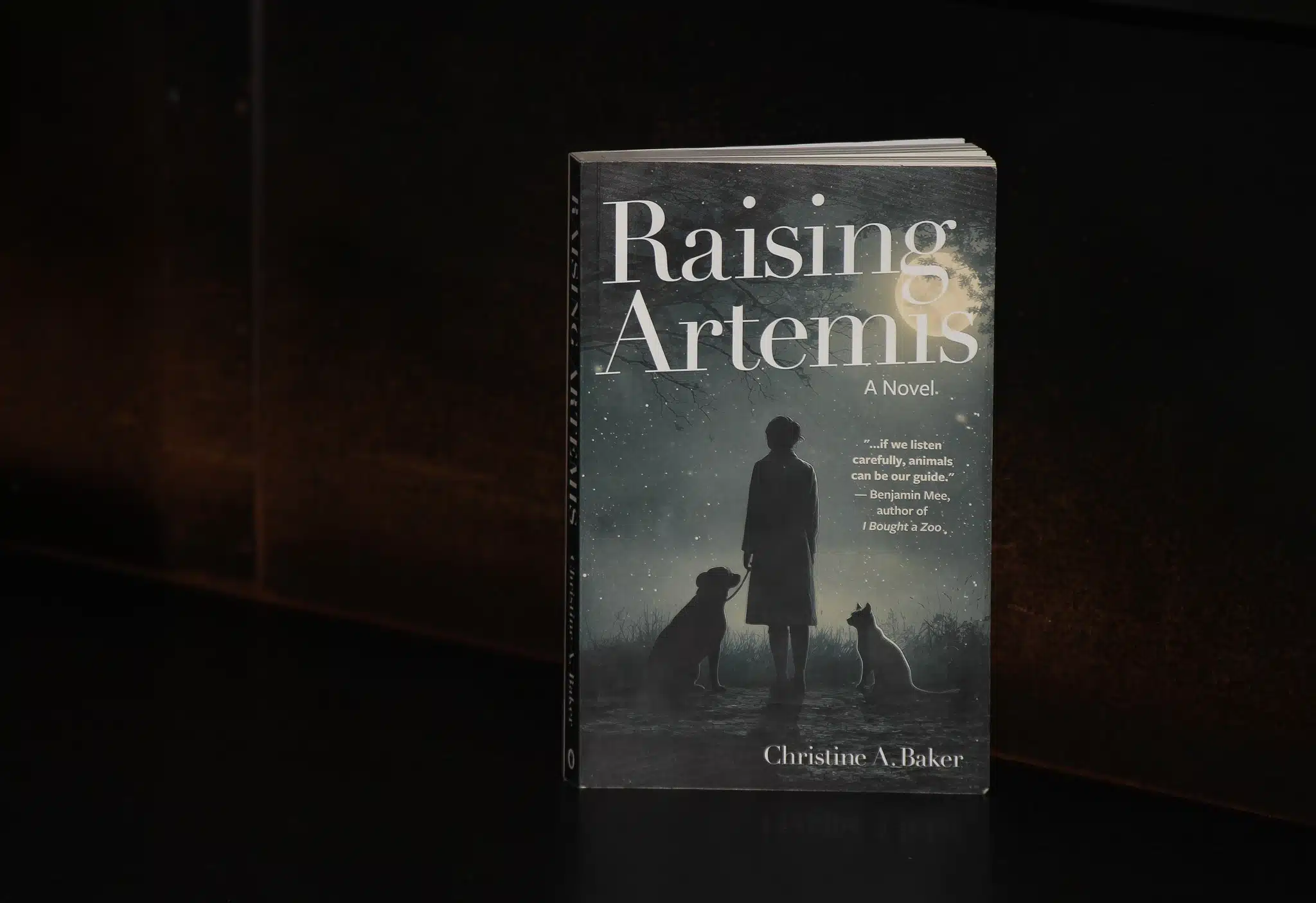
The “Raising Artemis” front cover shows Artemis standing outside on a starry night with a full moon. She appears to be gazing off into the distance while a dog and a cat stand on either side of her. Her apparent reflectiveness sets the tone for a book about a woman on a journey and the animals standing on either side of her show their support for her. The cover feels more artistic than sales oriented.
On the front cover, the book title text is slanted slightly upward and the quote “if we listen carefully, animals can be our guide” by Benjamin Mee appears along with the author’s name.
On the back cover, the book blurb and more author quotes appear.
Reviewer’s Personal Opinion: Touching Pet/Human Interactions, Too Much Narrative
The strength in the novel lies in Artemis’ interactions with her pets. I have owned dogs most of my life and found it easy to connect to Baker’s animal characters. I love having dogs as companions and feel that I have learned to understand them most of the time. So many of the interactions the dogs and cats have with Artemis are touching and beautiful and remind me of special moments I have had with different pet dogs over the course of my life.
I found it compelling that the story was narrated by Lucy and that the animals worked together to support Artemis. I especially enjoyed the scenes that highlighted the special connection the pets felt with their owner.
Artemis annoyed me in the beginning. She was so unhinged and became angry when her superior called her out on her incompetence. I don’t believe most medical professionals would want to be performing so badly and putting patients at risk.
After Artemis is put on leave, she’s still in her scrubs and goes to the animal shelter and adopts the kitten she soon names Phoebe. It’s a very touching scene and gave me insight into the “real” Artemis behind her unhinged and willful exterior.
There was no mention of her ever having had one or wishing she could find someone. This absence felt awkward to me. At some point in the story, I would have liked to know why Artemis had no interest in finding a life partner.
Chapter 41 up until the Epilogue did not work for me. Sections were choppy and many simply slowed the story and felt unnecessary.
On page 195, the narrator cat, Lucy, says “It was so lovely to walk inside a building without wearing a mask,” which was likely a point-of-view slip because we all know that cats don’t wear masks. Some pet owners masked their pets during the pandemic, but this practice was not common.
Artemis apparently gravitates toward medicine to compensate for the guilt she feels over her brother’s death and not being with her beloved childhood dog, Sam, during his final moments when he was put to sleep. I felt like this character point could have been developed in more depth. I did like the scene where she saved the animals and a shelter volunteer during an emergency while thinking of her brother. Every action she took saved animal and human lives this time, and it helped her feel empowered again.
I have not met the author in person or connected with her online. An advanced review copy was given to The Rauch Review, and I was assigned to review the book.
Baker states at the end of the book that all the animals in the book are ones she owned and that the book is a “love letter to them.” The author felt present to me in Artemis’ character.
Conclusion: Strong Emotional Elements, But Noticeable Flaws
‘Raising Artemis’ is a touching story about a group of pet cats and dogs, live and deceased, banding together to support their owner, Artemis. Her gentle and loving interactions with these animals and the growth Artemis experiences carry the story. The choppy sections late in the book, unrealistic hospital scene, and a point-of-view slip detracted from the reading experience. These issues resulted in my choice to deduct 1.5 stars from the rating.
Buying and Rental Options
‘Raising Artemis’ in not yet available for purchase. It is slated for release December 15, 2026. It can be pre-ordered from Amazon and Barnes and Noble.
E-Commerce Text Purchases