
As an Amazon Associate, we earn from qualifying purchases.
TLDR
‘Mere Christianity’ by C.S. Lewis explores life as a reflection of God, but fails to provide readers with meaningful direction to follow. Lewis lays out large theological themes for readers to grapple with independently. Read our review to see where “Mere Christianity” succeeds and falls short for its readers.
“Mere Christianity” by C.S. Lewis attempts to cover how God is illuminated in life. The reader is supposed to learn how life is a reflection of God, so that we can learn about God through our lives.
The problem is that this message is not written as an overarching theme imbued through all parts of the text. The reader is not given a clear direction to follow. Instead we get various theological concepts that are not fully explored or backed by evidence.
Our review and analysis breaks down, in-depth, why this book fails to meaningfully explore Christian concepts.
Context: Speeches Adapted Into a Book
The context of this text is that it was originally a series of speeches. Even as speeches, it fails.
A speech could have been one sentence explored in 10 minutes. Instead we get 100 ideas not thoroughly explored and investigated. Lewis also brings up concepts such an Pantheism which could be covered in a full book. Instead he gives appetizers, not meals.
The Problem With Books Made From Speeches
“Mere Christianity” is a compilation of speeches Lewis made about various aspects of Christianity. Many authors and publishers have monetized non-book pieces by packaging them as a book with a theme. This strategy often fails.
When a writer is skilled in one text format, there is no guarantee their writing in other formats will immediately reach the same level of quality. Like novel writing, speech writing requires a combination of talent and practice.
It’s unlikely that Lewis practiced speech writing as much as being a novelist. In his novels, he was able to articulate complex, nuanced views about Christianity. His speeches fail in this regard.
There are cases when speeches can be compiled into good books. Because MLK was an excellent speech writer, we highly recommend purchasing at least one of his speech compilation books, namely “All Labor Has Dignity.” Unfortunately “Mere Christianity” is not one of these worthwhile purchases.
If you want to consider a similar but superior book by Lewis, check out our review of “The Screwtape Letters.”
At The Rauch Review, we care deeply about being transparent and earning your trust. These articles explain why and how we created our unique methodology for reviewing books and other storytelling mediums.
Book Cover: Not Much Relation to the Book’s Content
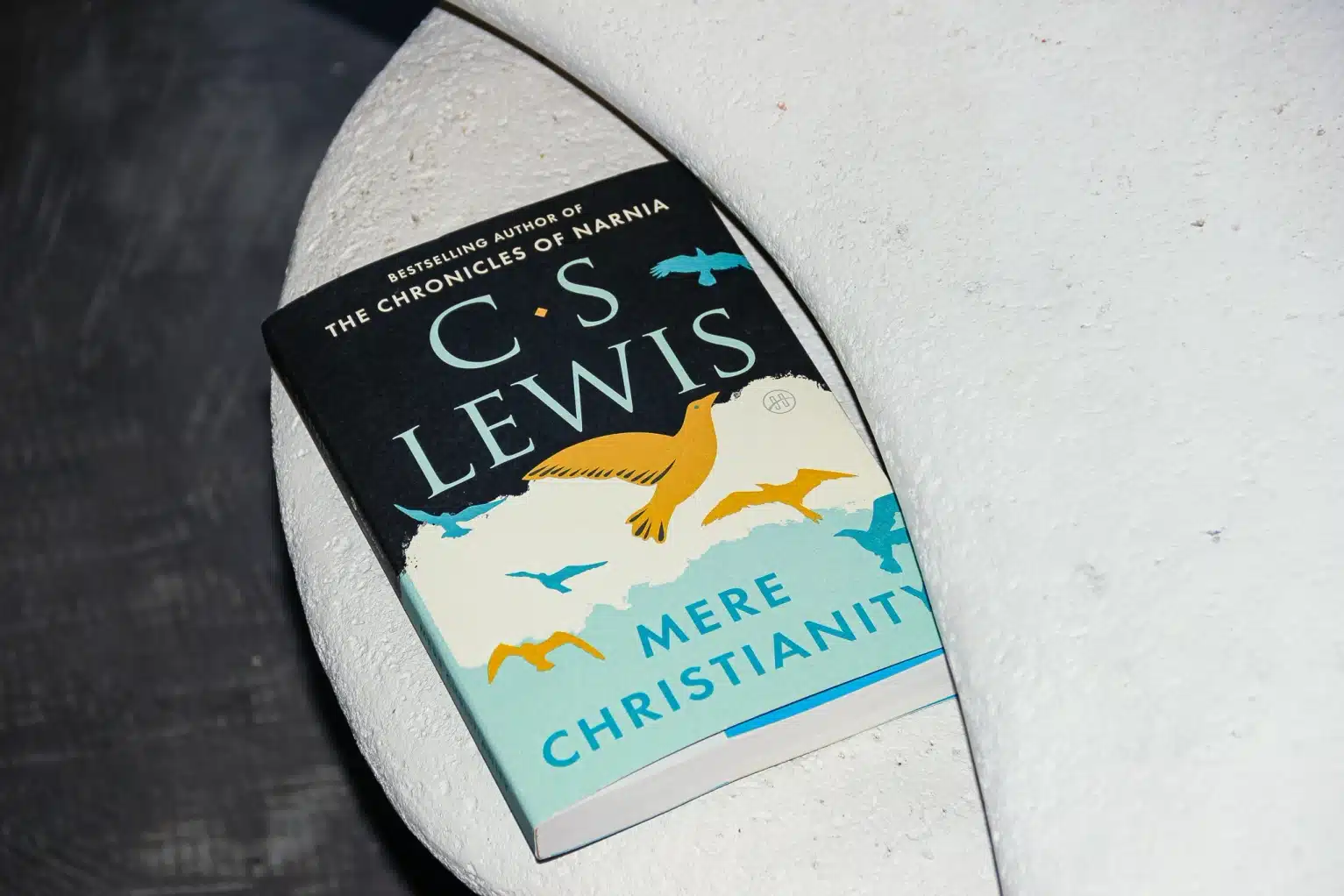
The book cover contains birds, which makes me think of the Christian dove in yellow and blue in front of yellow and blue clouds. Other than a dove reference and clouds appearing in the Bible, I am not sure how it relates to the book. Pantheism, morals, and being in unison with God doesn’t evoke birds and clouds to me. But the book has no focus either.
Audience: Christians Who Are New to the Faith
The book is for someone who wants to learn about facets of Christianity without a deep dive into a focused concept. This book is definitely for someone beginning their walk in faith, but not someone who has already read the Bible. Some ideas expressed are introductory while some ideas are more theory-focused. The content has been altered to make it read more like a book than a speech.
Summary: Four Topics, Each With Its Own Section
“Mere Christianity” is separated into four sections:
- Right and Wrong
- What Christians Believe
- Christian Behavior
- The Trinity
This review will express the focus of this book and where it fails using the first five chapters of each book.
The book focuses on how life reflects God; however, its ideas are not fully investigated. Anyone looking for research topics will find ideas to further explore through this book.
Analysis and Critique
Book 1: Right and Wrong
Chapter 1: People Actually Don’t Always Know What is Right
C.S. Lewis begins “Mere Christianity” with the “Laws of Nature,” which is basically a set of principles that he finds all humans agree upon. The problem is that even though we know what is right, we do not always follow what is right.
Lewis is clear on his point of view, but lacking in his evidence. This first assertion could have been expanded upon throughout an entire book in and of itself. He talks about how Egyptians and Babylonians created moral codes that seem to agree with how most people perceive morals, but Lewis does not appropriately use evidence. Lewis could have written a book that served as a comparative analysis of various culture’s moral codes. He could have organized a book where each chapter chooses one moral code to analyze how various cultures throughout history have addressed specific moral assertions.
“Laws of Nature” is Lewis’ first assertion that is lacking in proof. He names cultures with similar codes without stating those codes and doing an analysis of their point of view.
There are many ways he could have designed his proof. We mentioned moral code cultural comparison. He could have isolated those cultural comparisons by time period. The reader was not told if those cultures interacted through trade routes, which would naturally involve each culture having the same morals since they interact with each other.
Lewis mentions that people know right from wrong, but choose to break rules. Why and how have various cultures resisted their moral nature, and is rule-breaking then unnatural? Humans disagree on issues daily, so how can Lewis state every time we go against our morals, we are not doing what we think is right? Some cultures are legally bound to religious morals.
This topic is a whole book. Legal documents, which would have anecdotal information around rule-breakers in theocracies, could examine who is breaking rules, their relationship to morality, and why they choose to break rules. Is it even a choice or how a person naturally thinks?
Lewis’ point of view explores how God is reflected in life, so he finds that the world reflects God. Lewis does not go into specific moral codes with enough evidence; thus, the reader does not know how the “Laws of Nature” are reflected in life. Lewis uses evidence in random ways that are not backed by enough proof. Many know Christian doctrine, but without directly using Biblical evidence and culture-dropping countries without stating their code, his idea remains unexplained.
Chapter 2: Physical Evidence for a Spiritual Argument
Lewis compares instincts to “Moral Law.” He defines instinct as giving into our desires, while morality allows us to resist our desires. He uses physical evidence, for example, New York being a physical location no human would deny exists.
He does not use spiritually-physical evidence. This distinction would have been an opportunity to describe miracles or phenomena, such as being healed through someone laying hands on you. Spiritual-physical evidence to prove his point could be a whole book.
Laying on of hands and the miracles it provides is a whole book of spiritual-physical evidence. Physical evidence is not comparable to morality without the spiritual component to back it up. We know New York exists. A better example could have been used for evidence.
The first chapter deals with breaking spiritual law. Where is the evidence of what causes us to break spiritual law outside of him simply announcing it?
Lewis has not convinced the reader that morality is not simply indoctrination because he lacks spiritual-physical evidence: manifestations of morality that are tangible. He does not address how our conscious is built by society and assumes we are born, programmed with morality inside us. He has not observed enough phenomena to prove his perspective. Lewis offers assertion without justification.
God is illuminated in us when we obey him, but he has not addressed thoroughly if we are born with him. Evidence of miracles could have supported this. Texts of healing through hands could have expressed this. Not assuming humans are bad through instincts that are always bad could have given credibility to this.
Chapter 3: Not Enough Evidence to Support His Theory on Why People Follow Morals
Chapter 3 is interesting because Lewis addresses internal human design in contrast to morality, which is external to us. This part is where he suggests that people follow morals that have nothing to do with who we actually are. We follow just because. We have no reason to be moral; it is something we simply do.
This chapter fails too, but is ambitious. Anecdotal evidence of consequences of immorality would have made sense here. The reader would get some idea of why to follow morals, but Lewis suggests there is no reason to by stating it is external to us.
When Lewis mentions that morals is something we “should” do, even though we are not predictably moral asserts that morals are an ideal, not a reality, which weakens his point of view. Faith is central to this book, which might be why his work lacks concrete evidence. The reader is given assertions, the same way a Bible verse can be assertive. But, for a book that presents a point of view, the reader needs evidence.
It is hard to see how God is illuminated in reality without evidence. Lewis drops one piece of evidence to describe his assertion, but doesn’t then prove his assertion with enough evidence. Lewis’ points are clear, but he does not provide credibility.
Chapter 4: Insufficient Evidence on Ideas of Materialist vs. Religious Views
Then, he compares the materialist view to the religious view. The materialist states things don’t have a reason to exist. The religious view states that something external to us is why things exist. For there to be a religious view, Lewis doesn’t seem to provide too many reasons. Lewis states that humans naturally attempt to understand themselves, and we need a guide to get through life.
This perception is theoretical in a way that is difficult to think of ways it can be proven. You could bring up miracles, but that does not disprove the materialist view because phenomena can exist without reason. The other way would be to prove communication with God. This communication would suggest an external source. For Christians, this conversation happens through the Holy Spirit.
But speaking in tongues isn’t experienced by everyone. This is where Christianity becomes an invitation. A whole book could compare the materialist and religious view under the lens of glossolalia. Lewis does something worse than an unproven assertion; with this, he gives an unproven theory.
How do we illuminate God through a theory? With this theory, perhaps through spiritual phenomena. If Lewis gave evidence on the materialist and religious view, that could have offered more insight. Without evidence, all we have is an idea.
Chapter 5: No Examples of Salvation Through Hardship
Lewis addresses the need for hardship in life with the assertion that comfort does not always lead to positive outcomes, while the work of being sanctified as a Christian leads to the positive outcome of salvation. But, again, this is an assertion not backed by evidence. A statement like this could be backed by autobiographies of people who are saved. Each biography could serve as evidence.
We could also find books by people who are not yet saved, but are on that journey. A book like this would show the consequences of decisions a person makes as they move closer to God. We all have a tragic flaw. The condition that holds a Christian back — adultery, theft or Satanism — is a topic worth a read as its own book. As we see ourselves reflected, we can see ourselves overcome. Hamartia, the equivalent Christian term for tragic flaw, is worth exploration.
Lewis addresses how we make a wrong turn in life and how comfort can become uncomfortable. Autobiographies of our journey through Hamartia depict the challenge we all want to overcome. Every author would reflect distinct color within a prism of our fall.
Lewis could have used this chapter to show how God is illuminated in all humans. It would have been nice to have in-depth evidence for the assertion he upholds within this portion of “Mere Christianity.”
This book is more of an inception than it is complete. It is a beginning. It is potential.
Book 2: What Christians Believe
Chapter 1: Is God the World?
Lewis covers a few belief systems in chapter 1 of book two, including Pantheism, Christianity and Atheism. The core message in this chapter is whether God is external to the world or if God is the world. He believes Atheists take meaning out of the world. External meaning, internal meaning, or the world having no meaning could be a whole book.
Lewis mentions God is good and separate from evil, but our instincts blur the lines of good and evil in a world that distinguishes less between good and evil. God’s illumination is thus, internal, external, or meaningless in life.
Frame of reference is integral to deciphering Lewis’ message in this chapter. If God is the world, we can understand God by understanding the world. If God is separate from the world, some parts of the world do not reflect his morals. If the world has no meaning or no creator, the world has no design. God gives the world a guide to understand its creation.
A book about whether God is external or internal to the world could be covered in great length. The reader could learn how God is reflected in the world and if everything in the world is even a reflection of God. If the world has no meaning, there is no need to understand the world. Does God give humans purpose? Why do we come up with reasons for things?
What would be the test for understanding if the world is a projection of God or an external playground that sifts us morally? Tests for God’s illumination being external or internal is a whole book. I guess this is the point of miracles. Documentation of miracles explores the spiritual tests of God’s design. What is the rubric of experimental rigor?
Chapter 2: Missing Reasons for Why People Become Evil
Lewis believes evil comes with some positive attachment. For example, maybe you want money, which seems good, but then you have to do something bad to get it. Positive attachments to evil could be a research topic. It could be complemented with studies on how to decipher pure good from good/evil experiences and how to resist temptation. This analysis would add a call to action for the text around resistance of evil.
Once again, Lewis has made a clear assertion without enough evidence. He states cruelty is the work of sadists and pleasure seekers without all the other possibilities of why someone would be evil. If he would have teased out phenomena around his theory and added a call to action, it might be more compelling. Instead the reader is left with an incomplete thought. The book feels like a long ramble, with little evidence, and little reason to read other than to be inspired.
The context of this book is that the text comes from speeches he gave, which is why it is a ramble. But even a speech could have more structure. Expansion of this work would be desirable. Tested ideas would be necessary. A call to action would be ideal.
God’s illumination of humanity’s decisions is core to this chapter. We are faced with phenomena that can be purely good, purely evil or a hybrid of the two. How we deal with dilemmas determine our relationship with God.
Chapter 3: A Shallow Exploration of Free Will
Lewis asserts that Earth is a place of free will by offering a choice between good and evil. God is the optimal image of good, so outside of him is evil. This assertion is another without reason. This passage would have been an opportunity to go in-depth about free will or offer some point of view that would inspire the reader. We only find from Lewis that humans can make choices.
How does the world illuminate God’s purity? This question would be a lifetime of work. Lewis could have used anecdotal evidence. He could have given a reason for doing good. The context of this text is that it is an invitation into Christianity, but outside of definitive words like free will, it is unclear what should be done as the reader. This section focuses on how to be a Christian, but doesn’t give strong reason for why.
Yes, the reader can avoid hell. Yes, the reader can choose to be a good person. Yes, the reader can look to the world for signs of God. Lewis tells you what Christians think, but that idea is so broad that each facet needs its own book.
Lewis gives almost stream of consciousness thoughts on topics in Christianity. This book could inspire a series, but as a standalone book falls short. The reader isn’t convinced why he should become a Christian. Instead he is given stained glass shards of various facets into a world vast and uncontained.
Chapter 4: Ignoring the Fact That Most People Know the Basics of Who Jesus Is
Lewis states repentance is only for sinners, not for God, because Jesus was without sin. God surrendered, which teaches us to surrender. Someone who has never heard of Jesus might not know this, but this doesn’t add information to someone who is Christian. Lewis’ audience is someone who doesn’t know Jesus, and the guinea pigs for his theology. It offers another assertion without call to action or evidence. This assertion would have been an opportunity to learn about salvation.
The steps to being saved would have been great to read. It would have given the reader a call to action. It would have given the reader something to strive for.
Instead, we’re given an idea. Instead, we’re given a premise.
Lewis does imply God is illuminated in us as we grow while he holds our hands through our Christian journey. Lewis does state that we are sinners, which would have been an opportunity to prove this against the perception that we are no longer sinners since God has saved us. “Mere Christianity” offers ideas without opportunity for personal development.
Chapter 5: Baptism, Belief and Communion
Lewis offers the three things Christians have in common — baptism, belief and communion. He also states that Christianity focuses on God operating in us (not only that we think about him).
Baptism and communion are two separate books. Belief is too broad, and is the focus of this book. God operating in us is a whole book. A whole author’s career could cover baptism — from historical documents of its occurrence to theology around the reason it exists (same for communion).
Belief could be a career, but needs to be done appropriately. This book focuses on belief and clearly shows why it lacks focus. A new book could cover each commandment. A new book could cover God’s grace. A new book could cover if someone believes we are saved from sin. And even then, each book could be more focused.
God operating in us is a career on the fruits we bear. Each author’s book could be a fruit, embodying the principle of a person’s work. What does an author manifest and how is it a reflection of them? Who has the right to lead other Christians? Where do we see God in our production?
God is illuminated in our words and actions. How do our words reflect our beliefs? Can we believe in God without submitting to his word? How can we have faith and continue to sin? It’s one thing to state you believe in God. Another to show you actually believe in his word as expressed through your conscience.
Book 3: Christian Behavior
Chapter 1: What Does It Mean to be in Unison With God?
Lewis argues that a purpose of Christianity is to be in unison with God; social and personal integrity are crucial toward achieving this goal. This is another assertion without support of how in great enough detail. This assertion is kind of what the book is about, but is not reflected in every aspect of this book. While becoming in unison with God is a focus of this book, this perspective is not framed as the overarching message of the book. Each section is a facet of this, but each section also has its own focus.
This lack of detail is where the structure fails. Had this been the overarching theme, “Mere Christianity” might have been more successful as a work. Lewis could have emphasized being in unison with God when discussing the “Laws of Nature.” Choosing between good and evil could have been framed as a way to get closer to God. Humans distinguishing Christian choices from instinct to get closer to God would add focus.
Then you have sections that are less of a fit. Understanding God as either a projection of the world or separate from the world offers insight into the nature of God, but does not explain how to get closer to him. Morality being external to us offers insight into the nature of having integrity, but isn’t specific to a call to action of getting closer to God.
This chapter could have been the focus of the book and would have offered great insight into how God is illuminated in the world. The reader would have understood how God is reflected in life, while learning how to be a better Christian. Being in unison with God could have focused on the “how” instead of the “what.”
Chapter 2: Cardinal and Theological Rules
Lewis covers cardinal and theological rules. Cardinal rules should be followed by all humans. Theological rules are specific to Christians. These rules seem random and could be covered in two separate books. Cardinal rules could be illustrated through life examples in one full book alone. The same could be done for theological rules.
If Lewis wanted to focus on the “what,” he could explore the history of both rule sets. If he wanted to write about the “how,” he could have written about specific individuals’ lives that illustrate these values. He could have explored the “why” to understand why someone would even want to follow these rules. “Mere Christianity” seems like a class on topics that don’t have a point. It’s like a teacher who explores in real-time and didn’t complete the research.
The point of view is clear, but not expansive. The reader will know what each rule/virtue is about, but not much else. No application. No reason. Just theory.
Bible verses could have been referenced here for how God showed he is a reflection of these values. We could even learn how these values are reflected in life. Instead we get notes without a book. Because this book is actually a collection of speeches, it might have made sense for the speech format to be more obvious. This book would be more successful if formatted like it originally was made. As a book, it fails.
Chapter 3: The Golden Rule
Lewis mentions the Golden Rule of treating others as you would like to be treated. The reader is not given in-depth information about this. A whole book could have been written about people who follow the Golden Rule. The reader is given random Christian principles with random assertions in ways that are still barely an introductory text. It was as if Lewis was asked to speak and conducted bibliomancy to make decisions about what to write.
He does mention charity and giving. I would have loved to read a focused book on giving. “Mere Christianity” fails because it is a collection of speeches written as a book. A book comes with implications different from a speech. There is a certain decorum expected from a book. Lewis breaks expectation.
The Golden Rule has many ways that it can be discussed. Lewis concept drops without enough context. It does not even read as a step-by-step guide of actions to live by. The response is not curated. Who should read this other than someone looking for a rabbit hole?
How God is illuminated in the Golden Rule would have been an amazing book. Even how he is illuminated in us. “Mere Christianity” doesn’t do enough because it does too much. Each idea within it could be further explored.
Chapter 4: Unexplained Name and Concept Dropping
Lewis does something I call name-dropping and concept-dropping where he mentions an obscure prominent figure or a concept the reader might not be knowledgeable of without offering explanation and context.
For instance, he name drops Himmler, which might be the Nazi Heinrich Himmler. He uses Himmler to assert that greater Christians have a larger learning curve, meaning they have the most growth to do when it comes to morality; thus, are more exceptional because they’ve done more work. He contrasts how psychology focuses on norms more than morality and mentions that we should apply Christian principles to society.
Lewis struggles with thorough drenching of each concept he aims to explore. He has a new assertion in each chapter and does not offer great context for his assertions. He is a clear writer without thorough investigation.
The convert Paul is relevant in this chapter. He illuminates God’s purpose in a way reflected through Christian learning curves. Paul was the antithesis who complemented Christianity’s credibility. Each convert found can offer their own book via their testimony. Each person is evidence.
Chapter 5: Comparisons of Social Values
Lewis often offers examples, but one illustrative example is different from extensive evidence. He offers a comparison of social modes and Christian values. Modesty is different from chastity because modesty is subjective and personal to the word’s speaker. We all have different perceptions on what is considered modest. Chastity is more strict; it is abstinence or marriage.
Social modes are a focus of this chapter for him. If only he lived now. Lewis stated that putting food out on a stage for people to look at is strange, especially without them being able to eat. The subjectivity of modesty compared to chastity as social modes is revealed here.
Lewis did not live to see mukbangs. A mukbang is a trend where you literally watch people eat.
Lewis could have written a whole book comparing social modes to theology. He offers various social constructs, such as prudeness, modesty and propriety. Each of these words is at least an essay. Distinguishing social modes from theology is a life-long research project.
Book 4: Beyond Personality
Chapter 1: Bios vs. Zoe
Lewis compares the natural world, which he calls Bios, to the spiritual world, which he calls Zoe. Bios could be a book; Zoe could be its own book. A comparison of the two could be their own book. Lewis states that humans cannot be God, but the goal is to be God-like. He concept-drops once again for an idea that could be a full book. While it is understood that this text is an adaptation of speeches, each speech could be a whole conference.
Lewis imbues duality into his expression. In this case he uses Bios and Zoe. Before he compares morality and instinct. Duality concepts is a whole research career. He doesn’t go deeply into what Zoe and Bios are like. There is expression without extension of the idea.
Being God-like is also its own book. Lewis goes over the characteristics of Christian qualities, but the text isn’t organized around being God-like. It is a sketch of various Christian concepts. There is thematic structure around Christian ideas, but no core focus.
How God is illuminated in life seems to be the intention, but it fails. There is no clear direction of this being the overarching idea. There is no clear structure of this being the overarching idea.
Chapter 2: Contradictions on How to Learn About God Through Other Christians
Lewis describes how Christians can learn about God through other Christians because we are a reflection on him. In the same chapter, he mentions how humans cannot comprehend the Trinity because we are on an earthly realm that is made of a different type of properties and design. A biography could be written where a person embodies each Christian virtue to teach about Christianity. This book seems like a long ramble that doesn’t contain a central point of view. This offers another assertion without illustration or evidence.
The Trinity is not thoroughly addressed in this chapter. Lewis just tells us that The Trinity is beyond human comprehension without offering spiritual evidence as to why. The “how” is also barely addressed. There is no extension of the idea beyond the assertion. The reader is left with an incomplete idea.
It seems that Lewis presents a book of theories without much else beyond the ideas. He does not offer strategies for how we can learn from other Christians. He could have mentioned fellowship in church or prayer circles. Instead he just presents a suggestion. No concrete approaches are given.
Chapter 3: God in Relation to Time
Lewis states that God is not bound by time; he is beyond past, present and future. He exists in all time. This point pivots from the idea that he is inconceivable as The Trinity.
Lewis does not have footnotes for his statements, which makes it unclear if he is looking at other sources or making things up. Some ideas expressed are definitely Christian, but some might be his own perspective. If he used sources, this work would be more authoritative and would seem researched.
Instead the reader is given various ideas without explanation and no clear sign of the source. Lewis does not use Bible verses for his ideas. He presents another assertion without explanation. The relationship between God and time could be its own book. A description of how God compared to time is lacking.
If God is outside of time, Lewis explaining this notion more would have helped. He makes an assertion without offering what God is in relation to time instead. Lewis doesn’t even explain where God is outside of time. He has a clear point, but didn’t write anything about his perspective. There is no point of view.
The book explores how God is illuminated in life. Lewis does not offer time outside of God. Lewis does not offer what a timeless world looks like. He creates work that makes the reader ask questions instead of receive answers. The text is incomplete.
Chapter 4: God Begetting God
Lewis states that humans become sons of God through loving The Father so the Holy Spirit will move through. “Mere Christianity” has no trajectory or pathway.
Even as speeches, the ideas are lacking. A speech makes sense when bite-size ideas are thoroughly expressed in a short amount of time. This topic is one that would allow for that, but terms like Bios require a format that allows for more time. The Holy Spirit moving through us is perfect for the time of a speech, but still Lewis is vague and rambles.
We are never given a clear pathway to read. In this same chapter, he talks about God begetting God because he is one person. This one idea could have been explored in one speech.
He uses logic to describe why God begets God instead of creating God. He states that someone cannot make themselves; thus, God didn’t create God. Other parts of “Mere Christianity” push against aspects of God being conceivable. Other parts seem to function on man-made logic and theories. The reader does not get expanded ideas.
God can be illuminated through us as expressed through the Holy Spirit. But this chapter deals more with theology than about God being illuminated through life. This chapter has the idea of what the Holy Spirit’s function is. The function of the Holy Spirit is a whole book. This chapter also has more than one idea that is not thoroughly investigated.
Chapter 5: Christ, the Son
Lewis states that God became a Son of God to show Christians how to become Sons of God with the promise of eternal life, if we accept him. The book could have been about this, but instead lacks focus.
A book like this that adapts speeches would have been more appropriate as a compilation of a series of speeches that were related in content. These chapters have little that connects them. While the book is made of four sections, each topic remains unexplored.
Lewis explores how we can become Christ-Like, but the book didn’t stick to that angle. The text drifts in various directions. There is no stable idea steering the experience. Instead we have various assertions and points of view. Everlasting life is also tangentially explored.
Salvation is its own book topic. Instead it is touched upon in this same speech. How to accept God is a whole series of speeches. How to become saved is its own topic. There is no focus.
God being illuminated through us is covered in this chapter. The reader can see that we should become Christ-Like. We learn about salvation without enough of the “how.” The text does not give us clarity. We are simply not given enough of the “how.”
Critiquing the Critics: Are We the Only People Trying to Critique This Book?
Of the dozens of consumer and critic reviews we’ve browsed so far, all are glowing. None critique the depth of content in the book. The sense we get is that the vast majority of readers are simply happy to see praise of Christianity, a Christian philosophy with a unifying spirit (within Christianity) and non-novel words from one of their favorite novelists. Other reviewers are not actually trying to analyze how this book could have been better, how Lewis could have put more thought into his speeches or written proper books expanding on the ideas in his speeches.

Get the latest of The Rauch Review in your inbox, discover books you won’t see in stores, stay up to date on the “Rauching to Judgment” podcast and more.