
As an Amazon Associate, we earn from qualifying purchases.
TLDR
Hedges presents a compelling anti-war message and literary prose detailing his war journalism across the world. He attempts to explain why average people support wars and fail to end them. Unfortunately the narrative jumps around to the point where the book loses clarity. Readers should not expect hopeful rhetoric or a satisfying solution.
When preparing for this book, I went to its Goodreads page and saw that the promotional text opened with this quote from General Patton: “Compared to war all other forms of human endeavor shrink to insignificance. God, I do love it so!”
A person hopes that even a general realizes the atrocities of war, rather than elevating it to the ultimate human achievement. Chris Hedges, in “War Is a Force That Gives Us Meaning,” attempts to lay the groundwork for why people may feel that war does overcome our emotions and we fall victim to the rush of war being a driving force behind what we do as a society. He counterbalances our emotions with the ugly truth of war that people need to see so as not to be emboldened by General Patton’s exaltations of war.
In this counterbalance, Chris Hedges writes side by side throughout the book both the rationale for why we as individuals and society become overtaken with war, and the atrocities war brings. This narrative shows us the truth that, once it is over, our lives and our society are forever changed. And rarely in a good way.
The faint of heart might be able to handle this book, yet they need to know Mr. Hedges pulls from actual events in conflicts he witnessed. To create a sense of shock, he occasionally goes into graphic detail.
This book is not a how-to-end-war diatribe. It is hard-hitting both in the stories and Mr. Hedges points about why we fail to end wars in general. He makes points we don’t want to hear if we believe society can do better. There are a few critiques on the writing itself, but the points will resonate with you and leave you more concerned about who we are as humans than before you read it.
Does the title, “War Is a Force That Gives Us Meaning,” leave us with half the expectations of what we are about to read? Or is there a double meaning in that learning about war gives us a new meaning to comprehend?
‘War Is a Force That Gives Us Meaning’ Summary: Is Understanding the Horrors of War Enough?
Originally published in 2002, “War Is a Force That Gives Us Meaning” is Pulitzer prize-winning author Chris Hedges’ first book.
Mr. Hedges, known for his rule-breaking reporting style, gives us an in-depth look into his experiences in covering conflicts throughout the world. He brings together his work as a reporter covering four areas of conflict — Argentina, El Salvador, the Middle East and Croatia — showing the reader the realities of war that never make the 10 o’clock news.
The book contains an introduction and seven chapters that describe in detail the horrors of war from the viewpoint of many civilians who lived through the various conflicts. Each chapter has a theme that he juxtaposed his stories with the psychology of how wars are manufactured and woven into our lives through propaganda, elitist manipulations and more.
At The Rauch Review, we care deeply about being transparent and earning your trust. These articles explain why and how we created our unique methodology for reviewing books and other storytelling mediums.
Audience and Genre: The People Who Most Need to Read This Book, Won’t
One person who needs to read this book is Pete Hegseth, with an open mind. However, I doubt that will happen.
Originally I feel Mr. Hedges tried to reach an audience that wants to better understand why we fall victim to the need for war in any society so we can overcome our worst instincts. Today this book may be more suited to an audience that plays too many video games where the fighting appears real even to the point some people say they can experience a form of PTSD, yet these gamers never see the real horrors of war in these make-believe worlds.
For many this is still a good book to read to remind ourselves there is a choice in what we do. And for young adults this book can help them learn how to overcome the false narratives people in power will push to them so they can help society make better choices, not just about war but other endeavors.
Three Cs: Compelling, Clear, Concise
Editorial Note: We believe these three factors are important for evaluating general writing quality across every aspect of the book. Before you get into further analysis, here’s a quick breakdown to clarify how we’re using these words:
- Compelling: Does the author consistently write in a way that would make most readers emotionally invested in the book’s content?
- Clear: Are most sentences and parts of the book easy enough to read and understand?
- Concise: Are there sections or many sentences that could be cut? Does the book have pacing problems?
Before I discuss the particulars of the topics of how compelling the book is, or how concise or clear is the writing, I want to make one note that affects all three areas. Mr. Hedges throughout the whole book jumps back and forth between time, places and his literary references to highlight his points or thoughts. At times you find yourself immersed in El Salvador or Croatia or Iran, yet he jumps back and forth sometimes from paragraph to paragraph. You must reread a page or two to remind yourself which decade and which war he is describing and why did a switch occur.
Yes, Mr. Hedges does delineate the exact horrors and repercussions of each war, but he switches the whole scenario throughout the book in a manner that feels random. I know it isn’t random because he is going back and forth to make his particular point for that chapter, yet sudden changes from one scenario to another affect exactly how compelling, clear and concise the book is.
Compelling: Amazing Scenes Disrupted by Bumpy Transitions
Considering how well Mr. Hedges describes in detail what he sees and lives in the first-person narratives he gives us, you might think it would be more compelling. Yet his scattered presentation leaves us having to stop a moment and gather ourselves to move forward. And then we must realign ourselves with the topic of the chapter to appreciate the points he is making. The details shared should be a gut punch to us and force us to want to react. And in general a reader can feel the angst building inside, yet the shifting from one scenario to another distracts us from the impact the book wants to make.
The book is definitely compelling because Mr. Hedges gives us the vivid detail of the horrors he witnessed, or the individual stories. Yet the stories get lost to the big picture.
For example in Chapter 4 “The Seduction of Battle and the Perversion of War,” he spends five pages discussing life in the Gaza strip, how young boys are tempted to attack the Israelis and their subsequent injuries and death, then talking to the mother of one of the boys and her feelings about their lives and viewpoints. Then abruptly we are in Yugoslavia reading about the government allowing pornography, which coincides with the exact same time the war begins to tie together a point that “War and sex were the stimulants to divert a society that was collapsing.” (page 99).
Everything about the horrors of the situation on the Gaza strip became lost as you’re jolted forward. This is just one example of how the reader loses the impact and the emotional tie into one group of people or their story.
Another example is from Chapter 2 “Plague of Nationalism” where he switches from talking about Yugoslavia and the various cultures involved in the war to talking about Argentina. He does give us one transitional paragraph about the point he wants to make that crosses from page 58 to page 59. This bridge helps, yet going from pages of Yugoslavia back to discussing Argentina during the Falklands war with just one paragraph that feels bumpy and lacks momentum.
Clear: Too Many Narrative Switches
On a page by page basis, in each individual paragraph the reader is told a clear story… until it changes. As noted in the examples above, I clearly understood the scene, the description and what was happening. The story was well told with no difficulty reading it, until it switched. Yes the next point was well told also, but too many transitions were too stark, too much of a scenario change that you felt lost for a moment.
Mr. Hedges writes well. In all his books, his literary and historical references are on target. He successfully uses them to help make his points. In this book, though, even these references get in the way sometimes. They help make the point, but you have to piece together three or four stories that come at you differently to meld it all together.
Concise: Not Too Long, But Very Dense
It throws the reader into a maze of information and stories that they need to complete to fully understand the meaning at the end of each chapter. The points are made, but does the reader have to work too hard to grasp it all? I think some readers will feel exhausted.
I do feel the last chapter “Eros and Thanos” is the better one when it comes to tying the points together.
Prose Style: A Combination of Journalism and Literary Narrative
I once read that the problem with something called “gonzo journalism” is that it is not journalism because it puts the author too much into the narrative. And the story becomes more about the author than what is happening.
Chris Hedges does not have this problem at all. He certainly relates the stories to you. Sometimes in a journalistic style, he tells you the facts, the details, the who, what, why, when, where and how. Other times he gives you the story in a narrative fashion, yet he never becomes the story even when using a first-person voice. Mr. Hedges helps the reader to observe, not feel pressured to determine if the author is forcing a story onto them. Add in his ability to eventually tie up all the strings, and the reader feels both informed from reports and encouraged to think from the questions raised and points made. This combination makes the book philosophically and historically educational simultaneously.
Rhetoric: Reasoned and Credible, Not Hopeful
The narrative in this book is not always clear, but the points are. Mr. Hedges set out to engage the reader to walk away with an understanding of what drives us to believe in war as a society and why we as an individual may also be enamored with the idea or romanticism of war.
He uses each chapter to paint a picture of the elements that lead society to war, how this affects us as individuals and why we might go along, and eventually arrives at the point that we need to look beyond ourselves to find in ourselves what we need to accomplish to avoid war. And the last is easily said, yet difficult to obtain.
This book isn’t a book that says war is bad. This is a book that thrusts the horror of it into our faces, dives deep into what causes us to be misled, why we succumb so easily to something that inherently we should know is not going to end well and offers one solution at the end to help us overcome.
Cultural and Political Significance: We Have Seen This Before
Even though this book was written over 10 years ago, you see the same mechanisms being employed in Trump’s administration both to wage war over the radical left and Venezuela. This administration is setting the stage via the tools mentioned in this book to try and sell America a new agenda for two totally dangerous situations that do not benefit this country. It requires the people of the United States to know what Mr. Hedges communicates in this book to prevent any unnecessary use of any military action, either against our own citizens or a country that is in the grips of its own internal power struggles. In these two scenarios, Mr. Hedges’ book becomes more than just information. It becomes a warning to what we should not be as a nation and what we should recognize in ourselves as individuals to help avoid what the Trump administration is selling.
Too many Americans right now are falling victim to the messaging of the Trump administration. This outcome is what happens when people only hear the message coming from one source and do not explore other avenues for information. Some might call this book a leftist viewpoint, yet that assertion discounts that war is not inherently political, even if it has political motives. War is only for one side to obtain power over another. And as described in this book and in the long human history of war, the end results are never what the perpetrators promised.
One irony is the America First movement included the idea we should not engage in any more foreign wars. There are a small few that still seem to want that version of America First, yet at this moment apparently not enough.
Authenticity: Truth From a Seasoned War Journalist
Mr. Hedges brought 15 years of reporting on various conflicts and wars before writing this book. His previous work as a reporter validates the message about the details of war. His research offers us insight into what led to the various conflicts he covered. The history itself is right in front of us as all this is recent current events even for a book written more than a decade ago.
Mr. Hedges shares a unique perspective on war. He is probably not the only one to have these feelings and opinions as a reporter, yet he is the one who took the time to show us what we do not want to know. Too much of our studies as youth in school do not dive deep enough for these same young people to know that they do not want to go to war. Or at least that was very true up until the 1960’s and Vietnam. Now Mr. Hedges brings to many of us the truth of combat and horrors for the victims to an era where many of us can ask a contemporary, Is this true?
Critiquing the Critics: Thematic Analysis Instead of Constructive Criticism
These review samples will give you a sense of how the book was initially received across platforms and ideologies. Most reviewers did not offer significant constructive criticism.
For Spirituality and Practice, Frederic and Mary Ann Brussat writes:
With great force and clarity, Hedges delineates the us-verses-them mythology, the corruption of language, and the flag-waving patriotism that are part and parcel of a nation preparing for war. He laments that some of the humility that America experienced after the defeat in Vietnam, especially in the acknowledgement of its own capacity for evil, has vanished.
In Naval War College Review Jon Czarnecki writes:
Hedges wants the reader to see war for what it is—an evil designed by humans to empower great violence against other humans. Hedges depicts this evil graphically, many times and in many ways, throughout the book. He feels compelled to make his case in extremely stark terms because he knows that for all its wickedness, war is also a most addictive psychological and social drug. Worse, Hedges states, war is sometimes a necessary evil, a poison that civilized and humane peoples must take to defeat horribly deformed nations and peoples who have completely surrendered their humanity to it.
Goodreads notes:
In War Is a Force That Gives Us Meaning, he tackles the ugly truths about humanity’s love affair with war, offering a sophisticated, nuanced, intelligent meditation on the subject that is also gritty, powerful, and unforgettable.
What I found interesting is either people didn’t address the ending or his thoughts on how to combat the addictive qualities of war or the ones that did have different meanings. For Spirituality and Practice, for example, the reviewers say the book calls us not for action, but for repentance.
I saw only one review that critiqued the ending. In the Naval War College Review Mr. Czarnecki feels the resolution is:
Hedges closes with a plea: “To survive as a human being is possible only through love. And when Thanatos is ascendant, the instinct must be to reach out to those we love, to see them all in their divinity, pity and pathos of the human.” Love alone, for the author, has the ability to overcome human destructiveness. One feels almost compelled to regurgitate the Beatles line, “All you need is love.” Therein lies the serious weakness of this book. Hedges is convincing in his analysis and reflection on war but superficial to the point of triviality about its necessary counterbalance, love. It is as if he remains addicted to the very thing that he recognizes will destroy him.
Overall the book’s reviews are highly positive, yet the lack of addressing the ending is somewhat disappointing.
Book Aesthetic: Simple Yet Contemplative
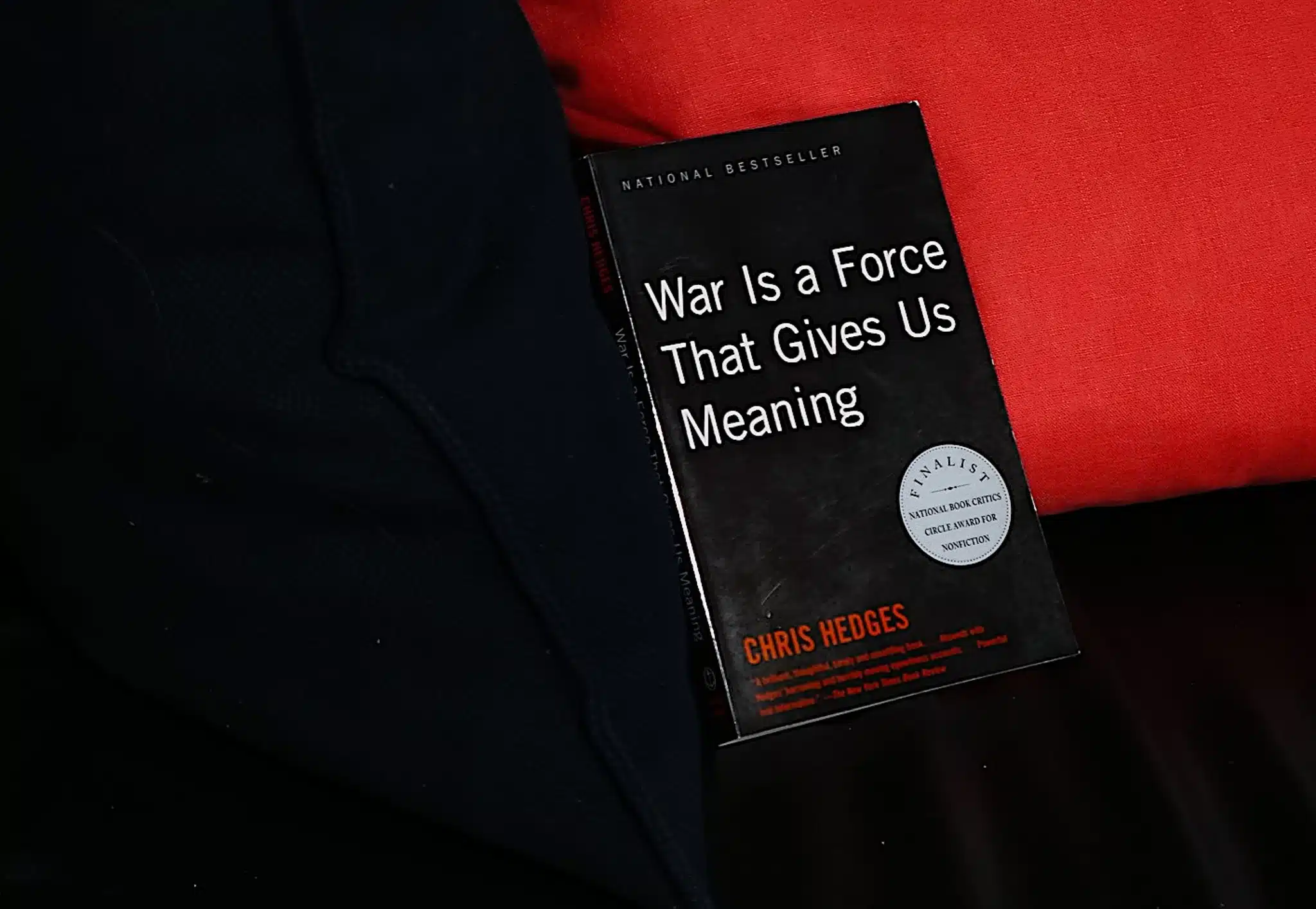
Nighttime gives us a picture that sometimes is difficult to piece together. This cover is clear in its picture, yet on the surface confusing in its message.
The cover of the book has a dark color tone (nighttime) with War written in red across the top and the rest of the title in white letters covering two lines under it against a black backdrop.
Some editions of the book have, underneath, a picture of a crowd marching. The people in the picture appear to be marching peacefully. All holding up hands clasped together with the skyline of a city lit up behind them. On the cover of the hardcover edition of the book available on Amazon, there is a photo of people marching, some of whom are holding candles.
The stark image of the word, War, hanging over some almost meditative looking faces, hands clasped, seems an odd choice to combine until you finish the book. Mr. Hedges’ resolution that love is what will help us overcome war, his Thanatos versus Eros conflict, clears up the initial confusion that just examining the cover creates.
Reviewer’s Personal Opinion: Love by Itself Is Not the Answer
You might surmise that I am not happy with the ending by reading my discussion of other reviewers. I made up my mind I was going to speak on the ending harshly long before I read other reviews. When I read the comments from the Naval War Review, I felt vindicated.
Yet let’s look at the whole of the book first. Chris Hedges can write well. There is no doubt about it. He is able to invoke emotions; reflections; you can see his imagery in your head; makes you want to reach out to him to follow up on what you just read; or even argue with him a bit.
His strength is his ability to present his arguments, lay out his points, back them up with research, and apparently he is well read. As a conservative I disagree with many of Mr. Hedges’ viewpoints overall, however I am not a fan of war, so this book spoke strongly to me.
When it comes to talking about war I did find one point interesting on a personal level. He writes on page 176:
“The tensions between those who were there and those who were not, those who refuse to let go of the myth and those that know it to be a lie feed into the dislocation and malaise after the war. In the end, neither side cares to speak to each other.
I know many people who have gone to war. This includes WWII, Korea, Vietnam and Iraq. Talking to veterans I hear quite extensive viewpoints on enemies. My Stepfather was a WWII bomber pilot. Years later he found out his TV repairman was a German who lived in an area where my Stepfather bombed regularly. They became close friends. A close friend of mine fought in Vietnam. Later on his wife worked for a company that employed quite a few Vietnamese. He would go pick her up from work, yet would stay in the car. The sight of Vietnamese people angered him tremendously. He knew this was on him, but he couldn’t get over his feelings. My Grandfather rode with General Pershing chasing Poncho Villa around in the early 1900’s. There were many skirmishes with Mexican ‘banditos’ or basically poor fighters trying to survive. After serving in WWI he retired and became a border patrol agent and was quite popular with the locals. As kids we crossed over the border easily and the people in the small town knew us because of our Grandfather. Also I spent years living in El Paso no one discussed what happened in the early 1900’s with Pancho Villa and General Pershing, it was if it never happened. I know this is quite a side track, but it is one example where some of Mr. Hedges definitive type statements throws me. Every individual survives war on their own terms.”
This personal point does not take away, for me, the total impact of the book. I agree that many to most survivors of war are adversely affected by it. That reality has also been communicated to me. My Father fought in Korea. He burnt his uniform when he left the Army.
And of course there are still people in this country who cannot accept the truth to the Civil War.
If for any reason, though, you hear someone talk about going to war, find a way to sit them down and read this book. War does become glamorized for the sole purpose of the perpetrators gaining something. This book breaks down the many reasons that dynamic happens and how easy it is to fall victim to the glamorization, the hype, the propaganda, the patriotism and worse the people like General Patton who live and breathe it as something worthwhile.
A couple other quick points along with the ending.
On page 106 Mr. Hedges states: “families who are stripped of all they own and then handed by the state apartments that were seized from others are complicitous, whether they like it or not, in the crimes of war.
To me that opinion is too callous. There are instances where taking over the property by choice can be complicitous, but survivors that need a place to live and that is what is given to them, should not be held to any accountability just for living.
I find page 111 to be a bit contradictory. You will need to read through the whole chapter to get the idea, but he shows some humanity existing and then states people will act in ways that are contradictory to what he just described.
There is an old folk tale involving an ancient indigenous warrior, his grandson and two wolves. The end result is we are who we feed. This message certainly applies to “War Is a Force That Gives Us Meaning” and Mr. Hedges’ ending.
As with many of Mr. Hedges’ books, he does something I admire. He offers a solution to the problems his books discuss. Yet his solutions to me always seem inadequate. A tripe response to something monstrous or destructive. I even like the concept he tries to address in his final chapter, the idea of the conflict of Thanatos and Eros, war versus love.
The problem is he just generally says, if we just let love take over, it will overcome our need to feed Thanatos inside us. And to me that is the difference. We feed Thanatos gluttonously. We put love on a strict diet. And you must give people a reason to love, and this endeavor takes more than just saying we need more love.
To feed love, there is a monstrous amount of work that needs to be done, from education, to cultural interactions, to actually sitting face to face with people who are refusing to accept the truth about others. For reasons I do not dare to try and explain, we, as humans, fall prey to false glamour, false bravado, so much noise we cannot see the truth. To state it in the book and to simply say love will overcome, is not enough. The effort to feed Eros takes more than that. The solution for us as societies to overcome war will take exponentially more effort than what it takes for us to fall victim to the romanticism of war.
Conclusion: Well-Written, But Setting Jumps and the Solution Offered Are Frustrating
As I have noted throughout this commentary, this book is well written. It might take a bit of effort to research his references to derive a fuller meaning, yet overall this book can be read without exploring deeper. A reader definitely walks away with a much greater understanding of why we as humans fall into the trap of war so easily time after time.
The cover of my edition does more to show the final answer to the book than it does when you first see it. The word war overhanging a peaceful gathering gives you a question. Why this difference, you may ask at first? Mr. Hedges does answer this question in his final chapter.
Overall I give this book 4.5 stars because I am frustrated and disappointed, not with the ending per se, but the weakness of the solution offered. Yet almost everything else about this book hits the nail on the head.
This book is still available in many large public libraries. In smaller towns you may struggle to find a copy.
Free Reading, Buying and Rental Options
Unlike most books, it seems like there are legal methods of reading “War Is a Force That Gives Us Meaning” for free. Here are a few we have seen so far:
E-Commerce Text and Audio Purchases
E-Commerce Audio Only
Physical Location Purchase and Rental Options
This book may be difficult to find in a new bookstore without ordering it first. Secondhand bookstores such as Half Price Books might offer an opportunity to pick up a hard copy.
Digital Rental Options
“War Is a Force That Gives Us Meaning” is available for rental on Libby and perhaps the app for your local library.

Get the latest of The Rauch Review in your inbox, discover books you won’t see in stores, stay up to date on the “Rauching to Judgment” podcast and more.