
As an Amazon Associate, we earn from qualifying purchases.
TLDR
Because the "Akira" manga tells its story over six volumes, it provides deeper character development, story arcs and world building than its eponymous movie adaptation.
What happens when the world as you know it ends? What do you do when all of the laws and societal norms that you take for granted every day suddenly disappear? Where do you go when everything around you has been figuratively and literally destroyed?
For the people of Neo-Tokyo, that is their reality. Having just barely rebuilt their city after a cataclysm a few decades prior, the air still teems with unease. The population teeters on the brink of falling back into chaos. Those old enough to remember the past have watched the city putrefy into a deeply corrupt authoritarian police state, while many of the youth have never known a life beyond squalor and crime.
We join two of those youths, Kaneda and Tetsuo, as they ride with their motorcycle gang through the restricted streets of old Tokyo one night. When Tetsuo accidentally crashes into a mysterious child running across the road, he awakens to strange telekinetic abilities and is immediately taken captive by the government. It’s now up to Kaneda to figure out where Tetsuo is and what exactly is going on. Little does either boy know that this one joyride will snowball into a battle for the fate of the planet, and things are only going to get worse for Neo-Tokyo.
‘Akira’ Summary: After the End
“Akira” opens with a few pages describing a past apocalyptic event. Seemingly out of nowhere, a massive and otherworldly explosion erupted from the center of Tokyo. Buildings were obliterated, thousands of innocents were killed, and the city was mostly wiped from the face of the planet. Due to the cataclysm’s unknown origins, international government leaders began wars out of paranoia and distrust. Everything was plunged into chaos and violence as people struggled and fought for survival, with politicians using the military to desperately try and maintain their grip on the civilians as society fell to pieces.
The primary plot picks up several decades later, when a new civilization called Neo-Tokyo has been built on the ruins of the old city. Neo-Tokyo is riddled with fear and unease. Most people are stuck living in poverty and filth under the watchful eye of the now authoritarian government. Our protagonist, Kaneda, is a common delinquent who was orphaned as a child and now fends for himself as a teenager, becoming the leader of a motorcycle gang called the Capsules. While racing through the streets one night, a member of the Capsules, Kaneda’s best friend Tetsuo, collides with a strange boy who was crossing the road in a panic. The ensuing explosion and fallout kick off an escalating series of events that come to involve government secrets, an underground resistance organization, psychic children, the source of the original cataclysm, space lasers and possibly the end of the world.
At The Rauch Review, we care deeply about being transparent and earning your trust. These articles explain why and how we created our unique methodology for reviewing books and other storytelling mediums.
Audience and Genre: Mature and Introspective/Violent and Crass
As brilliant as it is, “Akira” is incredibly strange and difficult to describe. It contains so many disparate and sometimes clashing elements. Even a laundry list of genres and themes still probably wouldn’t be enough to cover everything this manga has to offer. It touches on topics ranging from class warfare to international relations to Japanese history to existentialism. It pulls from dramas, comedies, science fiction stories, action films, political thrillers, tales of eldritch horror and religious texts. “Akira” has a lot on its mind and a lot to say, making it the kind of story where most readers are likely to find at least one or two facets that resonate with them.
Nonetheless, there is one major caveat to the broad appeal of “Akira”: this is a story meant exclusively for older and more mature audiences. While the brand’s popularity and some early moments in the manga may lead certain readers to believe that this story is just a slightly more extreme shonen action manga, Otomo delves into some truly dark and disturbing subject matter as events progress.
Beyond the violence and body horror that have become some of “Akira”’s hallmarks, the series touches on issues like war, drug addiction, poverty, mental illness, sexual assault and abuse. Characters are shown in moments of extreme duress, sometimes completely nude. Readers who might have discomfort or triggers related to that kind of subject matter should probably avoid this piece, especially some of the later sections.
Perspective: Everyone is Important
“Akira” has a massive cast of characters. While the story may begin centered mostly on Kaneda and his friends in the Capsules, it quickly spirals from there. The resistance and government angles are soon introduced, with each bringing its own team members and intrigue. As the story progresses, even more factions come into play, with even more backstories and connections to keep track of. While the writing does a good job of keeping things clear and understandable, Otomo does expect the reader to be able to remember all of these constantly shifting alliances and arcs.
Possibly as a result of having so much ground to cover, Otomo is unafraid to regularly switch between different viewpoints and perspectives. Come later volumes, readers will be regularly switching POV characters every few pages. Figures who are incredibly important early on will get shockingly killed off or abruptly disappear, leaving you to follow sometimes unexpected heroes for extended periods of time. Pretty much every named character gets a moment in the spotlight, and some of the most complex and emotional scenes don’t belong to the characters who would commonly be billed as the leads.
Three Cs: Compelling, Clear, Concise
Editorial Note: We believe these three factors are important for evaluating general writing quality across every aspect of the book. Before you get into further analysis, here’s a quick breakdown to clarify how we’re using these words:
- Compelling: Does the author consistently write in a way that would make most readers emotionally invested in the book’s content?
- Clear: Are most sentences and parts of the book easy enough to read and understand?
- Concise: Are there sections or many sentences that could be cut? Does the book have pacing problems?
Compelling: Long But Never Boring
“Akira” is an undeniably long and dense manga. However, Otomo’s art and writing keep things brisk and entertaining. The story immediately hits the ground running with the one-two punch of the opening apocalyptic flashback followed by the iconic inciting motorcycle chase, and things rarely let up after.
While the pacing does ebb and flow between action and exposition, there is a forward momentum and purpose to everything that occurs. Several pages of wordless fighting or establishing shots can be followed by paragraphs of sci-fi technobabble, and both are equally important for setting up future events. Actions and lore echo and reverberate even hundreds of pages later. This has the effect of making everything more engaging by virtue of the reader never knowing which characters or pieces of information will come back around in a pivotal way. With the amount of foreshadowing and callbacks, it rewards both paying close attention and repeat readthroughs.
Clear: A Lot Going On
“Akira” deals with a lot of heavy topics and complex themes, and it handles most of them with aplomb. Much of the story discusses metaphysical and pseudoscientific concepts that run the risk of confounding potential readers. However, through a combination of carefully placed exposition and reinforcing important concepts through repetition and visuals, Otomo manages to keep everything simple enough that the average reader should be able to at least follow the broad strokes of everything that’s occurring.
Still, there are a few instances where the ideas slightly overwhelm the available space. Sometimes, this world building deluge takes the form of the action grinding to a halt for a few pages while some scientists or mystics cover everything in text to explain some new development in detail. Other times, the artwork struggles to convey exactly which psychic attacks or gunshots are connecting and which aren’t. The eldritch designs contained in the later volumes don’t help. None of these minor issues are ever enough to throw off the manga’s overall comprehensibility or pacing, but there might be a few pages that require a reread due to masses of text or vague images.
To go with the minor structural problems, there are also a few small technical errors. Despite the translation being generally very strong and consistent, especially for the time, each volume does contain a small handful of spelling and grammar mistakes. For as complex and dense as the writing can be, though, the issues are impressively sparse and never interfere with legibility.
While Otomo’s penchant for having characters shout over each other can also cause some confusion in terms of which bubbles belong to whom and which order they go in, the most glaring flaw belongs specifically to the final volume. In addition to the usual small oversights that persist across the entire series, the last book bafflingly and consistently misspells a major character’s name for its full duration. The character even refers to himself incorrectly, despite an earlier volume making a pun about his name that no longer works with the new spelling and changed pronunciation. This mistake still technically doesn’t cause any problems in terms of the reader being able to understand the plot, but it’s a big enough discrepancy that some might take issue.
Concise: Few Moments Wasted
To call “Akira” concise would be a bit of a stretch. It’s a sprawling epic with dozens of characters and dense worldbuilding that is happy to occasionally halt the action to explain its more esoteric concepts at length. It would probably be more accurate to say that “Akira” is economic in its storytelling. Otomo aims to never waste the reader’s time, often having scenes serve multiple purposes at once to keep the jam-packed plot moving as smoothly and quickly as possible.
Dialogue scenes give exposition, establish worldbuilding details and shift interpersonal dynamics. These work in tandem with the action scenes, which reflect those character arcs and relationships while also setting up the stakes and plot pivots that inform everything moving forward. Even just silent establishing shots are so carefully planned out and detailed that you can often glean extra lore and foreshadowing just by spending a minute or two scanning through the artwork.
At worst, one could argue that Otomo is occasionally overindulgent with lingering on certain moments just because the imagery or concept is cool. But its art and ideas are some of “Akira”’s strongest points. Getting to spend more time with them is difficult to see as a negative.
‘Akira’ Character Development: Unconventional Arcs
It is impossible to say that characters in “Akira” do not change from beginning to end. There is not a single character who ends the story in even remotely the same place as where they started, both physically and emotionally.
However, befitting its oddball nature, “Akira” defies the usual character journeys that might be associated with common manga and action tropes. The closest “Akira” gets to a traditional arc is Kaneda slowly becoming a more effective leader and overall more mature person. However, both this bildungsroman-esque undercurrent and Kaneda’s flirtations with resistance member Kei take extremely unorthodox turns about halfway through, forcing Otomo to come at even these well-worn storylines with a fresh and completely unique perspective.
Key to the strange and fascinating paths the characters take is Otomo’s willingness to position anyone as an interim lead. While Kaneda may start out as the obvious main character, the scope very quickly broadens, requiring constant shifts to new characters in other locations so that readers are able to keep up. Soon enough, readers are jumping between factions and locales every few pages, occasionally multiple times in the same scene or even on the same page.
By giving himself permission early on to make basically any character the lead at any time, Otomo also creates another opportunity for himself, one that he takes advantage of with increasing frequency as “Akira” progresses. If any character can be the lead, then it follows that any character is also expendable. Seemingly crucial headlining characters will abruptly die or disappear for hundreds of pages, if not entire volumes. Characters who seemed completely insignificant will suddenly reappear much later and become lynchpins of the entire plot. If a character has a name or a unique design, there is a high likelihood that they will at some point become a recurring presence, if not a major player.
Due to giving almost every character moments of individual focus, the cast of “Akira” is rich and complex. They are contradictory and human without being nonsensical or frustrating. They make mistakes and understandably let emotions get the better of them sometimes. They are changed and affected by the extreme circumstances around them and not every character reacts to the developments of the plot in the same way, even if they’re on the same side.
The removals, introductions and reintroductions of characters at key points in the plot allow for a wide range of varied pairings and relationships to form. Characters who would have never interacted at the start have deep connections by the end, and most assumptions and first impressions a reader may have end up being flipped on their heads. It’s astounding that Otomo manages to balance fleshing out such a massive cast in such a relatively short run, but it’s just another testament to how well-crafted and tightly written “Akira” is.
Story: A Tale in Six Acts
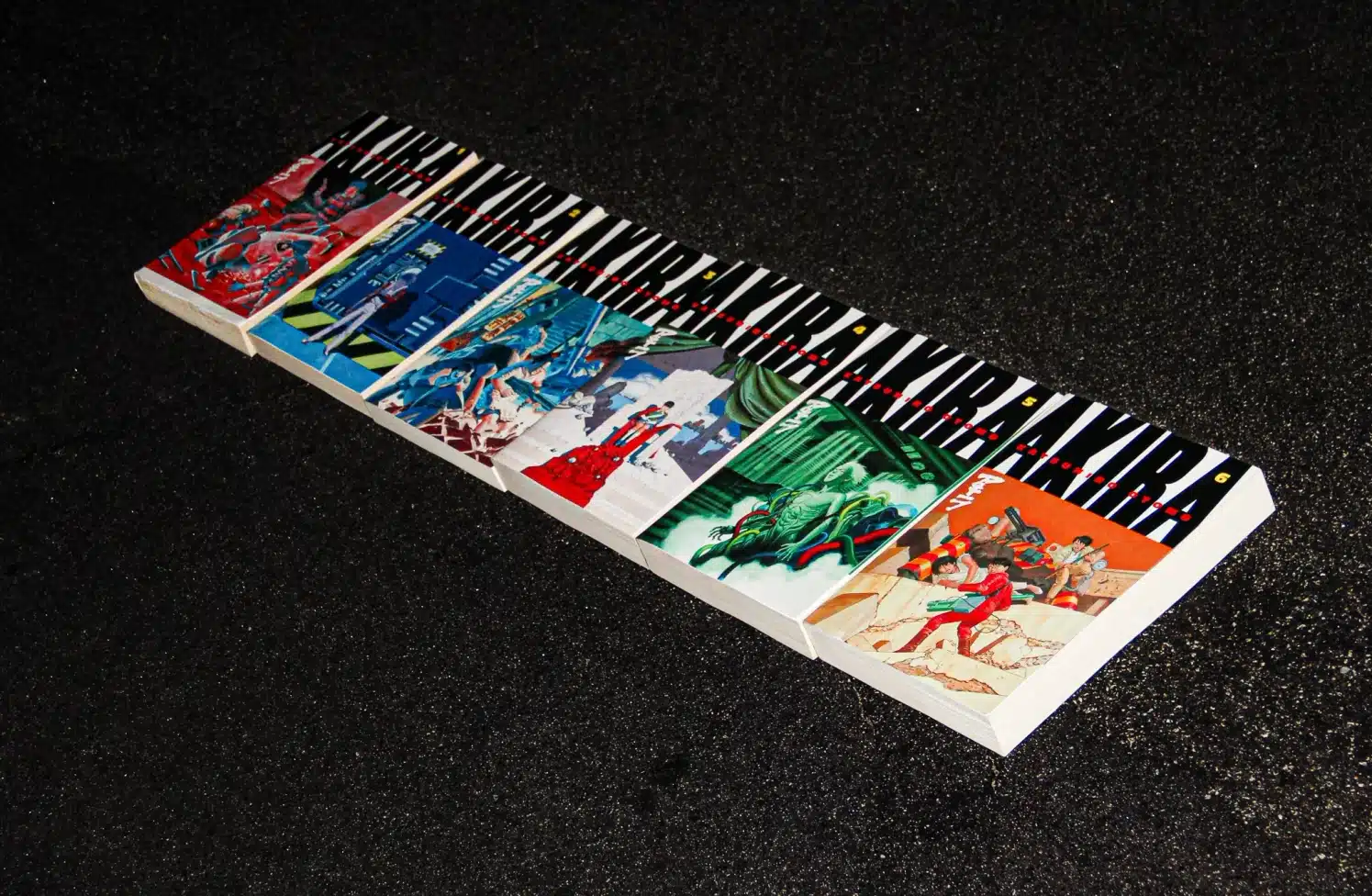
The story of “Akira” takes place over the course of six volumes, each containing several hundred pages of content. Each book is titled after one of the leads and covers a major arc in the plot, acting as something resembling an extended chapter. For example, the first volume is named after Tetsuo. It covers the motorcycle accident that awakens his psychic abilities and the ensuing fallout.
The second volume, which shares its namesake with the manga, covers Tetsuo’s attempts to find the titular character after he discovers that Akira may be linked to his new powers and the event that destroyed the original Tokyo. Each book contains twists, revelations and paradigm shifts that constantly contort what the plot looks like and what “Akira” can be. By the end, the characters, setting and tone barely resemble that of the opening volume.
Here’s a breakdown of the six volumes:
[Spoiler Alert]
- Volume 1 (Tetsuo): While out riding one night, teenage motorcycle gang member Tetsuo crashes into a strange boy. This accident awakens psychic powers within Tetsuo that put him on the radar of the government and allow him to take over a rival motorcycle gang by force. Tetsuo’s best friend Kaneda, the leader of his original gang, sets out to confront Tetsuo and put an end to his reign of terror.
- Volume 2 (Akira I): The fallout from Kaneda and Tetsuo’s encounter leads to the two of them, along with a member of a government resistance group named Kei, being taken into government custody. While there, the three of them discover secrets about Tetsuo’s powers and the source of a cataclysm that destroyed Tokyo several decades prior. Linking everything back to someone or something named “Akira”, Tetsuo makes it his mission to find out who or what that is.
- Volume 3 (Akira II): After Tetsuo finds Akira but gets separated from him, Kaneda and Kei take Akira and run. Followed by both the government and a mysterious cult, Kaneda and Kei must do whatever they can to avoid letting Akira fall into the wrong hands.
- Volume 4 (Kei I): A mishap with Akira ends with the destruction of the city, causing Kaneda to disappear and the remaining survivors to split into two factions: the cult of Lady Miyako and the Great Tokyo Empire lead by Tetsuo and Akira. Kei has allied herself with the largely benevolent Miyako and must now work with her to take down the Great Tokyo Empire.
- Volume 5 (Kei II): After a mysterious event returns Kaneda to the fold, he begins to work with the remaining members of old motorcycle gangs in an attempt to form an army against the Great Tokyo Empire. Kei, meanwhile, accepts an offer from Lady Miyako to become a medium and vessel through which psychic power can be channeled in the battle against Tetsuo and Akira. As Kaneda and Kei make their preparations for the final assault, Tetsuo is losing his sanity and his physical form as his powers spiral out of control and international governments become involved.
- Volume 6 (Kaneda): Kaneda and Kei begin their final assault on the Great Tokyo Empire, while Tetsuo struggles to keep his powers from taking over his body and mind.
[End of Spoilers]
The plot shifts and changes tremendously as events progress. At first, the main focus is Kaneda and the other Capsules trying to find Tetsuo and figure out what’s going on after the fateful opening motorcycle accident. Soon, however, the government and the opposing guerilla resistance movement become key factors, with characters like Kei, Ryu and Colonel Shikishima immediately emerging as major players. This expansion in scope moves us from a violent revenge plot to a covert espionage mission.
“Akira” continues to play with genre. At various points, the story combines elements of action, comedy, drama, science fiction, fantasy, spiritualism, thriller, romance and horror. The cast and scope also only increase as tensions escalate, with later additions like the psychic children, Lady Miyako and Kaori eventually becoming just as pivotal to the narrative as those who were there from the beginning.
Prose Style: Scarce But Serviceable
Possibly due to “Akira”’s massive cast, most of the writing is character dialogue. Even narration is usually presented as someone’s inner thoughts. In the few exceptions that it’s not, such as the first volume’s prologue, the prose often takes on a grand and majestic tone, giving proceedings a kind of mythic quality. Otherwise it is usually brief and functional.
Dialogue: A Sign of the Divide
One of the most integral themes of “Akira” is the divide between those with power and the common man, and this divide is woven into the very fabric of the dialogue. This style is most easily seen through juxtaposition.
Kaneda is a hot-headed teen who has lived his life fighting for himself on the streets. His vocabulary consists largely of slang and swears. He’s at times functionally unable to maintain a polite conversation due to lacking the proper language, the experience in those environments and the desire to conform to society’s rigid expectations of him. The colonel and the other government officials speak only in business and scientific terms, with even disagreements and outbursts still possessing a level of decorum and poise that Kaneda cannot muster even at his best.
These speech patterns extend well beyond the leads. In addition to Kaneda’s close friends, many of the other bikers and street urchins of Neo-Tokyo’s seedy underbelly speak with the same profanity-laden language and barely-contained rage as the leading man. Having lived a life buried by this authoritarian regime, many of the youths in this story have an understandable contempt for those in positions of power and society at large. Even just lacing their conversations with curses and taboos is a part of their resistance against the systems that oppress them.
The colonel’s manner of speaking, on the other hand, is usually reflected by others in positions of influence, whether it be the rich Nezu, the bureaucratic government scientists or the mysterious cult leader, Lady Miyako. Unlike Kaneda, who lives his life bulldozing others and not caring what they think about him, these figures of significance must be careful what they say and do, whether it’s because they’re trying to gain and maintain followers or because one wrong word could lead to disaster. This need to please people and calm the crowds leads to their words feeling hollow and disingenuous. They will say what they must to get what they want, which makes it difficult to know if any of it is true or sincere. Kaneda may be many things, but he is never insincere.
In this way, the dialogue also serves as a reflection of the characters’ arcs. As events progress, Kaneda does learn to better control his words and emotions. However, he never loses his cheek or sense of self, still cracking jokes and having outbursts just at more appropriate times. Through this growth, he becomes a better leader to his men and a better ally to Kei because he maintains his passion and honesty while focusing his efforts in ways that will ultimately be less messy and more effective.
‘Akira’ Setting: A Cyberpunk Pioneer
With Neo-Tokyo, Otomo gave the world one of the most iconic cyberpunk settings in media history. Its bright lights and impressive semi-futuristic infrastructure are offset by its dingy conditions and oppressive atmosphere. While the story almost never leaves the city, it does delve deeply into many of its nooks and crannies, leaving readers very familiar with its landmarks and citizens by the end. The characters will visit and revisit important locales, commenting on changes in the landscape or things they’ve learned from previous experiences. Even the paths between will become recognizable as characters plan infiltration routes or run from enemies.
Some of the places we visit in Neo-Tokyo include Kaneda’s restrictive vocational school, a dive bar that the Capsules frequent, the resistance hideout and the abandoned Olympic stadium. Each of these places represent a different aspect of Neo-Tokyo and the plot, with even the sewers connecting them becoming a recurring element.
The school is the government trying to directly exert its will on Kaneda and his peers, and the bar is one of the only places they can escape to that doesn’t disrespect or speak down to them. Once the resistance and Kei come into the picture, Kaneda is given a sense of purpose beyond just generally being a nuisance to authority figures. However, as the resistance pulls Kaneda away from school and the bar more and more, he comes to realize that this new responsibility will have repercussions far beyond just getting to hit on a cute girl and possibly find Tetsuo.
[Spoiler Alert]
The Olympic stadium stands as both a monument to the government’s greed and hubris, as well as the location where many of the most pivotal plot swerves occur. The cold and sterile biomechanical design of the stadium’s inner workings foreshadow the alien concepts and unfeeling yet overpowering forces that lie within. It was the epicenter of the original apocalyptic event and, about halfway through the story, another apocalypse occurs there, completely leveling Neo-Tokyo.
This event completely shifts the paradigm of the second half of the story, with the once bustling city becoming a demolished wasteland in which the already destitute and desperate citizens are now stuck literally murdering each other to survive. At this point, most previous landmarks are destroyed, with the only things of importance left standing being Lady Miyako’s temple and the Olympic ground zero. A new entity called the Great Tokyo Empire rises up and establishes itself as a new faction, creating their homebase in the stadium’s dilapidated ruins. The already unsustainable situation of the first half becomes even more dire and unstable in the second.
On the rare occasion that the story does leave Neo-Tokyo, we usually don’t venture too far. While there are a few quick cutaways to the Earth’s atmosphere to occasionally deal with space laser shenanigans, the furthest we go otherwise is the waters just off the coast of Japan. We visit a few aircraft carriers and war rooms while following Colonel Shikishima and other government officials around behind the scenes, but even escalating matters to an international affair doesn’t do much to move the focus away from Neo-Toyko.
Rhetoric: What Does It Mean to Be Free?
“Akira” is a story where many themes and motifs weave together to form a greater whole. At various points, Otomo discusses authoritarianism, the failures of governments to truly help their citizens, classism, the ethics and limits of scientific experimentation, empathy, human desperation, the existence of higher powers, sexism, survival of the fittest and many other topics.
Despite how dark and cynical “Akira” gets at points, Otomo opts to put a largely humanist lens on all of the events, urging people to respect and support each other even in times of widespread distress. Othering people and making them feel like outcasts or less than is how you end up with someone like Tetsuo.
In a broad sense, the story can be read as Kaneda, Kei and their companions fighting against progressively more powerful and metaphysical forces of oppression. The first enemy is the school, stomping out individuality and trying to get the students to conform to what the government needs of them. Once Kaneda joins the resistance, the academic proxy is replaced by the government itself, with Colonel Shikishima acting as its mouthpiece. For a while, it seems as though this as far as things will go, with Kaneda and Kei trying to thwart attempts at scientific experimentation and awakening or controlling Akira. However, this all changes in the second half.
[Spoiler Alert]
It becomes clear that there are forces beyond even the government that seek to overtake and control humanity. Once Akira reawakens and Neo-Tokyo is obliterated, the goals of the characters understandably become more nebulous. They know that they still must fight for their lives, but the opposition has suddenly gone from military personnel to otherworldly beings with unfathomable abilities. How do you escape invisible forces that seem able to surround and overpower you no matter how far you go?
In the end, it’s the humanity of the characters that manages to overcome the existential threats. Tetsuo’s connection to Kaneda manages to pull him back from the brink several times over the course of the story, even if it isn’t ultimately enough to fully save him. And despite being an emotionless cipher for the vast majority of the plot, Akira’s old memories and bond to the other psychic children end up being the key to solving many of the overarching conflicts. No matter how grand the scope or stakes become, Otomo makes sure that the characters’ internal journeys are just as integral as any citywide explosion or superpowered fistfight.
Cultural and Political Significance: The Dark Tropes of Womanhood in Manga
Much like in the manga, Kei deserves her own moment in the sun. She begins “Akira” as an easy entry point for Kaneda into the resistance movement subplot. Kaneda’s attraction to Kei is basically his only motivator early on, beyond finding Tetsuo, so it’s kismet when his goals coincidentally overlap. In such a male-dominated and male-oriented story, Kei’s womanhood and beauty are constantly remarked upon and lusted after by the men around her, with Kaneda being far from the only one to find motivation in it. Even during resistance missions, enemies will often underestimate or completely disregard her.
At first, the manga plays into this motif, with most of Kei’s arc centering the men around her. However, something shifts in the later volumes. Unfortunately discussing most of Kei’s best and most impactful moments constitutes spoilers for much of the second half of the manga. For the spoiler-averse, just know that while she may seem barely a step above a rote love interest at the start, she develops into arguably the most vital character in the entire story. There is a reason why two of the six volumes are named after her.
[Spoiler Alert]
Once Neo-Tokyo is destroyed, Kei steps to the forefront as the new lead. All of her romantic subplots understandably take a backseat while she is forced to deal with the problems in front of her. This shift is especially poignant once Kaneda suddenly disappears, leaving Kei as possibly the only one who stands a chance against Tetsuo and Akira. When the endgame battles begin in earnest, it’s Kei who does most of the physical fighting against the giant eldritch abominations. At a time when most manga and anime were content to have their female leads be cheerleaders who occasionally got one spotlight fight (usually against another woman), Otomo was unafraid to have Kei fully take up the mantle of an action hero and have her lead the charge.
Whether intentional or not, Kei’s late-game rise to prominence also increases the profile of several other female characters. Chief among them is Chiyoko, Kei’s resistance battle partner and closest confidant. Once everyone else is forced out of the picture, “Akira” is left as a borderline two-hander between Kei and Chiyoko as they wander the wasteland. Suddenly, their friendship and bond becomes almost as important and possibly even more immediately central than Kaneda and Tetsuo’s. While her tender and protective side comes to the surface as she becomes more prominent, Chiyoko is also completely unafraid to get her hands dirty, being able to take out hoards of enemies on her own without needing any psychic powers or special weapons.
There is also Lady Miyako. Introduced as a mysterious cult leader early on, she eventually becomes the heroes’ mission control, giving pivotal exposition and telepathically guiding Kei and others during operations. Since the psychic experimentation prematurely ages its subjects, her actual age is a mystery, but her wisdom and calmness under pressure play in direct contrast to Kei’s inexperience and youthful impulsiveness. Lady Miyako concocts almost every plan used by the leads once the threat has progressed past a certain level, and she isn’t afraid to use her own powers to fight when necessary.
Along with characters like Kaori, Kiyoko, and Sakaki, one can easily see the strengths in “Akira”’s female cast. Especially for the era, it features a diverse range of ages, abilities, body types and perspectives. Switching to Kei as the lead halfway through was a brave and ambitious move that pays dividends in both enriching the story and making it more interesting and timeless.
However, it would be disingenuous to say that the execution of everything is perfect. Otomo does disappointingly fall into several tropes that are exceedingly common when men write female characters. For example, one of the most persistent threats Kei faces in the wasteland is men trying to objectify or sexually assault her. Kei always manages to escape mostly unscathed, but other characters aren’t so lucky, though nothing is ever fully shown beyond some nude and frightened women.
Kei also has a lot of very uncomfortable interactions with Kaneda when they’re first getting to know each other, with the barometer swinging wildly between “he’s being a creep, but it’s possibly supposed to be endearing” and “she’s violently overreacting to him trying to be nice.” It’s meant as comedic relief to break up tense moments, but it only serves to make both characters unlikeable. Luckily, they both quickly grow out of it, and Otomo does manage to overall do very strong work with his female cast.
Critiquing the Critics: Are They Right About Characters Not Having Enough Backstory?
For the most part, “Akira”’s critical reception was and continues to be sterling. Most reviews both from the time and now are raves that compliment Otomo’s artwork, the expansive story and the detailed setting. Otomo deserves every plaudit he receives, and time has done little to tarnish the reputation of the manga.
One of the few negatives that occasionally pops up in critical discourse is the simplicity or shallowness of the characters. As many of them lack in-depth backstories or overly complex personalities, it’s easy to see where this argument stems from.
However, I would argue that the core simplicity of the cast is a feature rather than a bug. In a story that already has so many moving parts, getting bogged down in the histories and minutiae of the characters would only cause the pace to drag. Readers are already given the pieces that they need to understand everything that occurs, and the manga seemingly purposefully leaves certain points vague and open to some interpretation. The complexity comes from the external forces that push the characters to respond and change, with the melodramatic aspects of the plot acting as both catalysts for and reflections of their arcs.
Book Aesthetic: Manga Artwork at Its Finest
One of “Akira”’s most defining and iconic aspects is Otomo’s incredibly complex and expressive artwork. From the character closeups to the crosshatched shading, the imagery sometimes evokes a feeling similar to pop art and vintage American comics. Every landscape and building is rendered with the utmost care and purpose, with even massive establishing shots containing consistent details and tiny bits of foreshadowing for eagle-eyed readers. The amount of effort and passion poured into this work is palpable on every page.
However, there are a few extremely minor issues with the visuals that pervade the entire series. Due to the extreme detail and amount happening in some of the wide shots and action scenes, it can sometimes be difficult to determine what the focal point is supposed to be. Relatedly, the chaotic fights combined with the occasionally metaphysical nature of some attacks can make understanding pieces of later battles a challenge.
Despite Otomo’s skill and artwork generally improving as the series progresses, there are a few beat and transition panels where it’s clear that they didn’t receive quite as much artistic attention. Nonetheless, these nitpicks don’t detract from the story’s overall comprehensibility or enjoyment. The highs of Otomo’s artistry vastly outweigh the miniscule negatives.
‘Akira’: Manga vs. Anime: Abridged and Altered But Still Iconic
It is difficult to overstate how important and groundbreaking the film adaptation of “Akira” was at the time of its release. As a Japanese anime, it served as a major trailblazer in bringing the artform to prominence in Western countries. As a piece of animation, it helped prove that the medium wasn’t only for children and could also be used to tell mature and impactful stories. As a film, its influence is still felt today, with moments like Kaneda’s motorcycle slide and Tetsuo’s grotesque transformation being directly referenced in media from around the world.
Directed and written by Otomo himself, the film heavily condenses the events of the manga. While the broad summary remains the same, many characters and arcs are fully dropped or consolidated into each other due to time restrictions. In general terms, the film remixes the events of the first two volumes and then skips to the end of the final volume, which had not actually been released yet at the time of the film’s premiere. It also takes liberties with certain aspects of the lore to streamline events and keep the pace brisk. Despite its omissions and changes, however, having Otomo at the helm means the adaptation perfectly maintains the manga’s heart, style and attention to detail.
The largest casualties in terms of character losses are obviously those that come into prominence later in the story. While Kaori has her origins changed so that she can feature earlier and keep her role as Tetsuo’s tragic object of affection, Chiyoko, Sakaki, Yamada and the various citizens of the Great Tokyo Empire aren’t so lucky and disappear completely. A few other characters, such as Lady Miyako and Joker, make cameo appearances, but their purposes, personalities and fates end up vastly altered by their heavily diminished screentime.
[Spoiler Alert]
With all of the cuts, the remaining major players are allowed to keep pragmatically assembled microcosms of their original arcs and most iconic scenes from the manga. Kaneda and Tetsuo still have their escalating rivalry and doomed friendship, and Kei still gets to have her moments of introspection and action. Shikishima and Ryu both still become disillusioned with their respective factions, Yamagata still gets his fateful standoff against Tetsuo, Keisuke still assists Kaneda and Kei, Nezu still betrays everyone, and Akira still has his moment with the other psychic children. While the context and circumstances of most of these events are changed, they still heavily mirror the original plotlines and carry a similar impact.
If there is one minor inconvenience brought on by all of the excisions, it’s that certain aspects of the world and lore don’t get the time or attention that they did in the manga. The film moves very quickly, and it expects the audience to be able to keep up, even when things are being shown or explained in an esoteric way. Everything will make perfect sense to someone who has read the manga, but things like Kei’s proficiency as a medium or the existence of SOL get somewhat glossed over. An average viewer will be able to follow the plot, but the mechanics and specifics of certain aspects of the lore may be confusing due to not having the additional information and context that was present in the manga.
For all that the movie removes from the manga, it does add a few interesting twists to the original story. For example, Miyako’s demotion to a cameo means that the psychic children now take over her role as a primary source of exposition and strategies, raising Kiyoko’s profile in particular. The compressed timeline also means that many character dynamics are altered, such as Kaori now being Tetsuo’s friend from school or Akira having died not long after the original apocalypse. This compression has the ripple effect of elevating characters who lose some of their prominence in the second half of the manga, such as Ryu, Nezu and Yamagata. There are also a few setpieces that are exclusive to the adaptation, such as the scene with the giant stuffed animals and the protest riot subplot. In general, the film is probably best viewed as an alternate interpretation of the manga’s story.
[End of Spoilers]
All of the discussion of changes and omissions does nothing to take away from how impressive and enjoyable “Akira” is as a film. Seeing the manga’s artwork in lovingly rendered color and motion still looks incredible 40 years later, and the score manages to somehow sound religious, tribal and otherworldly all at once. The addition of movement and sound does so much to add to the atmosphere and tone that the manga was already masterful at conveying. It’s clear that Otomo had a vision and a plan for how he wanted to bring his manga epic to the screen, and the resounding critical praise and lasting cultural legacy prove that he created another masterpiece in the process.
Reviewer’s Personal Opinion: An All-Timer for a Reason
It’s difficult to find something new to say about “Akira.” As one of the urtexts of Western anime cult fandom, both the manga and especially the film have been reviewed, analyzed and picked apart by basically every otaku on the internet. However, certain things are classics for a reason, and “Akira” is undeniably one of those works.
While it’s obviously impossible to be perfect, it’s difficult to say where “Akira” can improve. There are several arguable negatives that can be written off as stylistic choices or matters of preference. Even the critiques mentioned in this review were mostly nitpicks. The story doesn’t feel dated despite its age. Technical mistakes can likely be considered mostly translation errors and not flaws with the original text.
The writing is incredibly intelligent, both in its science fiction aspirations and in its economic pacing. The plot and characters are complex and engaging, constantly and unexpectedly evolving to keep the reader guessing and invested. The artwork is gorgeous, and the extreme detail gets used for both artistic and practical purposes. Otomo gave the world a masterclass in manga storytelling with “Akira,” and that statement holds true today.
‘Akira’ Review: A Must-Read Classic for Any Manga Fan
Katsuhiro Otomo’s “Akira” stands tall as a monolithic presence in the anime and manga communities. Its influence across global popular culture is still being felt today, with many of its most iconic moments and ideas having become integral parts of the broader science fiction vernacular.
Even with this totemic reputation preceding it, the “Akira” manga somehow still lives up to (and possibly surpasses) expectations. With its gorgeous artwork, sprawling story, complex characters and creative concepts, Otomo created something timeless that other artists are still trying and largely failing to replicate even now. That the manga still feels so fresh and prescient over 40 years after its premiere volume debuted is a testament to Otomo’s generational skill and talent. Even those already deeply familiar with the more famous film adaptation will still find a ton of new and engaging story arcs and characters to latch onto, giving more context and lore that make an already incredible film even better. As long as you have the stomach for its darker and more violent moments, “Akira” comes highly recommended for anyone with even a passing interest in manga.
Buying and Rental Options
E-Commerce
Physical Location Purchase Options
The “Akira” manga series is available at many locations of these large bookseller chains:
- Barnes & Noble
- Kinokuniya

Get recommendations on hidden gems from emerging authors, as well as lesser-known titles from literary legends.