
As an Amazon Associate, we earn from qualifying purchases.
TLDR
In “A Wish in the Dark” by Christina Soontornvat, Pong challenges the moral lines of containing prisoners simply because their mother is a criminal. The resource provision of light, a medium of power in the novel, is embedded with political choices.
“A Wish in the Dark,” a Thai culture inspired retelling of Victor Hugo’s “Les Miserables,” written by American Christina Soontornvat, illustrates legal ethics through the lens of Pong, whose mother’s crimes automatically force Pong into a reform center. The belief is that kids whose parents are criminals need to be watched. However, the problem is the children are contained under horrid conditions at the reform centers.
This book is for future activists and scientists who want to understand how powerful people use resources to enforce political values with the hope of being the generation that creates safe politics around objects and energy sources. Christina Soontornvat is an American who has created a vivid retelling of Hugo’s novel, which brings to question if all Americans can re-create another American’s story, especially given that A Wish in the Dark is a retelling of a classic.
Where is the fine line when you retell a story, especially if other Americans recreate from an already retold story?
‘A Wish in the Dark’ Summary: ‘Les Miserables’ Retold
The novel explores when rules are to be broken and when power needs to be reevaluated. Namwon is the prison where Pong is born, but the story mainly takes place in Chattana. The Governor enforces rules that are obeyed because he has the power to produce light.
Light is central to the function of Chattana, a city that was plagued with problems before Pong’s arrival. People obey The Governor because of how he controls light to enforce his authority, even though they do not like that children have to live in poor conditions in the reform centers. Once the prisoners come of age, they are free from the prison, but Pong doesn’t wait. When Pong takes matters into his own hands and escapes, he runs the risk of being taken to a worse prison called Banglad, but this risk is better to him than remaining a prisoner.
Father Cham serves as the male mentor to all youth and guides Pong along his journey when he escapes. If this story were to be retold by any other country, Father Cham would offer the proverbial anecdotes associated with the culture of the retelling.
Nok Sivapan would act as the reinforcement of laws of the culture, but her character goes through her own journey as she learns about her personal imperfections. Rules are not black and white and must be discussed with nuance, as each character comes to understand within their own journey. Like in America, it can be harder to get work if you are incarcerated. In the novel, like in America, gaining work as an adult is difficult if you were sent to a reform center as Pong was in Namwon
Resource provision is key to this story. The Governor offers light, which allows the city to run, and he also provides protection for the city’s inhabitants. Yet the conditions children live under create a sense of corruption. Children are born into conditions they did not choose with little chance to have a full life even in adulthood. Soontornvat explores how some have power, but do not own responsibility. The reader will find that even when you are ambitious, the label you had as a child can still hold you back.
Fighting to claim your space is a major theme throughout the story. Each character has a point of view when it comes to rules that reveal an insight about who should have access to power and what it means to take responsibility over your life. As jobs include greater design, we live in a time where more Americans can work, but where will they work? How many of us Americans will be cheated in pay through having to work from a jail? Have we received the education to avoid this frustrating reality?
The implied narrative is that in different ways, not only are people against the rules of The Governor, but each character breaks the rules based on their stance. In different ways, each character bends rules by pretending to agree and covering for rule breakers as necessary. The story leaves room for interpretation of orchestrated revolution and subtle rebellion that each character takes part in. Everyone is in on the joke except The Governor.
Pong did not wait until he turned 18 to live out his dreams. Soontornvat created him in the present, not the future, although the story is in past tense. Light is not something foreign to humans; it is something that exists now. While various ways to understand it can still be discovered, it is a material we all have access to. Pong did not wait for a better future. He had a need and went for his dreams. The reader will see how others pushed towards their dream too.
Americans discuss problems with prison systems and mass incarceration. There are also Americans like Christina Soontornvat who do something about it. She wrote a book that serves as a blueprint for resource provision. Resources come in many forms, so this story can be told in many ways, each iteration specific to the ethnicity of the author. While cultural appropriation would need to be taken into account for revisions, retellings are not about re-writings. There is a fine line. When I think of a retelling I think of a framework, using a framework or design to guide a person’s story. Nothing about it should feel like copy-paste. Victor Hugo offered the initial framework. It would be nice to see other perspectives on telling Hugo’s story.
Design is planning, your approach to making, and how that approach influences the construction of the object. I wonder if design can be stolen since iteration is central to design. Hugo created a framework; design is structure. Soontornvat created a framework; design is potential.
Law mediates framework use. While “Les Miserables” is in the public domain, A Wish in the Dark is not given that it was published in 2020. This means A Wish in the Dark cannot be retold without permission. It would be nice to see if future writers look back to tell this story, the way Soontornvat told Hugo’s. If science evolves by then, I wonder if the material of choice will too.
The same way an object can be designed, the contents of a book are designed too. Retellings are mediated by law and reflections of appropriation. The science factor of A Wish in the Dark adds a modern touch to Hugo’s story in a time of mass incarceration and the school to prison pipeline. Soontornvat offers a solution in ways that I would love to see other writers of other ethnicities (I know she is American) do the same.
‘Les Misérables’ Comparison: Adaptations Versus Retellings
“Les Miserables” has various adaptations, from film to a musical; however, adaptations are different from retellings. Adaptations translate a source into another medium, while a retelling stays within the same medium. Design paints a different image of stealing since by nature it focuses on the realized potential of an idea. My definition of design in this instance is based on a story outline as a framework and the writer painting by numbers from the outline.
At The Rauch Review, we care deeply about being transparent and earning your trust. These articles explain why and how we created our unique methodology for reviewing books and other storytelling mediums.
Audience and Genre: Activists and Scientists
“A Wish in the Dark” is for the next generation of scientists and the power they can yield based on the resource they provide. Power is not just about force, but also about ethics. Businesses attract an audience; a resource has an audience. Activists help mediate power structures’ relationship to the resource they provide. Revolutions happen every time a business is replaced. Lessons could be learned from various culture’s iteration of A Wish in the Dark. While the book was fantasy, it felt possible; Soontornvat’s goal feels tangible.
Activists and scientific solution providers should pair up to read this fantasy novel within America’s current social climate where everyone’s going to jail and no one’s going to school. While you can’t legally publish your own version, creating one to hide in your closet to read when no one is looking is an option.
Perspective: Third- Person Symbols of Light
“A Wish in the Dark” is written in third-person limited, meaning it alternates between perspectives of Nok and Pong, who are both symbols of light in the story, while presenting third person close to their thoughts as opposed to the narrator being omniscient or knowing everything about the story in ways that the characters would not know. The story presents the contemporary position that who you are is more important than what you do; who you are is more important than talent and capabilities. The point of view is appropriate because third person limited invites the reader to hear what the characters think, allowing for a focus on each character. The dialogue tags lets you know that the story is in past tense, even though Soontornvat is able to make the story feel like it is happening as you read.
The Governor’s power to use light to power the city is reflected in how characters are perceived. Pong is associated with darkness while Nok is associated with light. As the story moves forward, light does not only reflect the typical good versus evil, but deals more with who imposes justice in contrast to who uses resistance to protect justice. A Wish in the Dark questions the relationship between morality and politics. Morality assumes that authority is on the good side; however, politics presents a context of opposing sides where one side might not be more justified, but instead presents the position of choice. That there is no necessary right and wrong, but instead are two opposing sides for each person to choose.
The side someone chooses is a reflection of personal values, not objective choice. The story creates an outcome that implies who was right, but others might disagree. How a story ends implies who was morally sound by presenting a happy ending. The very fact that we look for happy endings in stories shows who the author of a book thinks is right. The ending might seem happy, but if you look closer, joy is less clear.
Pong and Nok offer opposing perspectives on light and dark, which is mediated by The Governor who controls that resource that dictates the political morality. Circumstances around the light dictate the position that each character takes, which imposes ideas on the agency resource’s enforce. As the circumstances for characters change, some characters choose the other side of the light. This makes light, not necessarily a symbol of good and evil, but is more of a symbol of who has power and the choices dictated by that power.
The Governor is in control because of the resource he provides; the light is the object that negotiates this power. The narration is not omniscient, so the reader is able to perceive this negotiation in real-time. The light remains the same, main resource, but the navigation around that resource changes for characters whose circumstance changes.
Characters are static(no-change) or dynamic(they change) based on how their circumstances change. Humans change out of necessity. The relationship the characters have to power alter their desire to change. The point of view that the story is told in allows the reader to get a snapshot of these changes as they happen.
Three Cs: Compelling, Clear, Concise
Editorial Note: We believe these three factors are important for evaluating general writing quality across every aspect of the book. Before you get into further analysis, here’s a quick breakdown to clarify how we’re using these words:
- Compelling: Does the author consistently write in a way that would make most readers emotionally invested in the book’s content?
- Clear: Are most sentences and parts of the book easy enough to read and understand?
- Concise: Are there sections or many sentences that could be cut? Does the book have pacing problems?
Compelling: Yes, But More Imagery Would Have Helped
Each chapter’s length was justified. Soontornvat used vivid imagery throughout the book to engage the reader. The dialogue within the book also felt tangible as readers are able to empathize with the characters.
While Soontornvat was able to engage the reader using dialogue, I really wanted more imagery. Soontornvat’s imagery, when used, was extremely powerful; therefore, being able to experience more of that, especially in a book focused on light, would have been nice. Soontornvat’s sensorial approach could also have been magnified through more imagery. Then again, I’m someone who likes intensity. If you are a reader who likes content that is not over the top, you might appreciate her balance of imagery with character dialogue. The design and structure of the character dialogue and imagery focus on each character as opposed to a focus on the setting. In terms of pacing, Soontornvat balanced introducing each portion of the book with diving right in. No scenes felt too fast or too slow.
The light in the book are orbs of light that The Governor uses to power the city. While she doesn’t use imagery based on light specifically, she does use “illuminated”/vivid imagery in her book. She uses images like “pumpkin-rind yellow”, “golden-brown cheekbones”, “green herbs and steamed fish”, “golden egg-flour”, and “crumbled cake”; she uses many colors as opposed to light for imagery. But the power of the city depends on light as a resource produced by The Governor.
The scenes were vivid while allowing the reader to focus on the characters. Maybe this is why the book is not as colorful as I would like. The reader is not distracted by images and over-done setting and instead gets to focus on the characters. This might have been intentional and more colors and fireworks is simply a personal language preference. Many readers will find that the imagery intensity was perfect. Some readers might prefer excess.
The reader gets to sit with each character and gets to know them. You are able to empathize with their pain and conflict without judgement. Soontornvat writes in a way that allows this to occur. By focusing on dialogue and character interaction, the politics and decisions of the characters transcend the setting they are placed in. Each decision is a reflection of each character. We get to see what light really is—an object that inspires decisions.
Clarity: Clear For Readers of Different Ages, Even If You’re Not Familiar With Thai Culture and Engineering
I did not have to use a dictionary once. This clarity allows the reader to enjoy the story without having to look up every word.
Because it is inspired by Thai culture, if someone wants to do a deeper dive into how culture relates to the book, they can do so in their free time without having to stop reading to know what is being discussed. It’s great when an author can infuse references into their book with the option for the reader to research those references. This is where accessibility triumphs. You can understand the book without stopping. But, if you want more, those options are available.
Soontornvat has an engineering background, which is also interesting as the book is about light resource allocation and the politics that comes with it. While she infused Thai culture into the book, every American can relate. But more so, every American might have a unique lens through which to understand the story. This is where cultural appropriation actually becomes cultural exchange. Every culture deals with resource power struggles. Every culture works within a societal structure. How close the reference is to a culture decides when something is an exchange versus when it is appropriation.
Soonvorntat’s novel has clear language and a clear design. Inspiration through the framework of a text is different from taking parts of a narrative. Design in narratives is about the outline. The outline of a piece of writing is its design. While taking from this novel might have issues, others can be inspired by Les Miserables as Soonvorntat was. We think of writing as an art form; this is where a novel becomes a design.
Complex circumstances were described in an accessible way in “A Wish in the Dark.” The reader learns about politics without the jargon. The reader questions morals and ethics without dogma. The reader investigates loyalty within comprehensible experiences.
The focus of decisions made by children and young adults in the story adds to the simplicity of complex topics. Age comes with complexity, but the source of complexity exists in all our lives from birth. Values of loyalty, politics, and morals transcend age even if the language of those values and circumstances invoking those values mature as we get older.
Concise: Varied Prose, No Fluff
Soontornvat has justified language structure while breaking standards. Her dance of complex sentence structures in contrast to using simple sentences adds variety to engage the reader while also not adding fluff. The reader can get a sentence from her that has an em dash, followed by content that has a question mark with another em dash, followed by content with a period all in one sentence and I love it. She does not try too hard. She has clarity when she breaks rules. Her descriptive dialogue tags tell you more about the character than a simple “he said.” Americans who want to play with sentence structure should read this book.
Each detail in the book was necessary. Soonvorntat allows the story to come alive not only through events, but through helping the reader understand the characters through how they relate to other characters. Each moment felt intimate like how Pong and Somkit develop with each other and how their relationship re-emerges when they reconnect.
A Wish in the Dark described how people can become attached and how circumstances will separate them, only to bring them back together again. Characters in the novel change and remain the same based on circumstances which show how morality-based choices imply that people do not change, while politics imbues humanity into characters since change is embedded in political decisions.
Character Development: Coming of Age
Change is a major theme of this story. Pong resists. Nok sustains. Pong is playful with a sense of responsibility while Nok is more serious. Father Cham is the proverbial father-figure of balance. He used to try to change the world, but learned to negotiate with others instead. The Governor conserves Chattana’s qualities while everyone else deals with these qualities in a personal way. Father Cham realizes he’s not the only one who feels as he does. Pong might not know that he has others because Pong has limited access to other people, and it’s hard to see our blind spots. This is how each character is designed in the story — who they are in relation to the properties of Chattana’s rules. Pong clings to the perspectives of those he comes in contact with.
Each character is a representation of how people respond to rules. Nok and Pong are opposites. Father Cham and Nok’s father disagree with the rules, but handle them like adults in a “deal with it” fashion. Somkit is probably manipulative when he needs to be. The Governor feels like his power is valid and might even be validated by his power.
Some characters either evolve or change; evolution is more of a character developing, while change involves a complete revolution of the character’s values. Pong is experienced from childhood to adulthood and you can sense that he matures. Nok, did more than evolve in terms of maturity, she completely changed her values. The beginning of the book shows her completely supporting rules and the law. Circumstances force her to re-evaluate her values and her perspective of rules. When she changes, her personality does not change the way maturity one would allow. Her change deals more with mentality than it deals with personality. Mentality is your perspective of the world; it deals with more than mere behavior. Perspective is about your relationship to the world.
“A Wish in the Dark” is consistent with how each character relates to the rules. When a character changes, there is a force that acts upon them that makes the change make sense. While each character is consistent, they feel real. Characters are nuanced and feel real.
A retelling of this novel could explore various forms of character development in relation to change. This novel has characters who are consistent without being one-dimensional. You also get to see some characters change in ways where you ask if they were ever flawed or if that was just who they were.
Story: Rules and Politics
The story is governed by rules and the experiences people have based on the rules. If you are a criminal’s child, you go to jail. You are a criminal by birth, even if you did nothing wrong. If you escape, you go to a harsher setting and there may or may not be people willing to help you. It’s a coin toss. If someone else doesn’t like the rules, they will help you break them. If you break the rules with others, you both get punished.
People we meet come with rules for how we use their resources. The rules your co-criminal follows are the politics you work under when you work with them. Some co-criminals provide safety and others offer only risk. Some know how to break the rules. Some don’t. When others become subject to your politics, they might change for you. They now have your lens. More prisons means more criminals planned means increased corruption. Your thoughts make you vulnerable to the powerful who might find you suspicious. Characters in this story are not only in-jail or free; some are spies. Some have jobs they don’t want. “A Wish in the Dark” is about each character’s relationship to rules.
Retellings of this story could include using setting to show how appearances relate to rule-breaking. Imagery is another factor that could guide relationships to rule-breaking. Soontornvat focuses on characters so she illustrates each character through character descriptions when she introduces them. Literary elements can be explored to justify how others could write this book. You don’t have to publish it. You can keep it hidden in a personal drawer behind the fidget spinner near the front of your desk.
Prose Style: Vivid and Sensorial
I would describe this book as vivid, vulnerable and sensorial. Soontornvat illustrates each character upon introduction and uses dialogue tags to give the characters more illustrated detail. She is vulnerable to write a story about resource provision in a time where criminals are used for cheaper labor, which has been going on since the founding of America.
“Sensorial” describes how Soontornvat immerses the reader into the novel through her descriptive qualities. I want more imagery because I know she can do it well. Her descriptive abilities are undeniably amazing. She is able to help you empathize with the characters. At first I thought she was going to make the characters pitiful, but maybe those paragraphs where Soontornvat shows empathy were more of a nudge for the reader to sympathize with the characters. For instance, in the beginning of the novel, powerful people lacking empathy were emphasized. Adults have been through enough to find her empathy descriptions to be overdone, but this book is for children. A retelling could not have the narrator describe authority’s lack of care, rather show it through events the characters experience.
Setting: Namwon and Chattana
Pong was an anti-hero roaming around Chattana with a mark on his wrist that brands him as a criminal. Criminality is associated with certain types of decisions, whether you actually make those decisions or not. Pong seems innocent, but the mark on him brands him guilty no matter where he travels.
Father Cham has probably helped various people in the same way he helped Pong. Father Cham is an undocumented criminal. He provided a setting that helped people who slipped through the cracks. Each setting of the story had a design. Father Cham was around other adults whom he probably studied to know how to respond to specific situations.
When Pong was reunited with Somkit, this was a different setting with people of a certain age, many of whom were productive. Each setting — Namwon, Banglad, The Light Market — had a distinct culture where certain behaviors were appropriate. The Governor perceived criminals as people who made bad decisions. Certain environments attracted certain decisions.
Rhetoric: Vulnerability and Power
The powerful project onto the powerless, while the powerless work to escape their projections. Nok has issues I’ll let you read about. You ever meet someone who starts out with one reason they do not like you? The first reason is either valid or invalid until they find another reason to not like you and then they add some more. They are comfortable with their perception of you and do not want to invalidate this perception. It started with one reason, a reason they do not want to escape.
For the powerful, these projections start with rules. They had no intention of ever loving the powerless. They validate their perception with consistent invalidation. They could be mad with their wife, their children or personal qualities, but only feel validated by your invalidation. This validation comes at the expense of the powerless, who are then punished. The resource they provide is their light. They are giving you what you need and the rules are to protect you. They solidify this by saying, “nobody can love you better.”
The powerless work to escape their web. They build: to convince the powerful that they are hurting them, to convince the powerful that they can help themselves, to reveal to the powerful that they were never perceived by them as someone worthy of love.
Humans can be like ants, carving each structure until the rain forms a revolution in the dirt where mud is a variable in the new framework. The most memorable father is Nok’s. He was bad at his job. There were plenty of people who could have done Nok’s father’s job as the Chief Law Commissioner. However, people face three unsteady options: Nok’s father who can provide the easy life, an incompetent man with a scarred face providing strength or the bribed man we can control. All of this for inanimate light. Light in this case is powerful because it is a resource the characters orbit.
Nature is an agent of change in this story, which provides a framework for another retelling. Change is mediated by the powerful and the powerless in relation to nature as a resource. While I would have enjoyed more imagery, Soontornvat most likely focused on the characters since the focus of this story is politics, a study that focuses on people. History is documented on paper for the future to gaze at with laughter asking why people thought like that.
And maybe “I like” culture has transitioned into what’s appropriate, what’s useful for the time and circumstance. Soontornvat’s language choices give plenty of options for how to execute. Perhaps there are layers of this story suggested rather than told.
Cultural and Political Significance: Who Can Retell?
“A Wish in the Dark” needs to be retold by every culture without appropriating not because it was bad, but because it was good. I don’t think “A Wish in the Dark” is about overthrowing the government. I think it’s the exact opposite and I can’t wait to see the generation that comes up after reading this book. The book is centered around the medium of light. We live in the data age. This book has the potential to spark a light revolution. Light companies being overthrown and replaced by better light companies. It can spark a scientific movement that is based on mediums and materials.
Soontornvat has an engineering degree so I’m sure she thought of this when choosing light, an energy form in physics. This story could be retold with any scientific energetic resource — A Voice in the Dark based on sound, A Wave in the Dark based on heat, or A Force in the Dark based on gravity. Light is seen as positive by some characters, but not so much by the reader. Sound would pair great with proverbs or energy orbs produced by sound in a retelling. The fruit sound bears could reveal the character—trauma versus healing.
Critiquing the Critics: Are They Right to Not Like the Ending?
Critics have observed ideas similar to my own. It’s hard to not read this and think of the school to prison pipeline, resource allotment and justice in contrast to law. In terms of world building, I think of each micro-setting in the book as branded. Each setting comes with a specific mini-culture within the larger culture while many writers have spoken about how the setting reflects Thai culture.
Critics do not like the ending. I like how the solution is open-ended in ways that I’ll allow you to read. With the school to prison pipeline and injustice, it allows the reader to fill in a solution gap, which generates more thoughts for the reader who will now have to go out into the world and figure it out.
A Wish in the Dark points to contemporary values where decisions based on morality are transitioning into decisions based on politics. Politics present a life where circumstances change and humans have to adapt. Morality implies one-way to live and everyone who is not for that one way is on the wrong side. One-way morality keeps followers separate from everyone else.
Book Aesthetic: Emphasis on the Theme of Light
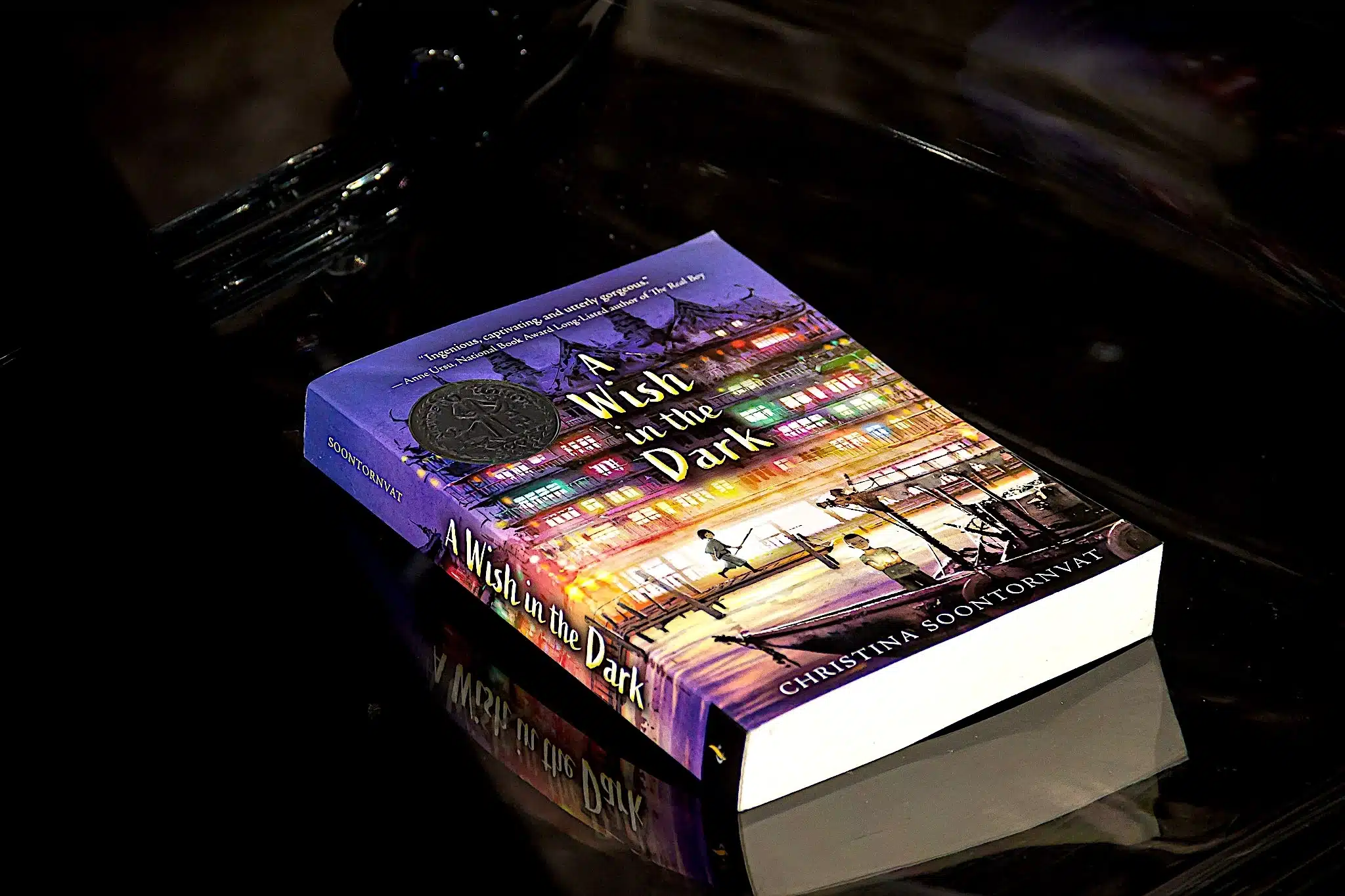
The book cover is as vivid as the text and seems to show Nok and Pong. It shows the Venice-like scene through the boat and rainbow lights that illustrate the city. Pong is standing strong and firm while Nok is running. Ironically Pong is the one running throughout the book. Both characters are looking at the reader. Pong is illuminated, which seems to reference a part of the book that I’ll let you read.
While there is a great deal of light on the cover, what is most noticeable is color as opposed to light. It makes me think of the vivid objects in the book like mangoes. Mangoes are not light, but imply color instead. Soonvorntat uses color often the novel as previously mentioned, which adds a layer synonymous to light.
Nok seems to be running, perhaps inspired by her search for Pong, while Pong seems empowered on the cover. Nok seems to be in motion, while Pong is still—holding a light. Their placement on the cover implies that Nok is closer to the light, while Pong holds light in a space closer to the dark.
Reviewer’s Personal Opinion: Entitlement or Rights?
I love what this story taught about power and the people we have to protect. If you’re complaining about the decisions of those close to you, you are not equipped to be powerful. Power always has to defend decisions that you, yourself would not make. The only alternative is to throw everyone in jail to “robotify” their life experience, controlling every detail. Imagine a life where everything you do is planned and structured other than your work. Your limo is called for you. Your flight is booked for you. Your dinner is planned for you. You only get to work. That’s the only part of you that exists. Sounds like phenomenological jail, right?
You might have always been told to make good decisions. But what happens when others need to make it too? Will you dim their light or will you guide it? And if you’re always right, you might be always wrong. No one likes the smart one, whether you think of intelligence or not.
Outside of labels, I just want to be human. Characteristics feel like jail. If the weather can sometimes be hot and sometimes cold, why can’t I sometimes be unintelligent?
The Governor would disagree. Power is stripped of its autonomy too. They always have to be powerful. Their hair is well-greased. Pants well-creased. A voice like Beyoncé’s.
Somkit might just be trying to survive. Intelligent when necessary, but for the most part living his life. Institutional validation wasn’t given to him. Was Pong his tool?
Father Cham looks back on life and might not think intelligence is real. Living day by day too. His life is about acceptance. He probably never told anyone “deal with it.” He taught them how.
Nok is insecure, but finds security through whom she attaches to. Her father gave her peace. She’s looking for peace. If you disrupt her peace, she’s looking for the next attachment.
Who do you want to protect? Who is worth the risks? Do you only like the lessons that books teach you or did you ever actually want to learn about life?
‘A Wish in the Dark’: Justice or Excessive Demands?
“A Wish in the Dark” is a commentary on how people relate to rules and the consequences of fighting for justice. Future activists and scientists can revolutionize the world through their creativity. Every culture can be inspired by this text to spark a peaceful revolution through science. Design is good when it iterates, not steals. Politics is attached to resources; therefore, resources are attached to rules.
The novel feels like it could happen right now in the real world even though it is written in past tense. The content of each chapter was engaging enough for each page length to not be overwhelming. The text is accessible while having various ways to further research it through its relationship with Thai culture. This book’s sentence structures break so many rules, yet are still clear. The reader can evaluate their relationship to rules after reading this book. It teaches that you should be mindful of who you choose to break rules with. The book has an immersive quality provoked by its style. Each setting in the book comes with a culture. The reader can also learn about the powerful and powerless. Hopefully this book inspires others to build.

Get recommendations on hidden gems from emerging authors, as well as lesser-known titles from literary legends.