
As an Amazon Associate, we earn from qualifying purchases.
TLDR
Bestselling author and licensed therapist Nedra Glover Tawwab helps readers create their framework for setting boundaries with her book “Set Boundaries, Find Peace.” It’s a perfect starting point for readers new to the practice. Read our review to see if it’s the right book for you.
In “Set Boundaries, Find Peace: A Guide to Reclaiming Yourself” New York Times bestselling author, licensed therapist and relationship expert Nedra Glover Tawwab introduces the idea that many people who enter therapy don’t realize they have boundary issues. Instead their difficulties with boundaries are disguised behind other problems such as difficulties with self-care and conflicts with other people. After pointing out that many of these issues actually stem from their difficulties in setting boundaries, Tawwab assists them in putting better boundaries in place. As Tawwab tells us:
“Boundaries will set you free.”
This book is a great starting point for people who want a basic idea of boundaries. For extreme cases of traumatic boundary violations, readers will likely need to bridge from the book to actual therapy.
‘Set Boundaries, Find Peace’ Summary: From Discovery and Deliberation to Advice and Action
Throughout “Set Boundaries, Find Peace,” Tawwab guides you toward discovering what your boundary violations actually are. She then advises on good practice for learning to communicate your specific boundaries to others. Tawwab goes on to advise readers on non-confrontational ways of dealing with the aftermath of self-assertion. She doesn’t sugarcoat the idea that there may be some discomfort and guilt attached to asserting yourself, particularly if you have not done this before. But the simplicity of her suggested conversations around boundary-setting aim to reassure and give confidence to readers moving forward.
Helpfully, Tawwab provides signs to look out for that show you need boundaries. Tawwab initially began sharing some of the ideas that fed into “Set Boundaries, Find Peace,” with her 1.6 million Instagram followers. Some of the signs she points out with regard to boundary violations in the book originally went viral on the platform, for example:
- You feel overwhelmed
- You feel burned out
- You frequently daydream about dropping everything and disappearing
The author hosts regular Q&A ’s on her Instagram page for advising on better boundaries. These social media campaigns led to Tawwab putting her vast experience of boundary setting into this book, as the number of questions around the same kinds of issues became overwhelming. Tawwab shares that she also struggles with boundaries, making her more relatable to the reader and her online audience.
Tawwab points out that the number one reason for avoiding setting boundaries is the fear of someone getting mad at us. But she suggests that fear is not rooted in fact, but in the stories we tell ourselves.
She goes on to suggest that clarity in what we want saves our relationships with others.
In the chapter, ‘The Six Types of Boundaries,’ she interestingly discusses some lesser recognized problems such as ‘Intellectual Boundaries.’ Coming under this boundary violation are items such as demeaning the parent of a child in front of the child, or calling somebody names due to their beliefs or opinions.
She helpfully supplies a short list of how to deal with each type of boundary violation in simple words, for example:
“You can disagree without being mean or rude.”
Tawwab emphasizes that ‘Time Boundaries’ are the most common issues she sees. The book discusses the difference between what she calls ‘little boundary’ and ‘big boundary’ violations. ‘Little B’ represents micro boundary violations that often occur in everyday encounters, such as a stranger telling you their life story, without asking anything about you. This type of violation, she says, does not spill over into the rest of your day or life, but such violations can become more significant over time.
Whereas ‘Big B,’ or macro violations, are violations that erode your relationships with others — for example, feeling responsible for everything that goes wrong in your relationship. The book explores societal biases, including gender, racial and LGBTQIA+, and themes such as body shaming. “Set Boundaries, Find Peace” also includes tips for how to handle boundary violations. The chapters end with an exercise to complete, using the information gleaned from the chapter, and applying this advice to your own personal experience.
Books Like ‘Set Boundaries, Find Peace’
Similar books within the self-help boundary setting market include:
‘The Book of Boundaries’ by Melissa Urban
Urban’s book takes a similarly direct approach to the area of boundary setting. Reviewers enjoy its humor and actionable-tools, similar to the praise heaped on Tawwab’s book.
‘Boundaries’ by Anne Katherine
Recognized as a classic within the psychotherapy community, Katherine’s book offers more in-depth advice from a retired therapist on specific relationship issues as well as what to do when these have broken down.
‘The Set Boundaries Workbook’
Nedra Glover Tawwab has also published a workbook to accompany “Set Boundaries, Find Peace.”
At The Rauch Review, we care deeply about being transparent and earning your trust. These articles explain why and how we created our unique methodology for reviewing books and other storytelling mediums.
Audience and Genre: Fans of Online Therapy
“Set Boundaries, Find Peace” falls within the self-help genre. Readers familiar with this specific type of book would recognize the short chapters, bullet pointed suggestions, and the ability to jump in and out of sections as needed. What feels less typical is the modern spin she puts on the genre. Tawwab draws on current concepts of boundary setting such as social media interactions, as well as online trends such as body shaming. These inclusions feel like a more modern approach to traditional books within this genre.
Although “Set Boundaries, Find Peace” would likely translate well to anyone who is struggling with setting boundaries in their own relationships and life more generally, it would likely particularly appeal well to a younger market. Some of these readers may have already discovered Tawwab on Instagram or through her media presence. Nonetheless, all readers who struggle with boundaries would likely find use in many of the sections.
Three Cs: Compelling, Clear, Concise
Editorial Note: We believe these three factors are important for evaluating general writing quality across every aspect of the book. Before you get into further analysis, here’s a quick breakdown to clarify how we’re using these words:
- Compelling: Does the author consistently write in a way that would make most readers emotionally invested in the book’s content?
- Clear: Are most sentences and parts of the book easy enough to read and understand?
- Concise: Are there sections or many sentences that could be cut? Does the book have pacing problems?
Compelling: Succinct and Relatable Ideas
The language used throughout “Set Boundaries, Find Peace” is clear and succinctly presented. The sections within each chapter are also fairly brief. It would be easy to dip in and out of these, as needed, rather than read the entire book through. This is a useful technique within the self-help genre to allow readers to seek out answers to their own personal issues.
The book has a relatable and inclusive tone and is written in a simple, straightforward prose style to allow readers to establish healthy boundaries in all areas of life. The blurb on the back of the review copy claims that Tawwab’s work is grounded in the latest research and utilizes cognitive behavioral therapy (CBT).
Tawwab aims to cover many of the usual — and less recognized — boundary issues in “Set Boundaries, Find Peace.” Readers should be able to find relatable case studies or advice, leading to a better understanding of where they might need to tweak their own boundary setting behaviors.
Clear: The Sections Make the Book an Easy Read
“Set Boundaries, Find Peace” is set out in two parts, numbered Part One and Part Two. There are then chapters within each part, setting out the common struggles Tawwab has seen both in her practice and through her online conversations.
In Part One, Tawwab looks at how to understand what boundaries are. She explores the different types of boundaries and the cost of not having any boundaries in place. She then concludes with what it looks like to have our boundaries violated. There are nine chapters in this section.
Part Two goes on to advise us in doing the work of setting our own boundaries. This is split into six chapters, and includes boundary setting in various relationships, dynamics and areas of life. Some of these include with family members, in romantic relationships, work friendships and, interestingly, on social media.
At the back of the book, as a kind of addendum, there is a self-assessment quiz and some commonly asked questions, as well as a further reading guide.
The book is written in an easy, fast-moving pace, perhaps reflecting the author’s aptitude for online engagement. She utilizes many case studies from her work, anonymizing names and identifying details, as well as some examples from her own life.
The chapters also contain short headed sections on some common boundary issues, such as ‘defensiveness’ and ‘ghosting.’ Tawwab uses simple writing rather than clinical jargon. This accessibility makes for a clean reading experience, and allows for her words to have a genuine impact on the reader. She also uses bullet points for lists, making it easy to return to the salient points.
Concise: A Lot of Ground is Covered Without Overloading
Though “Set Boundaries, Find Peace” feels like a significantly weighty book at almost three hundred pages, the length feels manageable and adequate. The text is well-spaced out and readable, and is written in a non-academic format. In contrast to some books within the self-help genre, Tawwab deals with a lot of information but disseminates it simply and succinctly. She covers a lot of ground in this book without the content feeling overloaded.
The initial introduction to the book and the ideas of boundary setting are also succinct. The reader can expect to be presented with useful, actionable information from the start.
Prose Style: Simple, Non-Academic and Direct
The author writes in a simple and direct way, almost as though she was having a conversation with the reader. This style feels very authentic. Though it is typical of the conversational style of the self-help genre, Tawwab appears to have a natural affinity for speaking to her audience. This affinity is likely due to several factors:
- She has many years experience of working with therapy clients
- She has a large online presence, which necessitates direct language
- She has authored eight books, so has perfected this type of writing
Tawwab’s occasional references to the author’s own personal relationship to boundaries also allows for a conspiratorial feel, without overloading the reader with personal, irrelevant information.
Rhetoric: Non-Intrusive
All self-help books, to some extent, have an element of rhetoric. Persuasive rhetoric may be used to build trust between writer and reader. The author of such books needs to show their own experience and decision to write the book and convince the reader to take action.
In “Set Boundaries, Find Peace” Tawwab employs the common persuasive technique of relatable anecdotes for both her own and her patients’ experiences with boundary setting. She does not, however, over-use this technique.
Cultural Significance: Relatable to Online Aggression
Tawwab’s book feels timely. As concerns are raised with regard to online and workplace aggressions, it feels that the author’s suggestions will relate to the audience most affected by such discussions. There has also been a significant increase in young people seeking counselling and therapy services. Books such as Tawwab’s, particularly given her successful online presence, may provide additional resources for seeking good mental health practices. The author’s astute way of relating to her audience will likely appeal to the lay-person’s attempts to take action towards good boundary setting.
Authenticity: A Genuine, Conversational Style
The author appeared to come from a genuine place of wanting to share the experience she has gleaned through both private practice as a licensed therapist and the common concerns she sees from her online audience. Tawwab’s expertise in these issues comes through clearly. So too does her relatability as a woman in the world who also struggles with boundary setting at times.
Critiquing the Critics: Mostly Positive, Some Claims of Shallowness and Milking Instagram Posts
Amazon reviews show that “Set Boundaries, Find Peace” rates highly in consumer reviews with a 4.6 out of 5 star average. Consumers find Tawwab’s advice to be practical and actionable. They also appreciate the non-academic style of her writing.
Some critical reviewers, however, have argued that Tawwab’s advice can feel generalized in some areas and tends towards shallow, surface-level advice, rather than digging into deeper, relational factors. There have also been suggestions that the author has simply written extended versions of her Instagram posts.
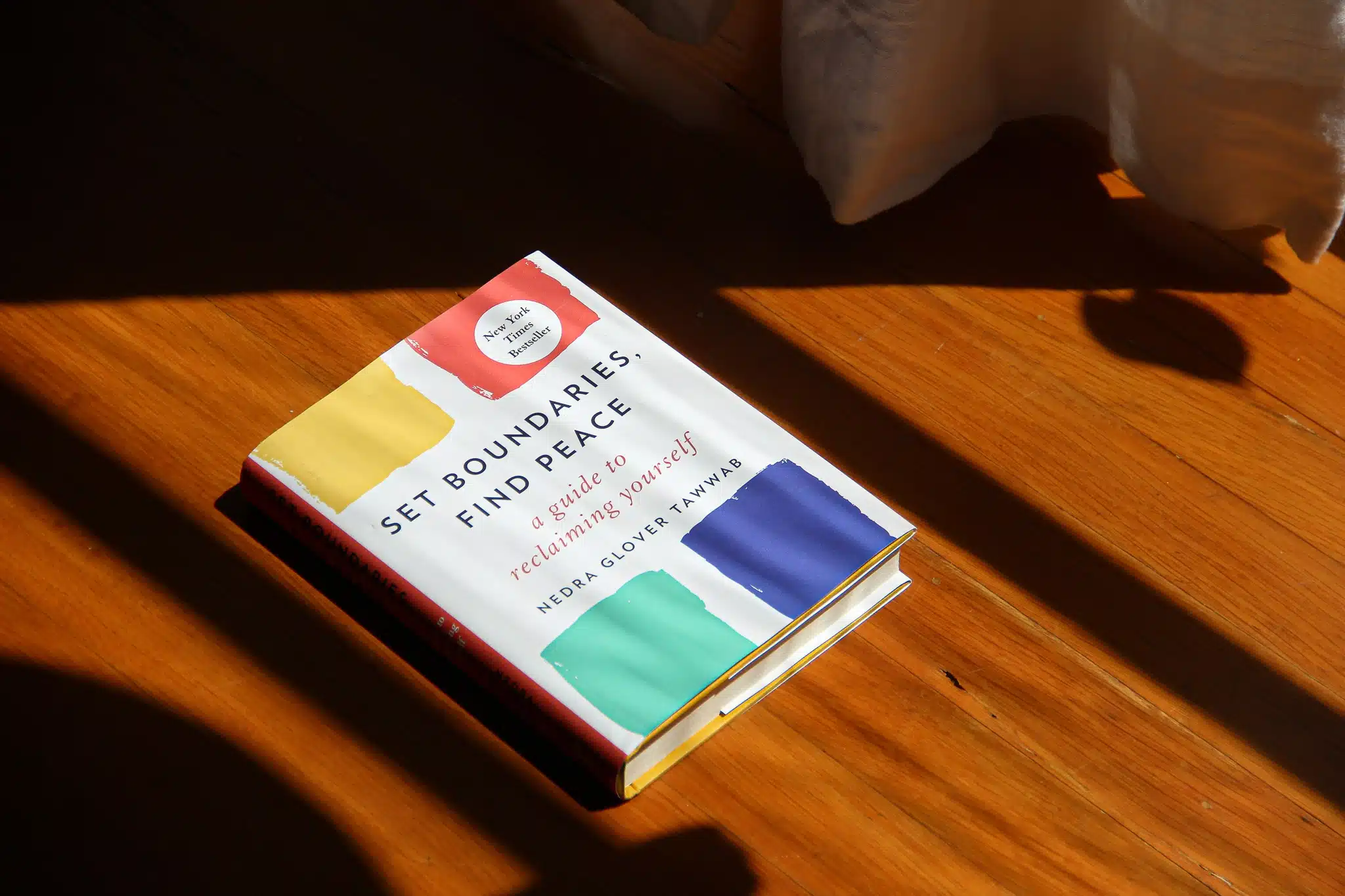
Book Aesthetic: Like a Child’s Drawing
The cover of “Set Boundaries, Find Peace” contains four corner squares of colored blocks. This has been pointed out as giving “a feeling of childhood, crayons, ease.” The cover isn’t particularly inspiring, or revealing of the content, but perhaps shows Tawwab’s intent to convey a simple message. The colored blocks could also indicate overcoming blocks in your boundary-setting difficulties.
Reviewer’s Personal Opinion: A Pleasant Surprise
Not a regular reader of the self-help genre, I found the book surprisingly helpful and informative. Although I initially thought it would be far more about setting boundaries where specific relationship issues occurred, Tawwab’s information on micro- and macro boundary violations really sparked interest in me. I genuinely hadn’t considered tiny irritations of life as being boundary violations before. But the more I considered her suggestions, the more I could identify how allowing for those small violations to chip away unchecked could actually lead to the larger, or macro, boundary violations.
Having not been a follower of Tawwab’s online work, her ideas were new to me. Though not a dynamically new area to discuss, the ideas set out in the context of “Set Boundaries, Find Peace” feel fresh and smart. I appreciated Tawwab’s jargon-free language and non-academic style. The book also didn’t veer too far into the ‘Manifestation’ market of many self-help therapy books of late. The advice was succinctly delivered and straightforward.
Though some of the critical reviews cite an element of shallowness, this critique appears to come from other therapists. For the lay-person simply wishing to strengthen their relationship to boundary-setting, this book would be an ideal start.
I could definitely identify areas I hadn’t even considered. The idea of micro violations was of particular interest to me and helped me to question where I haven’t always spoken up when small transgressions have occurred towards either myself or others. The idea of stereotyping certain groups in language used by others as a boundary violation was a wholly new concept to me. Tawwab’s book has made me consider the need to be more assertive when encountering such language in future.
My choice to review this book was in an effort to understand more about my own boundaries, and where these may need tweaking to have healthier relationships with others. In this regard, the book met my expectations.
Conclusion: A Simple, Basic Guide to Boundary Setting
“Set Boundaries, Find Peace” works as a typical self-help book. It is ideal for use by readers who may need some basic help with setting better boundaries.
The information and advice is presented in a highly readable format. The exercises at the end of each chapter are also useful.
It may not be so useful for readers who have deeper issues with boundary setting. It is possible that some readers may find the information contained in Tawwab’s book too simplistic. This limitation could lead them away from seeking professional support with mental health issues.
Although I personally enjoyed Tawwab’s direct and succinct advice on setting better boundaries, I have nevertheless awarded it a 4.5 out of 5 stars. This rating is due in part to some of the online criticism stating the shallowness of some of Tawwab’s advice. Her simple style and actionable points made the book accessible to myself. I can, however, appreciate that anyone dealing with deeper issues might find the surface level of some of her suggestions to be less helpful.
Buying Options
“Set Boundaries, Find Peace” is available at most physical and online bookstores. It appears within the self-help section of bookstores, usually found among other books on psychotherapy, boundary setting or mental health and wellbeing titles.
The book is also widely available in libraries and doesn’t appear to have long hold times.
E-Commerce Text and Audio Purchases
E-Commerce Audio Only
Physical Location Purchase and Rental Options
Digital Rental Options

Get the latest of The Rauch Review in your inbox, discover books you won’t see in stores, stay up to date on the “Rauching to Judgment” podcast and more.