
As an Amazon Associate, we earn from qualifying purchases.
TLDR
“Salt Houses” by Hala Alyan follows one Palestinian family over four generations as they handle life’s complexities across three continents. Lyrical and episodic, Alyan handles the narrative and its characters with grace. Yet, it features a handful of scenes that edged into being overly verbose.
“Salt Houses” is a novel that sprawls across time, geography and genealogy from Palestine to Paris in its 300 pages. Hala Alyan’s 2017 novel follows four generations of a Palestinian family spanning the 1940s to the early 2010s, and the choices and non-choices they’ve made to retain their personal sovereignty.
The novel is delicately written, overwhelmingly personal and intimate. The focal points of the novel are the relationships between the Yacoub family and their patterns and children, while the geopolitics of colonialism, imperialism and war push and pull the novel’s backdrop.
The family tree Alyan carefully creates and builds raises questions about class, identity and land, bringing a narrative-driven focus to a political struggle that is often reduced to numbers of casualties and settlements. Within these pages, the reader learns of the nuance around how a middle-class family navigates displacement and identity.
‘Salt Houses’ Summary: Homes That Come and Go, Built and Rebuilt
“Salt Houses” tells the story of a Palestinian family over four generations as they navigate life across three continents and eight cities. It begins with the young Yacoub family being forcibly displaced in 1948, at the onset of the creation of Israel and therefore a major and expansive settlement.
The story begins with a family of five: Parents Salma and Hussam, and their three children: Alia, Widad and Mustafa. The story also begins with displacement from the sea and the city of Jaffa to Nablus, a Palestinian city in the West Bank. The three children begin to become distinct to the reader, Alia and Mustafa becoming close siblings, and Widad growing distant.
Mustafa becomes concerned with, and later intoxicated by, the prospect of war. His local mosque begins to hold meetings that seem to span scripture and political zeal, and a deep desire to fight and resist for this land.
Alia starts to develop an adult life and marries Atef, who is also Mustafa’s close friend. However, the Six-Day War leads to Israeli occupation and raids of Nablus. Alia goes to Kuwait to visit her sister Widad, but a month turns into a lifetime. Atef, her husband, takes a job at the university in Kuwait, too. The place that is suffocating in heat and culture is now her home.
Spoiler Alert
Mustafa is left behind, presumably dying in an Israeli prison after both he and Atef were captured in a raid of their mosque, with Atef being released.
Alia’s narration drives the centre of the book, as well as the beginnings of her family, and her three children, Riham, Karam and Souad. They all grow up in Kuwait City, a place Alia resents for its hot climate and looming architecture. She takes her summers in Amman, a place she is comforted by as it’s made up of many displaced Palestinians, ‘using the ashes’ to build something new yet familiar.
We then spend a lot of time with Atef, and he then gives us more insight into how Mustafa was killed. His narration has a great deal of sympathy in it, especially in relation to his wife, Alia. We learn through his partnership with her that she’s dynamic, meaning she’s not always consistent in her parenting or moods, but she is freely affectionate.
We learn that Atef writes letters to Mustafa to help him cope, per doctors’ orders. He breathes deeply every morning after usually dreaming of torture and can feel his age. Writing letters is the only activity that has helped deal with the feeling that part of him is still in a loop with Mustafa, and another part of him survived. Alia has the same feeling. Even though her brother has died under brutality and ongoing occupation, she keeps gathering hair from the drain and going on with life.
Then we hear the voices of Alia’s and Atef’s children, picking up the baton of narrative. Riham and Karam take after Atef, considered, quiet yet self-assured. Souad clashes with her mother often because they are similar in their directness and seeing their desires and independence through.
The children navigate being Palestinian in Kuwait with the weight of grief in the air, always there, rarely addressed. After the invasion of Kuwait by Iraq’s Saddam Hussein, the family moves again, with Alia and Atef moving to Amman, and the children having moved or already chosen the U.S. and Europe.
The book winds down with the children living across different continents, and grandchildren’s observations moving the reader through the final chapters. Toward the end of the novel, we learn that Alia’s personality is no longer what is being accounted for by her memory gaps and long pauses. After a visit to a doctor, she is diagnosed with Alzheimer’s. In comparison to the more respectable and restrained communication of an older generation, it is Alia’s daughter who does not mince words and announces the diagnosis to the rest of the family.
Memory takes centre stage at the end of the novel, where everyone is pulling from it for different purposes. The grandchildren find Atef’s letters. He overhears their conversations about how he is having to ‘remember for them both,’ that being himself and Alia.
The book concludes with Manar, one of the grandchildren, taking these letters to what is now Israel, trying to honor and maybe figure out what her Palestinian heritage means when in the context of a lived Palestinian experience. She concluded that these memories actually may have nothing to do with her, and that as plain and unchanging as it is, the sea and occupation have taken what once belonged to her family.
Books Like ‘Salt Houses’
- Read our review of “The Arsonists’ City,” another novel by Hala Alyan
- Check out our list of other great books about Palestine
- If you’re into poetry about Palestine, start with Fady Joudah and ‘Rifqa’
At The Rauch Review, we care deeply about being transparent and earning your trust. These articles explain why and how we created our unique methodology for reviewing books and other storytelling mediums.
Audience and Genre: Lovers of Historical Fiction, Family Sagas and Pro-Palestine Politics
This book can be enjoyed by readers who enjoy historical fiction, family genealogy and delicate recountings of the mix between dramatic events and everyday life.
This book is great for audiences who want to know a more intimate and lived experience of what may hold for Palestinians, with the important caveat of class. The backdrop of the novel is the geopolitics that often become a statistic of the number of casualties. In this novel, you learn the insides of those numbers and how people feel about their homes and land and sea being stripped away through force, rape and war.
Perspective: Head-Hopping Omniscient
“Salt Houses” is written from the perspective of many members of one family tree. The author utilizes an omniscient POV to tell the story from one person’s point of view, through a third-person description. We learn about how the characters react and feel to the events and people around them, and parts of their inner monologue, which allows for a bigger story to be woven without needing to rely heavily or entirely on dialogue or monologue.
Three Cs: Compelling, Clear, Concise
Editorial Note: We believe these three factors are important for evaluating general writing quality across every aspect of the book. Before you get into further analysis, here’s a quick breakdown to clarify how we’re using these words:
- Compelling: Does the author consistently write in a way that would make most readers emotionally invested in the book’s content?
- Clear: Are most sentences and parts of the book easy enough to read and understand?
- Concise: Are there sections or many sentences that could be cut? Does the book have pacing problems?
Compelling: Slow, Steady, Imitate
What is most pronounced about this novel is the attention to detail given to intimacy.
For example, Alia slowly accepts the idea and reality of surrender: Nablus is gone, and it fell in the face of the angry men she never could support, men who fantasized about war. But when it’s here, and guns from America are in your face, all you can do is surrender and take a helping of shame.
The nature of grief is illustrated in all these intricate ways — and what could seem extraneous or verbose ways — but it seems like the only delicate way to even try to describe what slow, imminent dispossession feels like. This loss also comes out in the story and brief descriptions of the violence and violation. When Mustafa’s imam tells a story about leaving the sea and his family being assaulted by soldiers, we learn about the tactics used by the Israeli Defence Force, which is repossession of land on the basis of ‘absent deeds’ or through forms of warfare like rape and gender-based violence.
Alyan also pays attention to how quiet moments evoke grief and violence. In the move to Kuwait, Alia recalls a memory of finding a baby chick at her home in Nablus that Mustafa helped her approach. The chick was caught in a storm, and Mustafa showed her that it was OK to hold, pet, and care for the chick. She ends the memory with “the bird, Mustafa, the bombs, gone”.
As characters move, leave or pass on, the narration carries on like a phantom baton. The memory of someone still lingers in the pages of the people they loved and were connected to.
The idea of identity was very personal and diverse for each character. While Alia and Atef were surviving across multiple moves, grief, anger and acceptance, their children grew up with more stability and less interaction with violence and dispossession. They were attuned to their mother’s disinterest in Kuwaiti people and the differences in cultures she did and did not like. Souad’s children were not sure what it meant to be Palestinian, given they had been brought up outside of the country.
Clear: Winding at Times
The nature of a family genealogy and exodus from Palestine lends itself to multiple tributaries. The book begins in the 1940s and ends in the 2000s, with multiple continents and voices coloring in the story. The great strength of the novel is the poetry in the handoff of narration. The introduction of narrators and ‘new voices’ feels like a clear and frankly exciting descent of voices, spilling out from the family tree, adding dimension and colour to the story.
Concise: Verbose at Times
“Salt Houses” comes in at about 300 pages (softback cover). At times, scenes that take place at a kitchen table or in a car can feel lengthy and overly descriptive. The length, however, is quite laden with prose and apt descriptions of emotions that still give pause.
Character Development: Baton Handoffs
The characters in this novel gained color and understanding for the reader not through their own chapters, but through the eyes of the people around them. “Salt Houses” deeply privileges Alia and Atef’s perspectives. We learn a great deal about them as a couple through their own narrations. We learn about their children and grandchildren in how they perceive their parents, and also what they believe their obligation to be to them is.
For example, when we spend time with Alia’s narration, we learn about how her brother’s death was like a tsunami forever wrecking her city. She finally concedes to living in Kuwait and taking summers in Amman, which is where many Palestinians resettled. It’s like a remnant of home. But her husband doesn’t like it, or the project of rebuilding what’s been fundamentally lost. When she was pregnant, she walked into the ocean on New Year’s impulsively with the energy we are unsure of how it will go; if she wants to leave this earth or run away. But she gets into the freezing cold ocean and concedes that this is the beginning, only for her firstborn to nearly drown a few chapters later.
Atef narrates us through the tensions of married life, how different approaches reveal different motives. Atef is the chosen one among his children, and he takes a shameful pride in it. He is a present father and wants to fill the gap between him and his wife, as he has an internal monologue to just give her the letters to help her understand why they never speak about her brother.
Alyan is quite skilled at introducing family members and slowly and carefully unspooling their introductions, their feelings, and allowing the reader to place their own interpretation upon the characters. She doesn’t rely on a single character to function as a mouthpiece for the ‘right’ ideas or conclusions.
Prose Style: Oh So Delicate, Especially in Matters of Death
The writing style of this novel is impressively delicate, especially as it pertains to death. A great deal of the deaths of main characters in this novel happen off-screen. Death is introduced as a past event, referenced indirectly at first, as a feature of a different story.
Mustafa’s narrative is interesting because we spend a good amount of time with him, but we learn about his passing through the narration of his sister. It’s like a continuation of him. Where Mustafa left off, Alia picks up, just as fragmented as the circumstances of his death.
As the novel goes on, one gets the sense that death becomes an ordinary feature of life, so ordinary it is rarely dwelled on. Its impact is known and swelling up in the book and in the minds and spirits of the characters, but never discussed.
In the midst of the shape of death and the attempt at life, there is a standout feature of the writing: a consistent attention to how intimacy also changes shape. The author makes small yet significant note of Alia and Atef’s relationship, often through gesture and Alia’s point of view. For example, Alia talks about how Atef has been chaste in what she described as a “misplaced sense of decorum” in the aftermath of the death of her mother.
There is such salience in the specificity the author gives to the physical language couples develop and subsequently call upon when trying to communicate in the language that only lovers can. When Atef grabs her chin, harkening to one of the ‘ancient’ gestures he would do when they were a young couple, there is a door opened for the reader through which to see this couple’s love.
The prose doesn’t yell or scream or plead. The scenes in this book oscillate between vivid and detailed scenes of ordinary conversations at a table, the Oum Kahlthum song on the radio that is either turned off for its grief or turned up for its comfort, as well as more dramatic moments like near drownings and more forced moves.
Setting: Several Countries and Continents
“Salt Houses” takes place across several countries and continents. Each place comes with its emotions and connotations provided by the characters. Palestine is home, tradition and lineage. It is the sea and the everyday fishing culture, and sovereignty. Then it’s a memory.
Kuwait feels to Alia like a reluctant surrender and spiteful sentencing. Europe offers another world to Souad. Israel is hard to even utter for Manar. Alyan offers insights on the characters’ acts of becoming in each place, with the precedent that it could change at any time.
Cultural and Political Significance: Personal Accounts Amidst Political Reduction
As alluded to in this review, one of the stand-out qualities of this novel is the personal and narrative accounts of life that are impacted by one of the longest formal occupations spanning over 80 years. As such, this book offers a more human touch to a conflict that has been intentionally mangled and convoluted in the mainstream. “Salt Houses” also brings together surrounding stories of neighbouring geographies, with stories about Lebanon, Kuwait, Beirut and Amman.
Critiquing the Critics: It’s OK to Center Middle-Class Palestinians Who Weren’t Violently Displaced
The resounding feature of reviews for “Salt Houses” is the focus on how Alyan centers the privileges of a Palestinian family who was displaced, but not physically or violently displaced in the sense we have seen since the establishment of Israel, as well as the 3-year period stemming from October 2023. In some instances, this point is positioned as subversive to Western audiences, which could be read as functional and paternal rather than artistic and insightful.
Because Palestine has become a major political headline, it can become subject to a similar position as Black and African literature, which is to instruct. While lessons can be gleaned from stories and experiences, the emphasis on subverting a Western gaze centres a Western audience and renders the book as ‘proof’ of an alternative story, when in reality there are known and countless experiences to any person’s geography, contrary to what Western audiences are conditioned to believe.
As such, “Salt Houses” offers a personal account of middle-class Palestinians who are not the face of the war scenes, and memory therefore becomes a character all on its own.
Book Aesthetic: Referential to the Objects of Remembrance
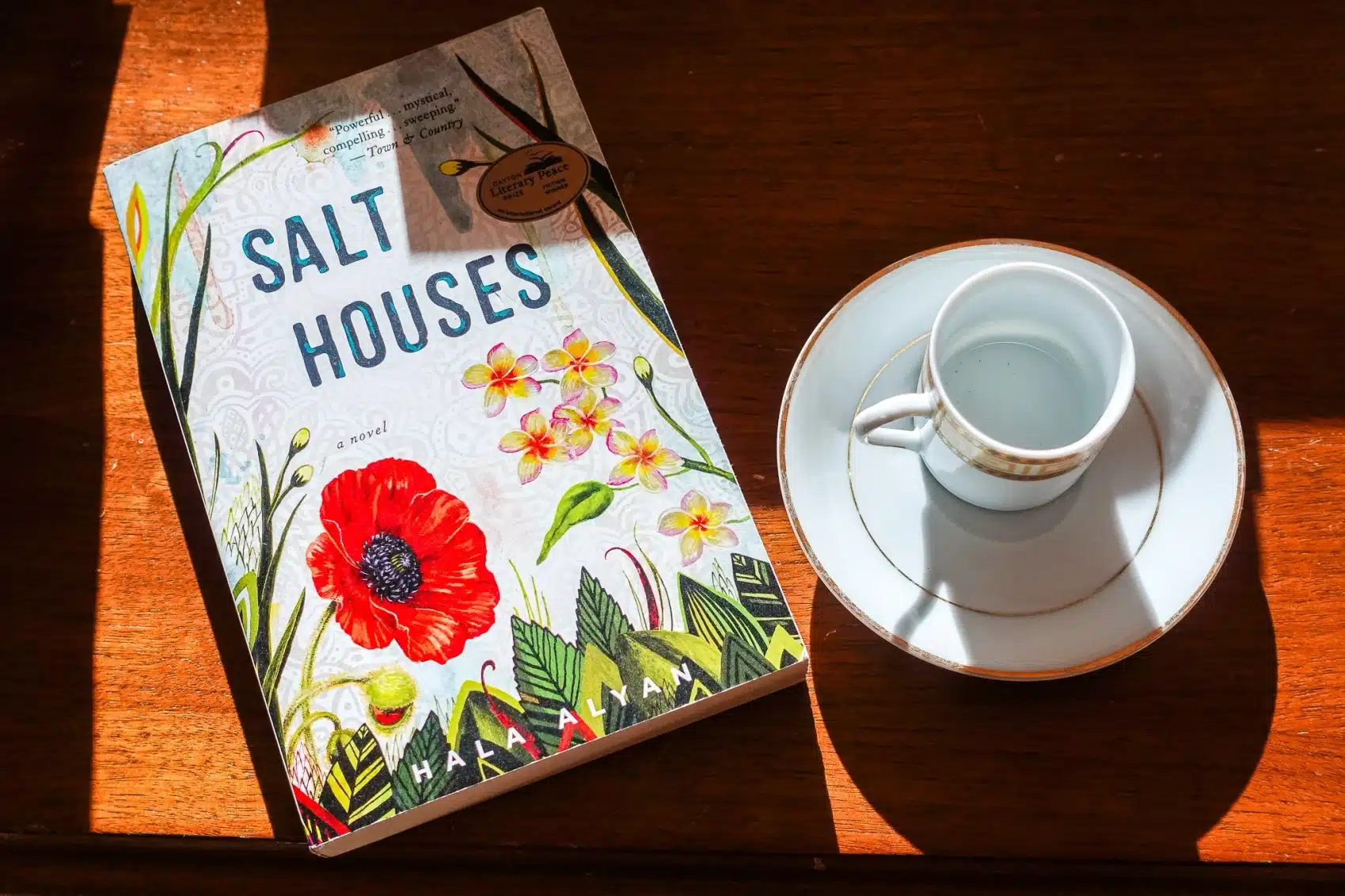
The soft cover copy of “Salt Houses” features an overhead shot of a teacup with coffee, both of which reference moments in the novel. In the opening chapter of the novel, Salma reads the coffee dregs of her daughter. Later, Alia buys a tea set because she feels drawn to its resemblance to one she had to leave behind.
Reviewer’s Personal Opinion: Impressively Attentive and Ideologically Diverse
“Salt Houses” is an impactful novel for me because there is such sensitivity in the writing. This style allows emotions, reactions and character growth to be read and felt, rather than flatly told to us. Alyan is also able to stage conversations that reveal the more closed-door discussions that surround ‘Palestinian resistance’.
One of the greatest confrontations in the book is a rhetorical one, and it’s between Abdullah — Riham’s son — Alia and her children. Abdullah calls out Alia’s children as “fair weather Arabs,” condemning their conversation about the state of the occupation, the fate of Palestine, extremists and leadership parties as a joke. Abdullah asks them if they’ve stepped foot inside a refugee camp, or if they know anything about being rendered a refugee. He says the people who are doing anything are the men in mosques, and that instead of becoming American and losing their culture, they should be in the mosque.
Alia refuses this righteous injection by saying that this kind of tactic lures young men into a war.
“Mama—”
“No, no. You listen to me, boy.” Abdullah lifted his eyes reluctantly to meet Alia’s. “You listen to me. What those men are trying to do, what they’re trying to sell you, this idea that you’re lost and they’re saviors and the rest of the world is evil, that what you need is to bow and surrender and fight, they’ve been doing that for decades. You think you’re their first one? They’ll pick up anyone hungry enough to listen. So don’t sit there thinking you’re special. Don’t sit there thinking you have some great secret. We’re all a mess. Iraq’s a mess, Lebanon’s a mess, don’t even get me started on Palestine. But if you think those hypocrites are going to save anything, those liars wearing God like some gold to attract boys… well, then you’re an idiot.”
Throughout the novel, the author grapples with religion and identity from several angles. The eldest daughter, Riham, who is the most devout and didn’t leave quietly, ruminates on how her grandmother taught her to pray, which was not to look at Allah as all good or all bad, but to accept the guidance and see yourself in it. Riham then considers how religion is being used to rile and satisfy anger. However, Riham still wants to confide in Abdullah because she recognizes that he is the only one who doesn’t forget, and talks about the past and the dead. Her dreams bring up some of these feelings and thoughts, alongside her waking memories that she gathers of her uncle Mustafa, who no one speaks about.
Alia, on the other hand, always saw “the struggle” as a boys’ club, and too many don’t come back. Having lost her brother to it, she is clear about the world and what it will take from you and what the costs are. For Alia, there is nothing noble about dying in a war that can make you feel like a giant before you go.
Lastly, I appreciated how the novel was able to address the sentiments and feelings of other major events like 9/11 and being Muslim or Arab in the U.S. The book shifts forward like a conveyor belt, with narration shifting to the children of Souad and Karam and their partners. The children have the same question that Riham still harbors: Why does no one talk about being Palestinian or Iraqi? The landscape is coloured in by the murmurs, whispers and yells of adults prompted by the TV or radio news of war, military and impending statements. This backdrop features in the children’s curiosity about what things were like or what letters from their parents dated in the 70s contained. Many characters move through life, following after one another, picking up and putting down obligation, curiosity, and memory as they go.
“Salt Houses”: A Worthwhile, Intimate Novel
“Salt Houses” reads as a very poetic book, where the author is able to pick up and thread several motifs and emotions. As a work of fiction, it is very considered, lyrical and episodic in nature.
The only reason I didn’t give five stars is that I found certain scenes of the mundane quite verbose, and a little extraneous. I think some cutting down on certain monologues or descriptions of passing time could have made me want to pay close attention to every word rather than finding the gems within quite long stretches of pages.
Buying Options
E-Commerce Text and Audio Purchases

Get recommendations on hidden gems from emerging authors, as well as lesser-known titles from literary legends.