
As an Amazon Associate, we earn from qualifying purchases.
TLDR
Claire Dederer, the author of "Monsters: A Fan's Dilemma," did a great job showing the emotional struggle of enjoying art created by horrible people. Unfortunately her analysis was often shallow. Readers should not expect a solution offered.
How do we reconcile our love for the work of great art by bad people?
This is the question posed by Claire Dederer in her nonfiction book, “Monsters: A Fan’s Dilemma.” In the post-#MeToo era, it has become an almost daily occurrence to hear of the fall from grace of another formerly revered artist. In her book, Dederer begins with her struggle to reconcile the admiration she feels for the films of director Roman Polanski with the fact of his rape of a 13-year-old girl. Rather than simply write an exposé of the monstrous artists’ she investigates. She tries to untangle whether we as the audience can separate art from its artist.
Does she eventually offer a workable solution that can sit well with us as conscious consumers? Let’s find out.
‘Monsters: A Fan’s Dilemma’ Summary: An Audience Biography
In 2014, book critic, essayist, and reporter Claire Dederer found herself researching one of her favorite film directors, Roman Polanski. Re-watching the films she loved, classics such as “Rosemary’s Baby,” (also a book by Ira Levin) “Chinatown,” “The Tenant” and “Repulsion,” Dederer struggled with the knowledge of Polanski’s past.
On March 10th, 1977, Polanski drugged and raped thirteen-year-old Samantha Gailey at actor Jack Nicholson’s house in the Hollywood Hills. A mother of a young daughter herself, Dederer found the appalling details of his crime too much to bear.
And yet. As Dederer confesses to the reader, she still found herself unable to turn away from his films.
Seeking answers to how to reconcile her feelings — how to separate art from the artist — Dederer’s mind keeps circling back to these stark and indisputable facts, which she describes in the book, “Polanski made ‘Chinatown,’ often called one of the greatest films of all time. Polanski drugged and anally raped thirteen-year-old Samantha Gailey.” During this soul searching, she comes to a realization: What she really needs to do is to write what she describes as an autobiography of the audience. Something that would help to balance out the greatness of the work and the terribleness of the crime.
Interrogating the lives of some of the monstrous men associated with the #MeToo movement and cancel culture leads her to more questions than answers. She discovers the idea of ‘the stain,’ the indelible mark left on an artist’s work once one becomes aware of their biography. Dederer also explores ideas around the so-called artistic genius. She discusses all types of ‘monstrousness’, including racism and anti-semtisim, mothers who abandon their children and alcoholism. Interestingly, she even inserts herself into the book.
“The person does the crime and it’s the work that gets stained. It’s what we, the audience, are left to contend with.” She suggests.
Dederer realizes that she is less interested in discovering a prescriptive solution to the problem of consuming the work of these artists. Rather, she seeks some idea of what happens to us as when we become the audience of their work while aware of this discomfiting information. As she discovers, the harder we look, the more likely we are to find at least a little stain. Everyone, she believes, could be just a step away from being cancelled.
Books Like Monsters: A Fan’s Dilemma
Readers might also like to check out Jia Tolentino’s essay collection, “Trick Mirror: Reflections on Self-Delusion,” where she examines modern culture through a feminist lens, often responding to media and celebrity status. Her writing is similarly conversational and thought-provoking.
Readers might also want to check out “The Abandoners: Of Mothers and Monsters” by Begoña Gómez Urzaiz. Written by Barcelona journalist Urzaiz, this title is a deeper dive into the area of the mother artist. Similar to Dederer, she places herself within the narrative. She also considers the wider societal implications on mothers. It is a far-reaching and more thoroughly researched book to that of Dederer’s, but only covers the issues as they relate to mother artists.
At The Rauch Review, we care deeply about being transparent and earning your trust. These articles explain why and how we created our unique methodology for reviewing books and other storytelling mediums.
Audience and Genre: Readers Who Enjoy Conversational Nonfiction
I enjoy Dederer’s style of writing. The subject matter she grapples with is, at times, dark. Yet she is more of a conversational nonfiction writer. Some readers may come to the book expecting a politically charged style of narrative or an exposè of celebrity and a defiant manifesto on how to tackle this problem. This is not that book.
Dederer moves through her theme as though she is trying to find answers for herself. It is not a heavily-researched book, nor is it a deep or academic study of cancel culture, celebrity, media or the abuse of powerful men. It doesn’t offer tangible solutions or set out to tell the reader how they should experience art in the future or which of the monstrous artists’ work they should or should not consume.
Three Cs: Compelling, Clear, Concise
Editorial Note: We believe these three factors are important for evaluating general writing quality across every aspect of the book. Before you get into further analysis, here’s a quick breakdown to clarify how we’re using these words:
Compelling: Does the author consistently write in a way that would make most readers emotionally invested in the book’s content?
Clear: Are most sentences and parts of the book easy enough to read and understand?
Concise: Are there sections or many sentences that could be cut? Does the book have pacing problems?
Compelling: The Theme Will Shock and Challenge the Reader
It would be difficult to be living in the 21st century, with the speed of the media and the cult of celebrity all around us, not to be aware of the issues within this book. However, even knowing about some of these artists’ crimes or misdemeanors doesn’t make the reader any less disgusted by them. Dederer’s conversational style of writing invites the reader into her inner sanctum, almost like a friend sharing some unpalatable gossip. The grief around what to do with the knowledge she gleans is clear. You can sense the handwringing she goes through in an effort to allow herself, and therefore the audience, the permission to continue consuming art.
Clear: Straightforward Writing Without Jargon, But Some Lack of Clarity Due to Mistakes
Dederer writes in a straightforward, no jargon manner. As an essayist, reviewer, and reporter, she is used to spelling things out for a mass audience. This professional experience shows in the way she respects the reader. There is a general sense through the book that she really wants to get to the heart of her subject, that she really wants and needs the audience to connect to her as a writer and the struggles she has gone through to make sense of this material.
The short sentences and crisp paragraphs are well-written, edited and suit Dederer’s style. There are, however, some questionable ‘facts.’ For example, at one point, Dederer suggests that J.K. Rowling is aligned with the gender identity movement. In fact, this is the very opposite of what she means. J.K. Rowling is a leading advocate for gender-critical views. This claim is most likely an error in Dederer’s wording and should have been edited out.
Concise: Good Pacing but Lacking Editorial Discretion
The pacing of the book is good overall. Dederer’s choice to insert herself into the book could have become meandering or overly self-indulgent, but her writing is so accomplished that this did not happen. She does play around with English usage, frequently using colloquialisms such as “urpy” to describe her nauseous feelings around male artists such as Picasso.
The book is around 288 pages. To me, this amount is a bit short. There were times when I wondered if she had gained a book contract and then struggled to write enough. Some of the chapters felt that they could have been combined. The book came out of a successful article Dederer wrote for The Paris Review titled “What Do We Do with the Art of Monstrous Men?” This backstory is an issue for some critics who have seen the book as a flimsy representation of what is a serious and perennial theme.
With regards to Dederer’s writing, there are no superfluous sentences or misused wording. She could, however, have gone deeper in some chapters.
Prose Style: Conversational and Familiar
As previously stated, Dederer’s prose style is conversational, rather than didactic. She does not assume authority over her subject. Instead she merely writes as an audience member herself. She aligns herself with her readers. The writing feels natural, not forced. This prose style reminds me of another nonfiction writer, Elizabeth Gilbert. Both Dederer and Gilbert tend to place themselves within the narrative and tackle their subjects in a way that shows they are processing their topic as they are writing.
Dederer’s habit of utilizing colloquial language did sometimes tend toward laziness. However, overall, it added to the general conversational tone throughout the book. Perhaps it was Dederer’s choice to use language to try to soften what was otherwise a deeply sensitive theme.
Dederer also writes with humour. Her writing can often be tongue-in-cheek and allow for a playfulness, despite the grim material. Discussing the conundrum on how to consume the art we enjoy free of our conscience, she asks, “Do we vote with our wallets? If so, is it okay to stream, say, a Roman Polanski movie for free? Can we, um, watch it at a friend’s house?”
Though Dederer’s prose style is not typical of serious themes of nonfiction writing, it is more aligned with contemporary explorations of modern culture. This kind of conversational writing style can be found, I would suggest, in personal essay collections by women in particular. It has the edge of assuming a personal connection with the reader. It conveys a trust in the writer and an amicable partnership between the two.
Rhetoric: On the Fence
The very theme of the monstrous acts committed by (mostly) male artists is not in itself controversial. The information is deeply ingrained within our cultural landscape. It is equally difficult to say the author’s views can be disputed in any way: the facts of the monstrous acts of these people have been verified and openly discussed online.
What I think is important to convey is that Dederer is putting forth the suggestion that we can still enjoy the art of these people without condoning their bad behavior. She is clear not to suggest, however, that this moral guidance remains true for all the artists mentioned, or for all members of the audience. She gives the example of a friend who was gang raped, who now refuses to consume art by anyone guilty of this crime. Conversely, she gives the example of another friend who believes we must separate all art from the artist who created it. His opinion, she states, is due to the positive impact art has had in his own life.
Dederer is not arguing for nuance, suggesting instead that the audience must decide for themselves. In this approach, she may disappoint some readers who are looking for either absolution or condemnation of such behavior.
Cultural and Political Significance: Particularly Relevant Again Because of the Epstein Files
The cultural significance of “Monsters: A Fan’s Dilemma” is clear. Never have we witnessed such a backlash to bad behavior or the problematic artist. Dederer’s book is not the first to tackle this and it is unlikely to be the last word on this subject. As I have suggested previously, she does not even give us any answers to our dilemma.
However, writing the book during the period of #MeToo and the rise of cancel culture gives it a unique perspective of being written as events were unfolding. Her brief inclusion of the 2016 U.S. elections and the rise of misogynistic comments during Trump’s campaign further make it a book of the moment. Now that the Epstein files are revealing the names of many famous artists, the issue is again a top news story.
I think that women in particular will perhaps warm to Dederer’s writing style and predicaments as a writer and a mother within the book. It is not limited to this audience. Anyone interested in cultural insights into media trends or the worrying rise of misogynistic, anti trans or antisemitic rhetoric may also find it of interest. Readers looking for more serious engagement with cultural or political argument, however, may not find it so enlightening.
Authenticity: The Author Genuinely Grapples with her Subject
Dederer appears genuinely concerned about her subject throughout the narrative. Her attempts to discover an answer or solution to how to continue consuming art when we know the biography of the artist is important to her. Dederer makes her living as a reviewer and critic of art, primarily books and films. She is asked to comment on podcasts and other media about the work of Polanski, for example. The book shows her deep concern for how to assimilate her knowledge with her genuine love for art. As she grapples with this, her own behaviour is also called into question within the book. As with other work by this author, she does not flinch when writing personally or when judging either herself or others.
Critiquing the Critics: Some Were Too Harsh
Rachel Cooke, a critic who worked for The Guardian, wrote quite scathingly on the release of the book. Whilst she believes this topic is good to tackle, she feels that Dederer’s thoughts are “muddled and poorly researched.” She finds that Dederer’s casual use of colloquial language makes her sound like an overgrown teenager. She writes, “The feeling grows that she doesn’t know what she’s doing. Thoughts and ideas come and go, explored at various speeds and in various gears, like cars on a busy motorway. You want to flag one down, but they never quite pull over.”
Cooke’s review feels unfair because Dederer is a gifted writer who engages with her material in a way that feels natural and authentic. Nonetheless, there is some validity to her assertions that Dederer’s research is a bit sparse in places. However, I would argue that she does not present her ideas as a researched thesis on the theme of monstrous men. She is clear to point out early in the narrative that the book is instead a study of the audience and how or whether they choose to consume the art in the face of such bad behavior.
The New Yorker, in comparison, praised the book, pointing to the author’s personal reflections on the theme, “A work of deep thought and self-scrutiny that honors the impossibility of the book’s mission. Dederer comes to accept her love for the art that has shaped her by facing the monstrous, its potential in herself, and the ways it can exist alongside beauty and pathos.”
The book does well on Amazon reviews, with readers overall finding it thought-provoking and enjoyable. Some directly reference Dederer’s way of circling the topic without telling readers what to think. This less authoritative tone seems to be a key factor in the enjoyment of the book. In opposition to The Guardian review, it perhaps shows that the audience wants to be entertained by a nonfiction book with nuance, rather than a deeply researched treatise on the theme.
Book Aesthetic: Different Names for the Same Book
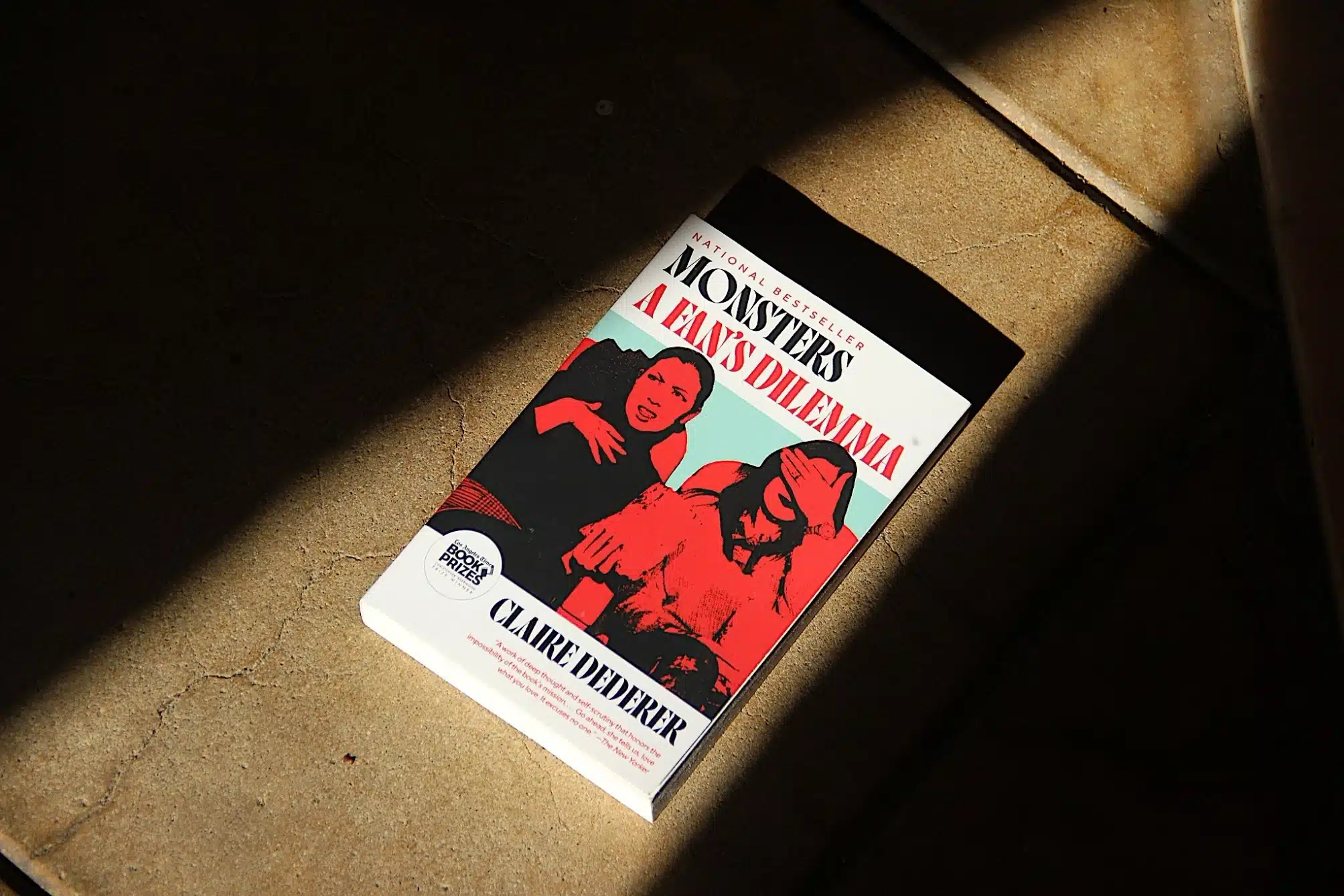
Readers should be aware that the book has two different titles, depending on region. It appears that the book was released in the U.S. under the title “Monsters: A Fan’s Dilemma.” Whilst in the U.K. the book is published as “Monsters: What Do We Do With Great Art By Bad People?” It is not clear why this is the case, and both have essentially the same cover design. The cover shows two female fans covering their ears and screaming, although there appears online to also be a cover showing two women watching something with one covering her eyes.
Whichever version of the book, the images are powerful at conveying the theme. The U.S. title to which this review has referred appears the clearest title.
Editorial Note: Joseph Rauch, founder and editor, wrote the below part of this section.
On Amazon, the hardcover version of the book has a confusing cover image: a man in swimming trunks, bare-chested, wearing what appears to be a cow mask, standing on a beach with the sand and ocean behind him, as well as a woman in the water and several ships in the distance. The man is holding his hands out, as if to say, “It was this big!” I have no idea if the cover is a reference or an abstract image. Is the man in the picture one of the monsters in the book? Is the idea of wearing a mask supposed to be a nod to monstrous behavior? If you know the story behind this strange book cover, please tell me.
Reviewer’s Personal Opinion: An Authentic and Thought-Provoking Read
It’s clear that Dederer struggled with her book at times and where to land on the topic of how to consume great art with the knowledge of the artists’ biography. An autobiography of the audience was always going to be a difficult task. To do so would perhaps require a consensus of opinions from viewers on what was or was not an acceptably monstrous idea or behaviour. As Dederer acknowledges, some audience members’ may have more difficulty with certain aspects of behavior, depending on their own experiences. She ultimately posits that we bring our own interests, opinions and backgrounds to the art that we consume.
Visiting college campuses to speak with young people about these issues, she says, “This is what I tell the students: consuming a piece of art is two biographies meeting: the biography of the artist that might disrupt the consuming of the art; the biography of the audience member that might shape the viewing of the art. Your biography, your feelings are important.”
The adolescent who feels like a misfit, for example, may still find solace through the lyrics of David Bowie, she suggests, in the same way she did as a teenager, before knowing anything of his history. Her suggestions that we simply accept the beauty of a piece of art whilst abhorring the deed committed by the artist, however, feels a bit simplistic. To simply register that these artists’ have committed unforgivable acts, whether now or in the past, and then move on with our enjoyment, tends to show a lack of deeper insight into how this dynamic can be managed. As Dederer stated at the beginning of her book, she wished to discover how she could enjoy watching the films directed by Roman Polanski whilst being aware of the facts of his crime. In this way, she does not, ultimately, answer the question she herself was seeking. The fact of the crime remains, and if we remember this each time we encounter the art, then it will surely take away from the enjoyment we previously sought.
The way that Dederer inserts herself into the narrative, and follows a theme through her thoughts as she explores it, reminds me of the work of essayist Joan Didion. Didion also tended to put herself within the narrative, investigating what she thought about her subject as she wrote. In the case of Didion, however, she did this particularly well, covering big subjects and making them personal. Dederer fell a bit short in comparison. Her research did not appear quite so strong. She had a tendency to begin a chapter only to lose track.
I did feel though that, in all fairness to Dederer, the book she had in mind when she set out must have ballooned in scope due to the emergence of the #MeToo movement during the course of writing. Other factors, such as the 2016 U.S. elections, also had a stark effect on the issues she was grappling with.
As a fan of Dederer’s writing, however, I found the book engaging and thoroughly readable. She writes about difficult topics with humor and honesty. Her willingness to put herself into the narrative also impressed me. She writes with nuance and sympathy for her audience. As a woman from a similar demographic to Dederer, I have also grappled with these themes through my own experience as a mother and woman.
Whilst I appreciated the way she researched and wrote about the themes in her book, I think this is down to personal taste of already enjoying her writing. I think if a reader came to the book expecting an interrogation of the issues around cancel culture or the abuse of powerful men, they may be disappointed. Dederer’s style is more conversational in tone, like a chat I could imagine having with a close female friend.
Ultimately, I wanted to share my thoughts on this book because I feel that it matters. Dederer’s writing may not be as far-reaching as perhaps some may wish. Still, I appreciated her willingness to tackle such an extraordinary time in the history of what it means to consume art, as well as question the people who make it. I appreciated her authenticity and willingness at times to accept that she could not give a definitive answer to her own central conundrum.
Conclusion: Expect Your Conscience to be Prodded
As previously stated, the book worked in its attempt to convey the current cultural moment. The author’s interrogation of the subject, whilst patchy at times, felt completely authentic. She is just as much a participant of the material as the reader. When she speaks about the difficulties of the audience, she includes herself in that demographic.
It cannot be ignored however that some critics found the book lacked deep research or thorough interrogation of the subject. It feels clear that if we come to the book with the expectation that it is going to be a deep exposè of monstrous artists’ or a political tract, we will be disappointed. If instead we come to it with an open mind and the expectation for our conscience to be prodded, we will perhaps come away more satisfied.
Though I have awarded this book 4 stars, this rating reflects the fact that although I thoroughly enjoyed reading it and would recommend it to others, I acknowledge that it does have its flaws. It is a little thinly researched at times and could perhaps have benefited from some further editing.
Buying Options
E-Commerce Text and Audio Purchases
E-Commerce Audio Only
Physical Location Purchase and Rental Options
The book is widely available to rent in public libraries in both the U.S. and U.K.
The book is widely distributed in both mainstream bookstores and in smaller independent bookshops. It is most likely to be found in the nonfiction and essay collection aisles.
Digital Rental Options
- Libby

Get recommendations on hidden gems from emerging authors, as well as lesser-known titles from literary legends.